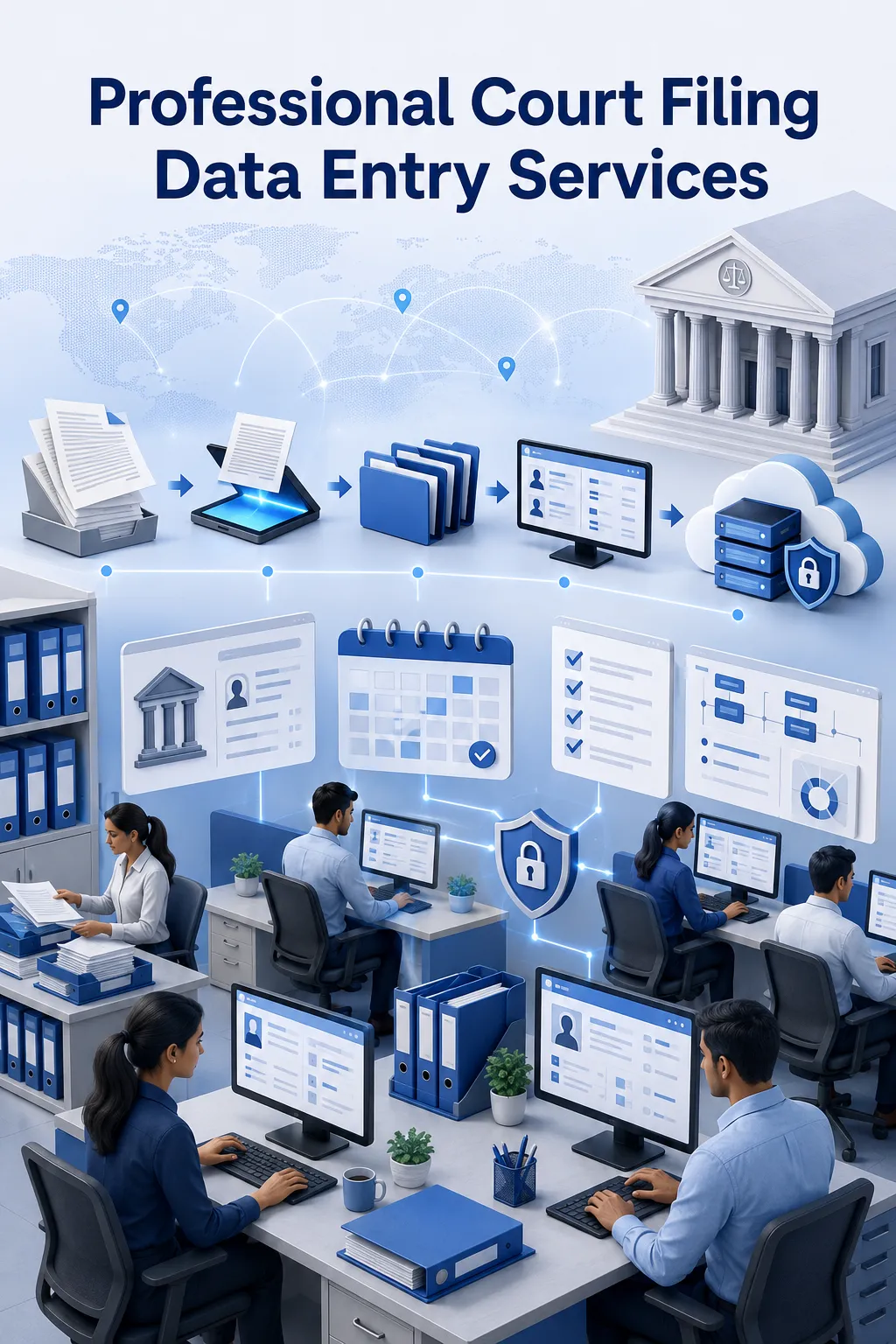
India-Based Data Entry Outsourcing Support Serving USA, UK, Australia, Europe, New Zealand, Singapore, UAE
Court Filing Data Entry

Professional Court Filing Data Entry Services for Accurate Case Tracking and Procedural Status Management

We provide expert court filing data entry services for law firms, litigation support companies, court services operations and legal departments that need case filing data, procedural milestones, hearing dates, party information and document indices entered accurately and consistently into case management systems, legal databases or court tracking spreadsheets.

Court filing data accuracy is time-critical. Incorrectly recorded filing dates, missed hearing entries, wrong case numbers or misidentified parties create operational problems that affect case management quality and can have serious professional consequences for the legal teams responsible. Our professional offshore legal data entry team processes court filing data with careful attention to identifier accuracy, date precision and consistent classification — following your case management system's field requirements exactly.

We serve litigation law firms, defence counsel teams, plaintiff-side litigation practices, government legal departments and legal technology companies that manage court case data at high volume. All court filing data entry is handled under strict NDA and confidentiality protocols from day one.

✓ Case Number Entry ✓ Hearing Date Tracking ✓ Filing Status Updates ✓ Party Name Records ✓ Procedural Milestones ✓ Multi-Jurisdiction Support
Trusted & Secure
🔒NDA Protected 🌐GDPR Aware 99.9% Accuracy 🎯Free Pilot Batch Fast Turnaround 🌍45+ Countries Served
5000+ Completed Projects
90% Returning Clients
16+ Years Experience
45+ Countries Served
50+ Professionals Team
Service Overview

Accurate offshore court filing data entry that keeps your case management records current and your legal team focused on casework

  • Case number and court identifier entry
  • Filing date and document type recording
  • Party name and counsel information entry
  • Hearing date and schedule management
  • Procedural milestone and status tracking
  • Filing receipt and service confirmation records

Litigation and court work generates a constant flow of filing data — new cases, motions, briefs, orders, scheduling notices, hearing adjournments and procedural correspondence — that must be entered promptly and accurately into the firm's case management system to keep case tracking current.

For law firms managing large litigation portfolios, the volume of court filing data entry required each day is significant. When this work falls to qualified litigation lawyers or experienced paralegals, their time is being consumed by administrative data entry rather than legal analysis, client advice and case strategy. Our offshore court filing data entry team handles this administrative workload efficiently and accurately.

We follow your case management system's field structure, your matter numbering conventions, your jurisdiction-specific identifier formats and your document classification codes precisely. Hearing dates, response deadlines and filing deadlines are entered with date accuracy as the primary quality standard.
Services We Offer

Court filing data entry across all case types and jurisdictions

Each service is managed with precise identifier accuracy, consistent classification and structured exception logging for any item requiring legal team confirmation.

01

Case Initiation and Filing Data Entry

When new cases are filed or received, accurate case initiation data entry is critical — case number, court identifier, filing date, case type, claim description, plaintiff and defendant information, counsel names and contact details, assigned judge and court division. New case records set the framework for all subsequent filing data. Inaccurate initiation data creates cascading errors through the case record. We process new case data from filing confirmations, case management system notices and court-issued case initiation documents — entering all required fields accurately and flagging any missing information before the record is created.

02

Court Order and Judgment Data Entry

Court orders, judgments, consent orders and judicial directions — entering order type, issuing judge, order date, effective date, subject matter description, compliance requirements, associated filing dates and matter identifiers from court-issued orders into your case management system. Orders with compliance deadlines require particular date accuracy — the deadline must be entered correctly and visible to the legal team responsible for compliance. We process court order data entry with primary attention to compliance deadline dates, matter identifier accuracy and order type classification.

03

Hearing Schedule and Calendar Entry

Hearing dates, pre-trial conferences, status conferences, deposition schedules, arbitration dates, mediation sessions and trial dates — entered from court notices, scheduling orders and calendar confirmations into your case management system and legal calendar. Hearing data entry is the most time-sensitive component of court filing data management. Missed hearing entries are a serious professional risk. We process hearing schedule data entry on the same business day notices are received where possible, with priority processing for hearing date entries versus less time-critical filing data.

04

Document Index and Filing Register Entry

Document indices for litigation cases — entering each filed document with its title, document type, filing date, filed by, serving parties, response deadline and associated pleading reference into your case management document register. Comprehensive, accurate document indices are essential for case preparation and discovery management in complex litigation. When every filed document is correctly indexed with its date, type and relationship to other pleadings, legal teams can navigate large case files efficiently and ensure response deadlines are identified and tracked.

05

Service and Proof of Service Data Entry

Service of process data entry — recording service dates, service method, served parties, server identity, proof of service filing dates and related case identifiers from process server reports, affidavits of service and court filing confirmations. Service records are legally significant documents in litigation proceedings. Accurate recording of service dates and methods is important for establishing jurisdiction, calculating response deadlines and demonstrating compliance with procedural service requirements.

06

Multi-Jurisdiction Filing Management

Court filing data entry across multiple state courts, federal courts, administrative tribunals, regulatory bodies and international jurisdictions — following the specific identifier formats, filing category codes, procedural classification conventions and date notation standards of each jurisdiction. Law firms with multi-jurisdictional practices manage filing data from courts with different case number formats, filing categories and procedural terminology. Our team follows each jurisdiction's specific conventions and maintains consistency within each jurisdiction's records rather than applying a single format across different court systems.

Input Sources and Output Formats

We process court filing data from all standard legal document sources

Court filing data arrives as PDF notices, electronic filings, paper documents and attorney notes. We process all formats into accurate entries in your case management system.

📂 Source formats we accept

  • Court-issued case notices and filing confirmations
  • Scheduling orders and hearing notices
  • Judgment and order documents
  • Process server reports and affidavits of service
  • Case management system exports
  • Attorney notes and case correspondence with filing data

📤 Delivery formats

  • Case management system entries (Clio, iManage, FileVine, Needles, etc.)
  • Hearing and deadline calendar entries
  • Document index and filing register records
  • Procedural milestone tracking updates
  • Exception log for items requiring attorney review

We confirm your case management system's field structure, matter numbering conventions and jurisdiction-specific identifier formats before starting any court filing data entry project.

How It Works

How we manage court filing data entry projects

1

Sample and Scope Review

Before a single record is entered, we review your source files, required output fields, formatting rules, turnaround expectations, quality standards and any system-specific requirements. This review prevents the most common cause of outsourcing failure — starting production before fully understanding what the output needs to be. We ask specific questions, review a representative sample and confirm our understanding in writing before work begins.

2

NDA and Secure Setup

We sign a Non-Disclosure Agreement before any files, system access or project details are shared with our team. Following NDA execution, we set up the agreed file transfer method — encrypted cloud link, secure FTP, your company portal or other approved method — and confirm access controls before the first file is received.

3

Pilot Batch

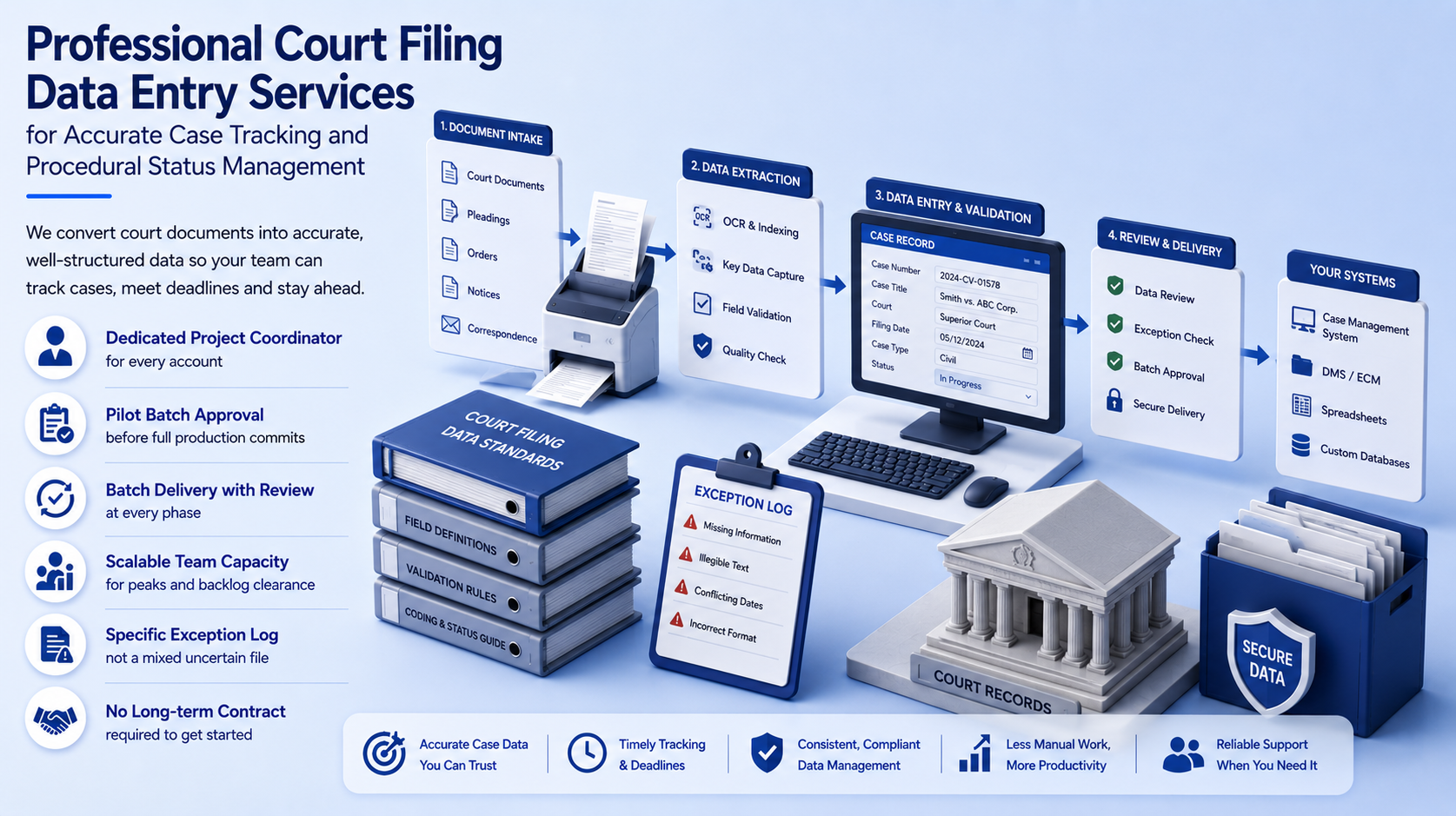
For every new project, we process a controlled pilot batch — typically 50 to 100 records — and deliver the output for your review before any paid production begins. The pilot confirms field mapping, output formatting, exception handling approach and accuracy standard so full production starts from a confirmed baseline rather than assumptions.

4

Controlled Production

Full production runs in planned batches with quality checks between each phase. Every batch is processed by operators who have reviewed the pilot-confirmed instructions and understand the exception handling rules. Checks for missing fields, formatting drift, duplicate entries and instruction deviations run throughout production.

5

Quality Review

Before any batch leaves our team, a quality reviewer separate from the production operators checks a defined sample against source documents and confirmed instructions. Exception items — records with missing values, unclear source content or uncertain classifications — are documented specifically with record reference and issue noted.

6

Delivery and Improvement

Final files are delivered in your agreed format alongside a clearly structured exception log. Your feedback on each delivery is reviewed by the project coordinator and applied immediately to the next batch. For recurring projects, the same team handles your account so operators know your preferences and output quality improves with each delivery cycle.

Ready to keep your case management data current without consuming attorney or paralegal time?

Share a sample of your court filing documents, your case management platform and your weekly filing volume. We execute an NDA immediately, provide a specific quote within 24 hours and run a pilot batch to confirm accuracy before production begins.

Start With a Confidential Pilot →

NDA executed before any case documents are shared. Strict legal confidentiality protocols.

Why Outsource to SDES?

A dependable offshore partner — full visibility, clear communication, consistent output

Why outsource to SDES
  • Dedicated project coordinator for every account
  • Pilot batch approval before full production commits
  • Batch delivery with review checkpoint at every phase
  • Scalable team capacity for peaks and backlog clearance
  • Specific exception log — not a mixed uncertain file
  • No long-term contract required to get started

Outsourcing to SDES removes repetitive production work from your internal team without removing their control over quality. You define the rules, format and standards. We follow them, flag anything outside those rules and deliver output your downstream systems can accept without a second pass.

Many clients started with a single backlog project and moved to a recurring monthly arrangement because the quality was consistent, the communication was direct and the process required significantly less internal management time than they expected.

Start Your Project →
Industries We Support

Court filing data entry for every litigation practice type

Litigation Law Firms

Litigation Law Firms

Plaintiff and defence side litigation firms managing high-volume court filing data across civil, commercial, employment and regulatory matters.

Corporate Legal Teams

Corporate Legal Teams

In-house legal departments managing multi-jurisdictional litigation portfolios and regulatory proceedings.

Financial Litigation

Financial Litigation

Financial services legal teams managing securities litigation, regulatory proceedings and enforcement action data.

Real Estate Litigation

Real Estate Litigation

Property dispute and real estate litigation teams processing deed filing data, eviction proceeding records and property litigation case management.

Healthcare Legal

Healthcare Legal

Healthcare legal teams processing medical malpractice, regulatory proceeding and clinical governance litigation data.

Legal Tech Companies

Legal Tech Companies

Legal technology and LPO providers delivering court filing data entry as part of litigation support and case management services.

Quality and Security

Accurate output, handled securely

Court filing data entry engagements begin with NDA execution before any case documents are shared. Team access is limited to individuals assigned to your firm's account.

Date accuracy is the primary quality standard for court filing data entry. Hearing dates, response deadlines and filing deadlines are verified against source documents and double-checked before entry. Any date-related ambiguity in source documents is flagged before the record is entered.

We follow your jurisdiction-specific formatting conventions for case numbers, court identifiers and procedural classification codes — not a generic format that approximates them.

🔒 NDA Protected Before files are shared
🌐 GDPR Aware EU data handling
99.9% Accuracy Multi-level QA checks
🛡️ Secure Transfer Encrypted file access
📋 Exception Log Every delivery
👥 Project Team Only Controlled access
Client Feedback

What litigation clients say about our court filing data entry service

★★★★★

We had used other offshore data entry companies before SDES and the consistent problem was exceptions being guessed at rather than flagged. SDES keeps unclear items separate with specific notes on every batch. That single difference has made the outsourcing arrangement genuinely low-maintenance for our team.

Operations Manager Business Services Company, USA
★★★★★

Running a pilot batch before full production was what made us comfortable committing to the full project. SDES processed our sample, showed us exactly how exceptions would be handled and made two adjustments based on our feedback. The batches since then have arrived consistently, in the right format, with a clear exception log attached.

Data Manager Professional Services Team, United Kingdom
★★★★★

The main reason we outsource data entry to SDES rather than doing it in-house is that our internal team's time is genuinely better spent on analysis and client work. SDES handles the production accurately, communicates clearly when something needs our input and delivers on the agreed schedule.

Back-Office Lead Growing Business, Australia
FAQs

Questions about outsourcing court filing data entry

Which case management systems do you work with?

We work with Clio, MyCase, PracticePanther, iManage, FileVine, Needles, ProLaw, CaseTrack and most other legal case management platforms. If your system is not listed, we assess requirements and can work within most platforms with appropriate access.

How quickly are urgent hearing notices processed?

For recurring clients with ongoing court filing data entry arrangements, we process hearing date entries on a priority basis — typically the same business day the notice is received. Turnaround expectations are confirmed at project setup.

Can you handle filing data across multiple courts and jurisdictions?

Yes. We follow each court's specific identifier format, filing category conventions and procedural terminology rather than applying a generic format. Multi-jurisdictional filing data entry requirements are reviewed and confirmed at project setup.

What happens if a filing document contains inconsistent or unclear information?

Any document where the correct case identifier, party name, date or classification is unclear or inconsistent with other filing records is flagged in an exception log with specific notes for your legal team to review. We do not resolve legal data inconsistencies without attorney confirmation.

💬