India-Based Data Entry Outsourcing Support Serving USA, UK, Australia, Europe, New Zealand, Singapore, UAE
Document Management Services

Professional Document Management Services for Organised, Accessible and Maintainable Business Archives

We provide expert document management outsourcing solutions for businesses that need their physical or digital document collections organised, consistently named, classified and maintained so the right document can be found when it is needed. The hidden cost of poor document organisation is significant: time spent searching, documents resent because originals cannot be located, decisions delayed because supporting documentation is not accessible and compliance gaps created when required records cannot be produced for audit.

Our professional offshore document management team in India processes document collections of any size systematically — applying naming conventions, folder structures, classification taxonomies and metadata standards across the complete collection — and establishes ongoing management workflows that keep document organisation consistent as new files arrive over time.

Good document management solutions are not primarily about the technology platform you use. SharePoint, Google Drive, a network file server or a specialist ECM platform all work well when documents follow consistent naming, classification and structure standards. The work is in defining and applying those standards consistently across a collection that may already contain years of inconsistently organised files.

✓ Document Classification ✓ File Naming Standards ✓ Folder Structure Design ✓ Archive Reorganisation ✓ Ongoing Management Support
Trusted & Secure
🔒NDA Protected 🌐GDPR Aware 99.9% Accuracy 🎯Free Pilot Batch Fast Turnaround 🌍45+ Countries Served
5000+ Completed Projects
90% Returning Clients
16+ Years Experience
45+ Countries Served
50+ Professionals Team
Service Overview

Systematic document management solutions that make every file findable and every archive maintainable

  • Document collection review and quality assessment
  • Classification taxonomy design or application
  • File naming convention development and implementation
  • Folder hierarchy and archive structure design
  • Metadata and index field creation
  • Ongoing document management and maintenance cycles

Effective document management requires consistent application of defined naming and classification rules across every document in the collection — not just the ones added after the new system was implemented. Legacy collections that have accumulated years of inconsistently named and organised files require systematic reorganisation before the benefits of a document management system are fully realised.

We begin every document management project with a collection review: understanding the document types present, the current naming approach, the primary retrieval use cases and the systems the documents need to work with. From this review, we agree a practical classification structure and naming convention before any reorganisation work begins.

As a professional document management outsourcing partner in India, SDES provides the systematic effort required to reorganise large document archives and establish ongoing management workflows at a fraction of the cost of equivalent internal staff.
What We Manage

Expert Document Management Solutions for Every File Type and Business Volume

Each management service is planned around your document types, retrieval use cases, business requirements and target storage platform.

01

Document classification taxonomy design and application

We design or apply document classification systems that match your business structure, compliance requirements and retrieval use cases. A well-designed classification system covers the right number of document type categories — enough to make meaningful distinctions for retrieval purposes, but not so granular that classification decisions are ambiguous and inconsistent. Classification also covers business function categories(Finance, HR, Operations, Legal, Marketing), time period categories (year, quarter, financial period), entity categories (client, project, department, site) and sensitivity levels (public, internal, confidential, restricted). For organisations that already have a defined classification system, we apply it consistently across a legacy collection that was never systematically organised. For organisations without a defined system, we recommend a practical structure based on your actual retrieval use cases before implementation begins.

02

File naming convention development and application

We develop and apply consistent file naming conventions across your complete document collection. A good file naming convention includes: document type code or abbreviation; entity identifier (client code, project number, department); date in a consistently formatted version (YYYYMMDD for reliable date-based sorting); version number or status indicator where relevant; and a brief descriptive element that identifies the specific document without requiring it to be opened. Consistent naming makes documents findable through filename search, sortable by date and type, distinguishable from similar documents and auditable for version control. Applying naming conventions to an existing collection requires reviewing each file and renaming it correctly — systematic work that our offshore document management team handles efficiently at scale.

03

Folder and archive structure design

We design and implement folder hierarchies for your document storage system — network drives, SharePoint, Google Drive, Dropbox Business, Box or other platforms. The folder structure is designed for your primary retrieval use cases rather than a theoretically logical hierarchy that does not match how people actually search for documents. A structure that requires navigating five folder levels to find a common document type will be bypassed in favour of desktop shortcuts and email attachments — defeating the purpose. We review how your team currently finds documents, what types of documents are retrieved most frequently and what combination of document type, entity and date period is most commonly used as a retrieval path. From this analysis, we recommend a two to three level folder structure that makes the most frequently accessed documents retrievable in the fewest navigation steps.

04

Document archive reorganisation

We reorganise existing document archives by reclassifying and renaming files, building new folder structures, consolidating duplicates and removing obsolete versions identified during the review. Large archive reorganisation projects are handled in phases: a defined section of the archive is reorganised and reviewed before proceeding to the next section, so errors in the approach can be identified and corrected early rather than discovered after the complete archive has been processed. Before reorganisation begins, the archive is inventoried — understanding what document types are present, how many files exist, what the date range of the collection covers and what the current naming and organisation approach looks like. This inventory forms the basis for the reorganisation plan.

05

Ongoing document management maintenance

We maintain document archives on a recurring basis for organisations whose ongoing operations produce a continuous stream of new documents that need consistent classification, naming and organisation. Ongoing management arrangements typically process new document inflows on a weekly or monthly cycle: incoming scanned documents, downloaded correspondence, completed transaction documents and other regular document types are classified, named and filed according to the agreed system. Periodic archive reviews check for documents that have been saved in the wrong location, naming inconsistencies that have crept in through direct saves by internal staff and version control issues. Ongoing maintenance prevents the archive from deteriorating back to the disorganised state that made the reorganisation project necessary in the first place.

Inputs and Output

We work with the files you already have

📂 Source formats we accept

  • Existing unorganised digital document collections
  • Scanned document batches requiring organisation
  • Network drive or cloud storage exports
  • Legacy filing system records
  • Mixed format document collections (PDF, Word, Excel, images)

📤 Delivery formats

  • Reorganised and renamed document collection
  • Classification taxonomy and naming convention documentation
  • Folder structure implementation in your platform
  • Metadata and index spreadsheets
  • Archive inventory and reorganisation report
How It Works

How we manage document management projects

1

Collection Review and Schema Confirmation

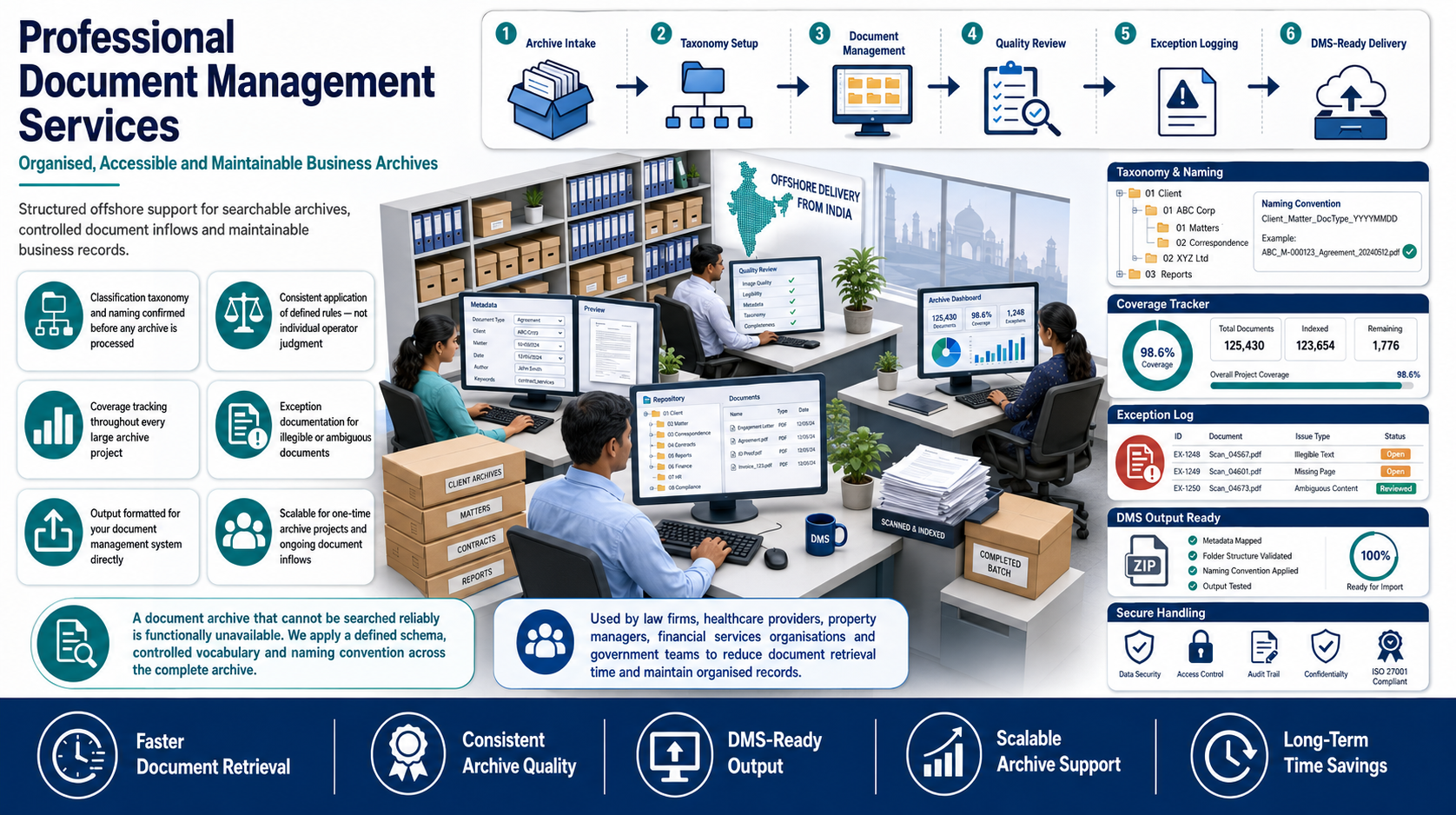
Document types, volume, quality distribution and retrieval use cases reviewed. Classification taxonomy, naming convention, metadata field definitions and target DMS requirements confirmed before production begins.

2

NDA and Secure Setup

NDA before any documents are received. For physical materials, secure handling and return procedures confirmed. For digital archives, secure transfer method and access controls established.

3

Pilot Batch

Representative sample processed and delivered for your review. Classification accuracy, naming format, metadata completeness and output structure confirmed from actual documents before the full archive is committed.

4

Phased Production with Coverage Tracking

Archive processed in coverage-tracked batches by document type, date range or collection section. Progress reported at each phase so completeness is confirmed throughout.

5

Quality Review and Exception Separation

Each batch reviewed for classification consistency, naming compliance, legibility issues and metadata completeness. Illegible or ambiguous documents documented with specific issue notes — not classified arbitrarily.

6

Archive Delivery and Documentation

Complete digital archive delivered in required format alongside taxonomy documentation and a coverage confirmation report showing completeness by document type and date period.

Is your document archive making daily work slower than it should be?

Share a sample of your current document collection and describe your primary retrieval use cases. We recommend a practical organisation approach and provide a free pilot reorganisation sample so you can evaluate the approach before committing.

Discuss Your Project →

Initial consultation and pilot sample at no charge.

Why Outsource to SDES?

Why organisations outsource document processing and indexing to SDES India

Why outsource to SDES
  • Classification taxonomy and naming confirmed before any archive is processed
  • Consistent application of defined rules — not individual operator judgment
  • Coverage tracking throughout every large archive project
  • Exception documentation for illegible or ambiguous documents
  • Output formatted for your document management system directly
  • Scalable for one-time archive projects and ongoing document inflows

A document archive that cannot be searched reliably is functionally unavailable. The goal of every document processing project is an archive where the right document can be found quickly every time — not most of the time. That requires consistent application of a defined schema, controlled vocabulary and naming convention across the complete collection, not just the most recent additions.

We have processed document archives for law firms, healthcare providers, property managers, financial services organisations and government teams. In each case, the result was an archive that reduced the daily cost of document retrieval significantly — and continued to save time for years after the project completed.

Start Your Project →
Industries We Support

Professional document management solutions across information-intensive industries

eCommerce

eCommerce

Online retailers and marketplace sellers that need accurate product data, catalog management, marketplace listing support and order management data entry handled consistently at scale without burdening their internal team.

Healthcare

Healthcare

Medical practices, billing companies and healthcare providers that handle patient records, clinical data, insurance information and billing documentation requiring precise entry and confidential handling.

Real Estate

Real Estate

Property firms, real estate agencies and title companies managing listing details, transaction records, deed data and client databases across large and growing portfolios.

Finance

Finance

Accounting firms, finance departments and financial services companies processing invoices, statements, claims, reconciliation records and financial document data at recurring volume.

Legal

Legal

Law firms and legal departments digitising and managing case files, contracts, compliance records, court documents and legal correspondence with appropriate confidentiality controls.

Logistics

Logistics

Freight companies, 3PLs and supply chain teams maintaining accurate shipment records, supplier data, inventory counts and delivery documentation across high-volume operations.

Manufacturing

Manufacturing

Manufacturers needing product specifications, supplier records, quality inspection data and inventory management data entry for production and procurement systems.

Agencies

Agencies

Marketing agencies, digital agencies and business services firms outsourcing data entry, list building, research and campaign data management to a reliable offshore partner.

Quality and Security

Accurate output, handled securely

NDA signed before any document is received. For archives containing sensitive personal, legal, financial or healthcare information, access is restricted to the assigned processing team. Physical documents are returned or securely disposed of per your instructions after digitisation.

Consistent classification is the product we deliver. Operators do not resolve classification edge cases with individual judgment — ambiguous documents are flagged for your team's decision, not classified arbitrarily. Your archive's taxonomy is applied consistently by design, not just on average.

For healthcare documents we apply HIPAA-conscious handling. For legal archives we maintain attorney-client privilege awareness. For financial records we follow your applicable regulatory framework. Compliance documentation is available for your vendor management records.

🔒 NDA Protected Before files are shared
🌐 GDPR Aware EU data handling
99.9% Accuracy Multi-level QA checks
🛡️ Secure Transfer Encrypted file access
📋 Exception Log Every delivery
👥 Project Team Only Controlled access
Client Feedback

What clients say about our document management work

★★★★★

We had 28,000 pages of scanned closed matter files with no metadata — just sequential TIFF numbers. SDES indexed the full collection with document type, matter reference, date and sequence. Indexing was consistent throughout. Our attorneys could search the historical archive by matter reference for the first time.

Litigation Support Manager Law Firm, USA
★★★★★

12 years of tenant files had been scanned but were completely unorganised — 6,200 documents. SDES classified, named and organised the full collection over eight business days. The naming convention was applied consistently and our property managers could navigate the archive reliably from day one.

Operations Manager Property Management Company, Australia
★★★★★

The indexing project covered three offices over four months. SDES tracked coverage by office and document category with weekly progress reports. We knew exactly where we were throughout. Archive quality was consistent across all three locations despite variation in source materials.

Records Manager Financial Services Organisation, UK
FAQs

Questions clients ask before outsourcing document management to India

Can you work with our existing document management platform?

Yes. We work with SharePoint, Google Drive, network file systems, Dropbox Business, Box, M-Files and most other platforms. Platform-specific naming limitations or metadata requirements are incorporated into the agreed naming and classification approach.

How long does a large archive reorganisation project take?

A 10,000-document office archive reorganisation typically takes 2-4 weeks including inventory, structure design confirmation and phased reorganisation with review. We confirm a specific timeline after reviewing your document collection sample.

Can you help design the classification system or do we need to provide it?

Both options work. We can design a classification system based on your business structure and use cases, or implement a taxonomy you have already defined. A collaborative approach — where we review your collection and recommend a structure — often produces the most practical result.

What happens to documents that do not fit the classification?

Documents that do not fit clearly within the taxonomy are flagged in a review list with the classification question noted specifically. Your team makes the final decision on edge cases rather than having us impose an arbitrary classification.

Can you maintain ongoing document organisation for new files?

Yes. Ongoing management arrangements process new document inflows on weekly or monthly cycles with consistent classification and naming standards maintained throughout.

What if our collection contains sensitive or confidential documents?

All document management projects begin with a signed NDA. Sensitive documents are handled with the same access controls and transfer security applied to all SDES engagements. Specific sensitivity handling requirements are confirmed at project setup.

💬