
India-Based Data Entry Outsourcing Support Serving USA, UK, Australia, Europe, New Zealand, Singapore, UAE
Data Quality Services

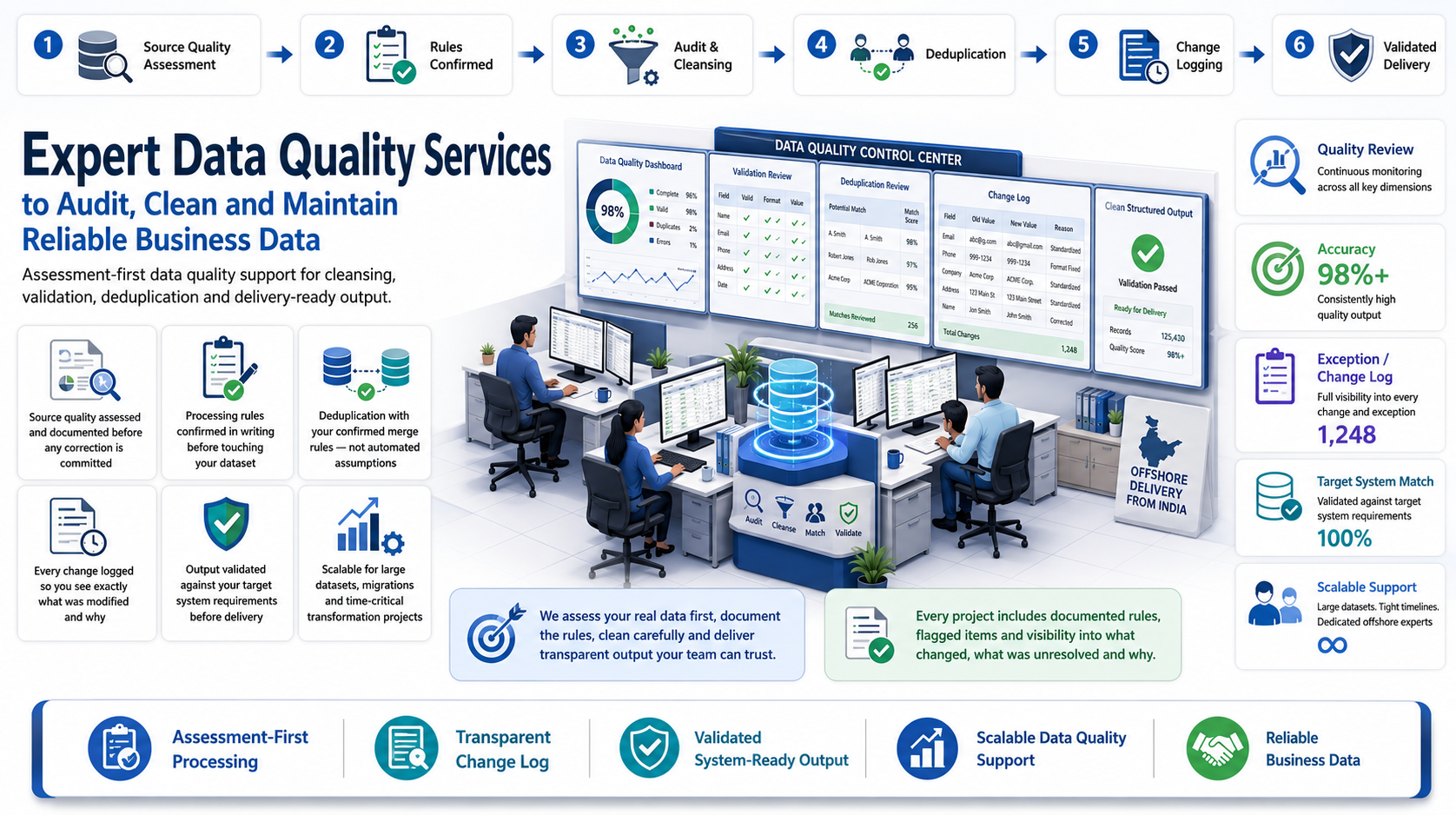
Expert Data Quality Services to Audit, Clean and Maintain Reliable Business Data

We provide professional data quality management services for businesses whose databases, CRMs and operational datasets have accumulated errors, inconsistencies, duplicate records and outdated information over time. The impact of poor data quality is rarely visible until it causes a specific failure — a customer communication sent to the wrong address, a CRM report that shows 140% of quota because of duplicate opportunities, a system import that fails because of invalid field values, or a sales team that stops trusting the CRM because the data is too unreliable to act on.

Our expert data quality outsourcing solutions from India give your team the systematic capacity to address quality problems at scale — not just patching obvious errors individually, but profiling the dataset to understand the full extent of the quality issue, applying consistent correction rules across the complete record set and delivering a measurably improved database that your team can rely on.

Both one-time quality improvement projects and ongoing monthly data quality maintenance arrangements are available. Many clients start with a comprehensive quality audit and correction project, then move to a regular maintenance cycle that catches new quality issues before they accumulate to the scale that requires another major correction project.

✓ Data Quality Audit ✓ Duplicate Detection and Removal ✓ Field Standardisation ✓ CRM Data Cleanup ✓ Ongoing Quality Maintenance
Trusted & Secure
🔒NDA Protected 🌐GDPR Aware 99.9% Accuracy 🎯Free Pilot Batch Fast Turnaround 🌍45+ Countries Served
5000+ Completed Projects
90% Returning Clients
16+ Years Experience
45+ Countries Served
50+ Professionals Team
Service Overview

Professional data quality solutions that deliver measurable, sustained improvement in database reliability

  • Data quality audit and field-level profiling
  • Duplicate detection with fuzzy and exact matching
  • Field standardisation and value normalisation
  • Outdated record identification and flagging
  • Error correction and gap filling from available sources
  • Ongoing quality maintenance cycles

Data quality deteriorates gradually and often silently. New records are added with slightly different formatting. Contact details go out of date as people change jobs, move or update their contact information. Duplicate records accumulate through multiple import sources, manual entry errors and company mergers. Category fields drift as different operators use their own judgment about classification values. By the time quality problems become noticeable, they typically affect thousands of records across multiple fields.

Our professional data quality solutions begin with a data audit — systematic profiling of your dataset to identify quality issues by type, frequency and distribution before any correction work begins. The audit gives you and your team a clear picture of what the problem actually is rather than working from assumptions, and produces a prioritised correction plan based on business impact rather than fixing issues in arbitrary order.

As an experienced data quality outsourcing partner in India, SDES provides the systematic effort that data quality improvement at scale requires — effort that most internal teams cannot sustain alongside their primary operational and analytical responsibilities.
What We Improve

Professional Data Quality Solutions for Every Database and Platform Type

Each data quality service targets specific, measurable aspects of data reliability and produces documented before-and-after results.

01

Data audit and quality profiling

We systematically analyse your dataset to understand the full picture of data quality problems before any correction work begins. The audit covers: completeness (what percentage of required fields are populated across all records?); consistency (are the same values represented the same way across all records?); validity (do field values match the expected format, range and reference values?); uniqueness (how many duplicate records exist, and what is the duplication pattern?); accuracy (do field values match the most recently available source information for key fields?). The audit report shows quality issues by type, frequency across the dataset and estimated correction effort — giving your team a realistic assessment of the work involved and the expected improvement achievable before any correction budget is committed.

02

Duplicate detection and systematic deduplication

We identify duplicate records using exact field matching for obvious duplicates, fuzzy string matching for name and address variations and cross-reference checking against primary identifiers. For contact databases, common duplicate patterns include: the same person entered from different sources with slightly different name formats; company records with inconsistent naming (Inc. vs Incorporated, abbreviations vs full names); records created during CRM migrations where existing records were not properly matched to incoming imported records. For each identified duplicate, we apply your defined merge rules — which record is the master, how to handle conflicting field values. Uncertain near-duplicates that share some but not all identifying fields are flagged for human review with both records preserved. Deduplication results include a summary showing confirmed duplicate count, resolved pairs and uncertain pairs awaiting review.

03

Field standardisation and value normalisation

We standardise inconsistent field values across your complete database to a consistent format that your filtering, segmentation, reporting and import tools can process reliably. Standardisation scope typically includes: date format alignment (all dates in YYYY-MM-DD or DD/MM/YYYY as required); phone number structure (all records in E.164 format or country-specific format with consistent spacing and punctuation); address component separation (city, state, postcode and country in separate fields if currently mixed together); capitalisation rules (consistent title case or upper case for names); currency and numeric format (consistent decimal separator, thousands separator and currency code); category and classification field cleanup (a defined controlled vocabulary applied consistently, replacing all variations with the standard term). Standardisation rules are documented and applied consistently across every record rather than selectively.

04

CRM and contact database cleanup

We clean CRM contact records specifically for sales, marketing and service use cases — the quality problems that affect campaign performance, sales efficiency, reporting accuracy and customer service quality. CRM cleanup covers: updating outdated job titles, company names and contact information from available verification sources; completing mandatory fields that are blank on existing records; removing or flagging records with no useful contact data (no email, no phone, undeliverable address); standardising company name formatting so records from the same organisation appear together in filters and reports; correcting email address formatting issues that cause delivery failures; identifying contacts at companies that have been acquired, merged or dissolved. After cleanup, your CRM segmentation is more accurate, your campaigns reach their intended audience more reliably and your sales team has data they can trust.

05

Ongoing data quality maintenance

We provide recurring data quality review and correction on your preferred schedule — monthly, quarterly or triggered by new data imports. Each maintenance cycle checks for newly introduced quality issues in records added or modified since the last cycle, applies the same standardisation and validation rules established in the initial quality project and delivers a brief quality report showing new issues found, corrections applied and current completeness metrics for key fields. Ongoing maintenance prevents quality from deteriorating back to the state it was in before the initial cleanup project — which typically happens within 12-18 months for any actively used database without systematic quality management. Monthly maintenance arrangements provide the best long-term data quality outcome at a much lower cost per cycle than periodic major cleanup projects.

How It Works

How we manage data quality improvement projects

1

Data Quality Assessment

A representative sample of your dataset is reviewed to identify quality issue types, frequencies and distribution. You see the actual problems clearly before scope and approach are confirmed — no surprises mid-project.

2

Rule Documentation and Confirmation

Processing rules, standardisation vocabulary, validation criteria, deduplication logic and exception handling decisions are documented and confirmed with your team before any production changes are made to your data.

3

Pilot Processing Batch

A pilot batch is processed using the confirmed rules and reviewed by your team before full processing is committed. Rule adjustments from the pilot are applied immediately before production begins.

4

Systematic Batch Processing

Full dataset processed in defined batches. Standardisation and transformation applied consistently across every record — not selectively. Validation checks between phases maintain rule consistency throughout.

5

Exception Reporting

Records where processing rules cannot be applied due to missing, conflicting or ambiguous information are documented specifically by field and reason. Clean and exception records delivered separately with clear documentation.

6

Validated Output and Processing Documentation

Cleaned dataset delivered alongside processing documentation showing rules applied, changes made by field and frequency, and an exception inventory summary for your team's review and action.

Not sure how significant your data quality problem actually is?

Share a sample of your database or CRM export — 500 to 1,000 records is sufficient. We run a free quality audit on the sample and report back on the types, frequency and distribution of issues before you decide whether to proceed with a full project.

Get a Free Data Audit →

Free quality audit and report returned within 24-48 hours.

Why Outsource to SDES?

Why organisations outsource data processing and quality work to SDES India

Why outsource to SDES
  • Source quality assessed and documented before any correction is committed
  • Processing rules confirmed in writing before touching your dataset
  • Deduplication with your confirmed merge rules — not automated assumptions
  • Every change logged so you see exactly what was modified and why
  • Output validated against your target system requirements before delivery
  • Scalable for large datasets, migrations and time-critical transformation projects

Data quality and processing work is expensive to undo if done incorrectly. Incorrectly merged duplicates are difficult to separate. Incorrectly transformed values populate a target system with errors that compound over time. We invest in the assessment phase — reviewing your actual data, identifying issue types and frequencies, and documenting transformation rules before any changes are made.

The output of every processing project includes not just a cleaned file but documented rules explaining what was changed, what was flagged and what could not be resolved. That transparency gives your team full visibility into the state of your data after processing.

Start Your Project →
Industries We Support

Expert data quality solutions across data-dependent business sectors

eCommerce

eCommerce

Online retailers and marketplace sellers that need accurate product data, catalog management, marketplace listing support and order management data entry handled consistently at scale without burdening their internal team.

Healthcare

Healthcare

Medical practices, billing companies and healthcare providers that handle patient records, clinical data, insurance information and billing documentation requiring precise entry and confidential handling.

Real Estate

Real Estate

Property firms, real estate agencies and title companies managing listing details, transaction records, deed data and client databases across large and growing portfolios.

Finance

Finance

Accounting firms, finance departments and financial services companies processing invoices, statements, claims, reconciliation records and financial document data at recurring volume.

Legal

Legal

Law firms and legal departments digitising and managing case files, contracts, compliance records, court documents and legal correspondence with appropriate confidentiality controls.

Logistics

Logistics

Freight companies, 3PLs and supply chain teams maintaining accurate shipment records, supplier data, inventory counts and delivery documentation across high-volume operations.

Manufacturing

Manufacturing

Manufacturers needing product specifications, supplier records, quality inspection data and inventory management data entry for production and procurement systems.

Agencies

Agencies

Marketing agencies, digital agencies and business services firms outsourcing data entry, list building, research and campaign data management to a reliable offshore partner.

Quality and Security

Accurate output, handled securely

NDA executed before any dataset is shared. Access restricted to the processing team assigned to your project. For datasets containing personally identifiable information, we apply data minimisation — operators access only the fields required for the specific processing task, not the full dataset.

We never overwrite source values without creating a documented log. The processing output records what was in the source, what was changed, what standardisation was applied and what was flagged as unresolvable. Your team can review and reverse specific changes if required.

For regulated data types — GDPR-covered personal data, HIPAA-covered health information, financial data with sector-specific obligations — we confirm specific handling requirements before processing begins and document our approach against your compliance requirements.

🔒 NDA Protected Before files are shared
🌐 GDPR Aware EU data handling
99.9% Accuracy Multi-level QA checks
🛡️ Secure Transfer Encrypted file access
📋 Exception Log Every delivery
👥 Project Team Only Controlled access
Client Feedback

What clients say about our data quality work

★★★★★

We had a CRM database with 22,000 contacts accumulated from multiple import sources over six years. SDES ran a quality audit first, gave us a clear picture of the problem, then processed the full deduplication and standardisation with our confirmed merge rules. The result was a CRM our sales team actually started trusting and using.

CRM Manager B2B Technology Company, USA
★★★★★

Our product catalog had five years of attribute vocabulary drift across 8,300 products. SDES standardised 140 attribute option values consistently — not just on recent additions. Layered navigation on our store started working correctly the week of the import.

Head of Digital Commerce Industrial Distributor, Germany
★★★★★

The processing report SDES delivered alongside the clean file was more useful than the file itself for understanding the state of our legacy data. We knew exactly what had been changed, what had been flagged and what needed decisions from our team. That transparency made the whole migration significantly easier.

Data Governance Lead Financial Services Business, Australia
FAQs

Questions clients ask before outsourcing data quality improvement

How do you define what counts as a duplicate record?

Duplicate detection rules are based on your primary identifiers — for a contact database, typically name plus email or name plus phone; for a company database, company name plus address or company name plus website. We confirm the matching rules with you before running deduplication to ensure the logic matches your definition of what constitutes a duplicate rather than applying a generic rule that might incorrectly flag legitimate separate records.

Can you improve data quality in our live CRM without disrupting operations?

Yes. We work from a CRM export for the bulk cleaning work, then deliver corrected records for controlled re-import. This keeps your live CRM system stable and available to your team throughout the cleaning process. For direct in-system work on smaller volumes, we can discuss a staged approach that minimises operational impact.

What is the measurable business impact of data quality improvement?

Typical outcomes reported by clients after data quality improvement include: lower email bounce rates and improved campaign deliverability; more accurate CRM segmentation producing better-targeted outreach; fewer failed system imports in scheduled integration workflows; faster report generation without manual data cleanup; improved sales team confidence in CRM data leading to higher adoption and usage. The specific impact depends on your current data quality baseline, which is why the audit is the right first step.

Can you maintain data quality on an ongoing monthly basis?

Yes. Monthly or quarterly quality maintenance cycles are available and represent the most cost-effective approach to sustained data quality. Each cycle applies consistent rules, checks for new quality issues in recently added records and delivers a brief quality report.

What fields do you prioritise in a data quality audit?

Priority depends on your primary use case. For sales CRM data, email validity and job title currency are typically highest priority. For marketing database, email validity and segmentation field consistency matter most. For product catalog data, category accuracy and attribute completeness are typically most important. We confirm priority fields with you before the audit begins.

How long does a comprehensive data quality project take?

A comprehensive audit and correction project on a CRM database of 20,000 contacts typically takes 5-10 business days depending on the number and complexity of quality issues found. We provide a specific timeline estimate after the free audit sample is reviewed.

💬