India-Based Data Entry Outsourcing Support Serving USA, Canada, UK, Australia, Europe, New Zealand, Singapore, UAE
Product Categorization Services

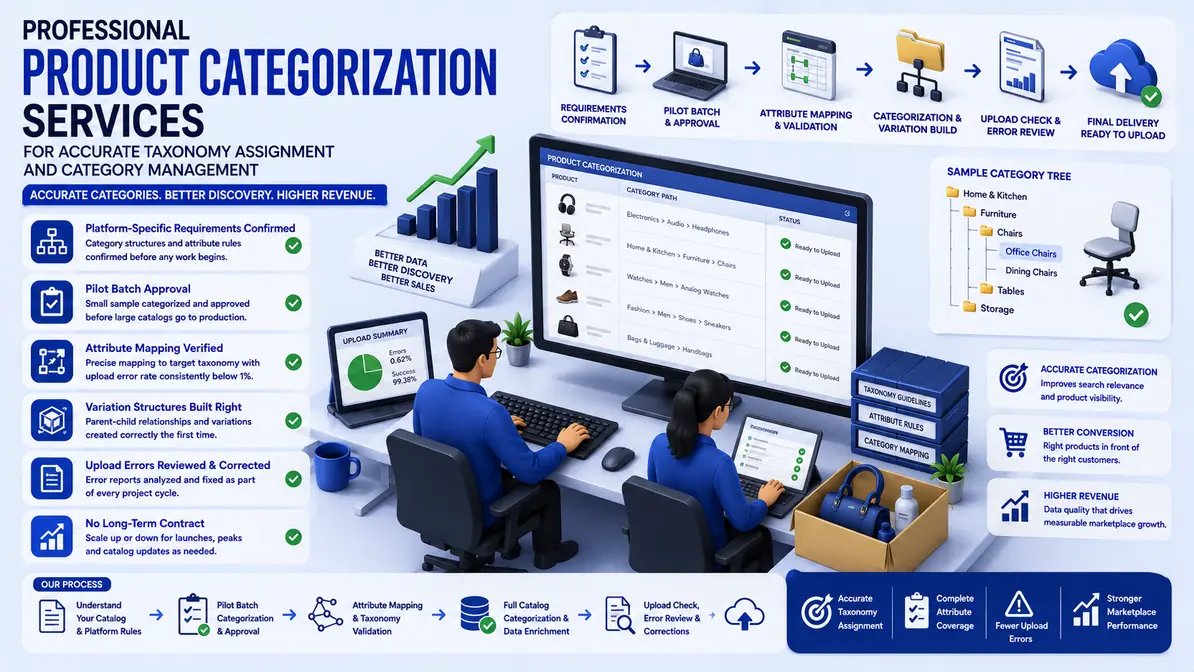
Product Categorization That Places Each Item Where Its Purpose and Attributes Support It

A product belongs in a category because of what it is and how the taxonomy defines that branch—not because one word in its title resembles a category label. Our professional product categorization services evaluate identity, use, audience and distinguishing attributes before assigning a destination.

An specialist reviews the taxonomy version, node definitions, inclusion and exclusion rules, required depth, multi-category policy and evidence expected for sensitive classes. The delivery team then classifies supported items while new-node requests, regulated categories and ambiguous product intent remain with authorised taxonomy owners.

Retailers, marketplaces and distributors outsource new-catalog classification, migration recategorization or backlog review when internal teams cannot examine every item consistently. The solution supplies category assignments with confidence, supporting evidence and a separate queue for products that do not fit responsibly.

Shri Data Entry Services team working on Product Categorization Services projects
5000+ Completed Projects
90% Returning Clients
16+ Years Experience
45+ Countries Served
50+ Professionals Team
Services We Offer

Choose the most specific supported node without forcing products into unsupported branches

  • Taxonomy version fixed
  • Node definition read
  • Product purpose understood
  • Exclusions checked
  • Depth rule applied
  • Ambiguity recorded

A broad category may reduce discoverability, while an incorrect leaf node can impose irrelevant required fields, filters or compliance rules. Effective categorization balances specificity with the evidence available for the exact product.

We compare titles, descriptions, identifiers, technical attributes and approved images with taxonomy definitions and category examples. Terms such as “for,” “compatible with” or “replacement” are interpreted carefully so accessories are not classified as the products they support.

Structured production review creates consistent throughput across large assortments. The documented workflow uses confidence and exception rules to keep questionable assignments visible instead of hiding them behind a fully populated category column.

Taxonomy classification for new products, inherited catalogs and changing channel requirements

Assignments follow the current approved taxonomy and the evidence present in each product record.

01

Taxonomy and node-definition review

Category trees, leaf nodes, synonyms, examples, inclusion rules, exclusions and required attributes are reviewed before production. Overlapping or undefined nodes are documented for taxonomy-owner clarification.

02

New-product category assignment

Product identity, primary purpose, intended user and category-specific attributes support selection of the most appropriate approved node. Sparse records remain at a defensible level or enter review rather than being over-classified.

03

Marketplace and channel classification

Internal categories are translated into the applicable marketplace or retail-channel taxonomy. Destination definitions control the assignment; similar category names across platforms are not assumed to mean the same thing.

04

Accessory, replacement and compatibility review

Accessories, spare parts, refills, covers and compatible items are distinguished from the main products they reference. Classification reflects the item being sold, not only the better-known product named in its content.

05

Catalog recategorization and node migration

Products affected by retired, merged, split or redefined nodes are reviewed against the replacement taxonomy. Existing categories provide context but do not automatically dictate the new destination.

06

Confidence scoring and taxonomy exceptions

High-confidence assignments, review-required products and taxonomy gaps are delivered separately with concise reasons. Potential new nodes and policy questions remain proposals until authorised owners approve them.

Commerce Platform Compatibility

Product Categorization Services: Direct Integration and Software Compatibility

Outputs are prepared around the field structure, controlled values and import requirements of your destination environment. Files can be delivered for review, staging or authorised import without forcing your team to rebuild the completed work.

Supported destinations

Catalog and product files prepared for multichannel commerce

Files are mapped to the client’s approved template, naming rules, identifiers and system structure before full production begins.

  • ShopifyProducts, variants and collections
  • WooCommerceCatalog and attribute imports
  • AmazonSeller and marketplace templates
  • eBayListings and item specifics
  • Magento / Adobe CommerceCatalog and store-view fields
  • PIM / ERP SystemsClient-defined product schemas
Source continuity

References stay connected

Source IDs, filenames, record keys and approved relationships remain available for review and downstream traceability.

Import control

Fields are mapped before production

Mandatory fields, formats, controlled values, character limits and relationship keys are checked against the destination specification.

Pilot validation

Test the handoff with a representative batch

Rejected rows, unsupported values and mapping conflicts are returned with exact references so approved corrections can be incorporated before full-volume delivery.

Delivery formatsStructured for review, staging or import
  • CSV
  • XLSX
  • XML

Column order, encoding, date rules, multi-value handling and destination-specific requirements can follow the receiving system’s approved specification.

Compatibility means SDES prepares outputs to specifications supplied or approved by the client. Product names identify commonly used destination systems and do not imply endorsement, certification or partnership.

Process, Quality and Security

A categorization workflow from taxonomy interpretation to reviewed product assignments

1. Study the Taxonomy

Version, hierarchy, node definitions, examples, exclusions, required depth and owners are documented.

2. Define Classification Evidence

The setup review confirms which product facts support, block or escalate assignments by category.

3. Calibrate Edge Cases

Accessories, bundles, multipurpose products, sparse records and overlapping branches form the pilot.

4. Classify with Reasons

The delivery team assigns approved nodes and records the evidence, confidence and exception status.

5. Audit Category Consistency

Samples, sibling-node boundaries, required attributes and reviewer agreement are checked by batch.

6. Release Assignments and Gaps

Approved categories, review items and taxonomy-policy questions are delivered separately.

📂 Source formats we accept
  • Product catalog and source descriptions
  • Current taxonomy and node definitions
  • Category examples and exclusion rules
  • Required-attribute documentation
  • Product images and technical specifications
  • Known category decisions and escalation policy
📤 Delivery formats
  • Categorized product dataset
  • Source-to-destination category crosswalk
  • Confidence and reason fields
  • Recategorization migration file
  • Taxonomy gap and new-node register
  • Ambiguous-product review queue

Quality review covers taxonomy version, valid node ID, supported classification depth, product-purpose evidence, sibling-category boundaries, required attributes, accessory treatment, confidence status and agreement between reason and assignment.

Automated suggestions and title keywords can accelerate candidate selection but do not replace taxonomy definitions. Low-information and conflicting products remain review items rather than receiving convenient leaf categories.

The production team applies approved classification rules. An expert client owner approves taxonomy changes, regulated categories, merchandising exceptions, multi-category policy and final publication of assignments.

🔒 NDA Protected Before files are shared
🌐 GDPR Aware EU data handling
Defined Quality Target Confirmed by pilot
🛡️ Secure Transfer Encrypted file access
📋 Exception Log Every delivery
👥 Project Team Only Controlled access
Free accuracy test

Need a large product catalog accurately categorised across your platform taxonomy?

Share a sample of your products and your taxonomy or category tree documentation. We classify a free sample set so you can review category accuracy and edge case handling before committing to full production.

✓ No credit card required✓ No contract required✓ 24–48 hour return
Get a Free Sample Categorisation
Source sampleyour_sample_data.csv
Received
Verified deliveryverified_output.xlsx
Reviewed
▣ Encrypted transfer◉ Quality controlled
Why Outsource to SDES?

Why reliable categorization depends on taxonomy meaning, not keyword shortcuts

Product Categorization Services workflow and quality review
  • Definition-led decisions
  • Product-purpose review
  • Accessory safeguards
  • Leaf-node discipline
  • Confidence controls
  • Scalable category maintenance

Catalog teams outsource professional product categorization when assortment growth and taxonomy changes create more classification work than internal specialists can review.

The documented workflow gives the delivery team precise node guidance while category policy, regulated classes, new-node creation and final merchandising structure remain with authorised owners.

Start Your Project →
Industries We Support

Product categorization adapted to different buying paths and taxonomy risks

General Retail and Marketplaces

Large mixed assortments classified to channel-specific leaf nodes with accessories and variants handled consistently.

Industrial and MRO Supply

Components, tools, consumables, replacement parts and equipment separated through technical purpose and attributes.

Electronics

Devices, accessories, components and compatibility products distinguished by function, model and specification evidence.

Medical and Laboratory Supply

Approved device and supply classifications applied without making unsupported regulatory or clinical determinations.

Home Improvement and Furniture

Products organised by use, installation context, material, room and configuration under the approved taxonomy.

Books, Media and Learning

Format, subject, audience, language and educational level used to support classification at the required depth.

Case Studies

Relevant Project Experience

Marketplace Taxonomy Reclassification

Project Name
Marketplace Taxonomy Reclassification
Volume
540,000 products across 3,800 leaf nodes — completed in 3 weeks
Problem
A taxonomy redesign retired broad nodes and introduced new branches whose names overlapped with legacy terminology.
Solution
A professional decision guide combined node definitions, required attributes and product-purpose evidence, while uncertain records remained above the leaf or entered review.
Outcome
The marketplace migrated its assortment without forcing sparse products into unjustified new categories.
Title
Taxonomy Operations Director
Industry
Online Marketplace
Country
United States

Industrial Accessory Classification

Project Name
Industrial Accessory Classification
Volume
226,000 parts, tools and consumables — completed in 12 weeks
Problem
Supplier titles frequently led with the equipment brand or model, causing accessories and replacements to be classified as primary machines.
Solution
The delivery team prioritised the sellable item’s function, technical attributes and part type. The solution routed ambiguous compatibility records to expert product engineers.
Outcome
Search and filters better separated equipment from the components, consumables and tools used with it.
Title
Catalog Governance Manager
Industry
Industrial Supply
Country
Germany

Home Retail Category Recovery

Project Name
Home Retail Category Recovery
Volume
118,000 products inherited from six suppliers — completed in 5 weeks
Problem
Supplier categories mixed room, material and product type, leaving similar items scattered across navigation branches.
Solution
Professional categorization applied the retailer’s primary-use hierarchy and recorded secondary merchandising facets separately.
Outcome
The retailer gained consistent primary categories plus a transparent list of multipurpose products requiring owner decisions.
Title
Head of Digital Merchandising
Industry
Home and Furniture Retail
Country
Australia
FAQs

Who owns the taxonomy and ambiguous category decisions?

Do you always assign the deepest available category?

Only when product evidence supports that depth. Otherwise, the record remains at a defensible node or is returned for taxonomy-owner review.

Can the same product be assigned to more than one category?

Yes, when the approved taxonomy and channel permit multi-category assignment. Primary and secondary placement rules must be defined before production.

What should we provide when we outsource product categorization?

Provide the current taxonomy, node definitions, product sources, required attributes, examples, exclusions, multi-category policy, confidence thresholds and review owners.

What should a Product Categorization Services pilot contain?

Provide Product catalog and source descriptions, Current taxonomy and node definitions, Category examples and exclusion rules. The pilot should include ordinary records and known exceptions so field interpretation, review rules and delivery structure can be confirmed before production.

📩 Get a Free Sample Categorisation
💬