India-Based Data Entry Outsourcing Support Serving USA, Canada, UK, Australia, Europe, New Zealand, Singapore, UAE
Product Data Mapping Services

Product Data Mapping That Explains How Every Source Value Reaches Its Destination

A supplier column called “Item” might represent a SKU, product name or manufacturer number depending on the file. Mapping it to the wrong destination field can produce valid-looking records with broken identity. Our professional product data mapping services establish meaning before data is transformed or migrated.

An specialist review compares source schemas, target requirements, product hierarchy, controlled values, units, cardinality and extension fields. The delivery team then documents and applies approved crosswalks while taxonomy ownership, business definitions and irreversible migration decisions remain with the client.

Retailers, manufacturers and platform teams outsource mapping when new supplier feeds, PIM implementations or channel launches create more schema work than internal specialists can absorb. The solution delivers field-level lineage, transformation rules, tested output and an exception register for values without a responsible destination.

Shri Data Entry Services team working on Product Mapping Services projects
5000+ Completed Projects
90% Returning Clients
16+ Years Experience
45+ Countries Served
50+ Professionals Team
Services We Offer

Map product meaning, structure and scope—not labels that merely look similar

  • Business meaning confirmed
  • Source authority ranked
  • Target requirement known
  • Cardinality checked
  • Transformation documented
  • Unmapped values retained

Two systems can use the same label for different concepts, or different labels for the same concept. Product “type” may mean a merchandising category in one source and a technical record class in another. Accurate mapping begins with definitions, examples and ownership.

We distinguish direct copies from transformations, lookups, aggregations, splits, defaults and prohibited mappings. Each rule states its source, destination, data type, allowed values, null treatment and validation condition.

Structured delivery supports large schemas and repeated supplier onboarding. The documented workflow preserves lineage so catalog owners can trace a target value back to its source and understand which rule produced it.
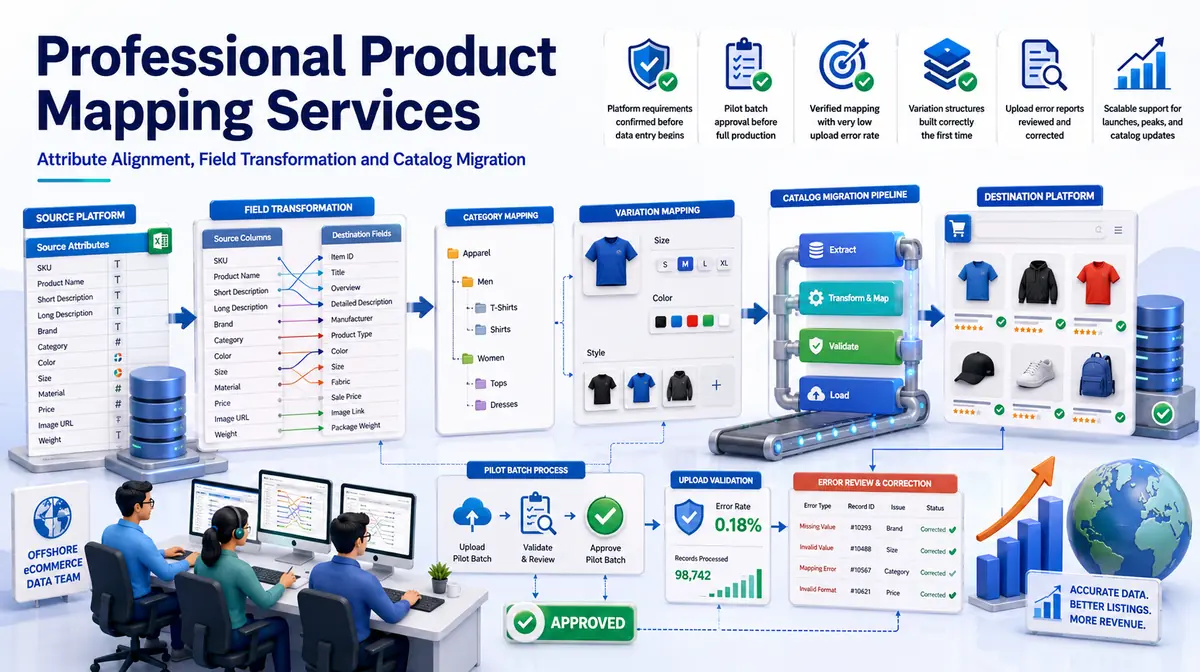

Crosswalks designed for fields, values, taxonomies and product relationships

Every destination value must have an approved origin, rule or explicit owner decision.

01

Source-to-target field mapping

Source columns, definitions, examples and data types are compared with target fields and requirements. Direct, conditional, derived, ignored and unresolved mappings are documented separately rather than hidden in one spreadsheet.

02

Attribute value and code crosswalks

Supplier terms, abbreviations and internal codes are mapped to approved destination values. Many-to-one consolidation and one-to-many expansion require explicit conditions so meaningful distinctions are not lost.

03

Category and taxonomy mapping

Source categories are aligned to target taxonomy nodes using product scope and attribute evidence. Broad, ambiguous or unsupported source classes return to taxonomy owners instead of being assigned to the nearest label.

04

Unit, format and transformation rules

Dimensions, weights, currencies, dates, booleans, text patterns and identifiers are converted under documented formulas and rounding policies. Original values remain available for verification and reprocessing.

05

Product hierarchy and relationship mapping

Parents, variants, bundles, components, accessories, replacements and media links are translated into the destination relationship model. Cardinality and key integrity are checked before migration files are produced.

06

Extension, channel and unmapped-field review

Custom attributes, plugin fields and channel-specific columns are inventoried against the destination environment. Fields without an approved target are retained in an exception or archival dataset rather than discarded silently.

Commerce Platform Compatibility

Product Data Mapping Services: Direct Integration and Software Compatibility

Outputs are prepared around the field structure, controlled values and import requirements of your destination environment. Files can be delivered for review, staging or authorised import without forcing your team to rebuild the completed work.

Supported destinations

Catalog and product files prepared for multichannel commerce

Files are mapped to the client’s approved template, naming rules, identifiers and system structure before full production begins.

  • ShopifyProducts, variants and collections
  • WooCommerceCatalog and attribute imports
  • AmazonSeller and marketplace templates
  • eBayListings and item specifics
  • Magento / Adobe CommerceCatalog and store-view fields
  • PIM / ERP SystemsClient-defined product schemas
Source continuity

References stay connected

Source IDs, filenames, record keys and approved relationships remain available for review and downstream traceability.

Import control

Fields are mapped before production

Mandatory fields, formats, controlled values, character limits and relationship keys are checked against the destination specification.

Pilot validation

Test the handoff with a representative batch

Rejected rows, unsupported values and mapping conflicts are returned with exact references so approved corrections can be incorporated before full-volume delivery.

Delivery formatsStructured for review, staging or import
  • CSV
  • XLSX
  • XML

Column order, encoding, date rules, multi-value handling and destination-specific requirements can follow the receiving system’s approved specification.

Compatibility means SDES prepares outputs to specifications supplied or approved by the client. Product names identify commonly used destination systems and do not imply endorsement, certification or partnership.

Process, Quality and Security

A product mapping workflow from schema discovery to tested destination records

1. Inventory Sources and Targets

Systems, files, fields, keys, product families, taxonomies, extensions and destination constraints are documented.

2. Define Business Meaning

The setup review confirms definitions, authority, data types, controlled values, nulls and relationship scope.

3. Draft and Challenge Crosswalks

Direct, transformed, conditional and unresolved mappings are tested with difficult source examples.

4. Apply Approved Rules

The delivery team prepares mapped data while retaining source values, rule references and exceptions.

5. Validate Target Behaviour

Required fields, types, values, units, keys, relationships and representative imports are checked.

6. Release Specifications and Data

Approved mappings, test output, lineage and owner-decision items are versioned and delivered separately.

📂 Source formats we accept
  • Source catalog schemas and sample exports
  • Target templates and field definitions
  • Attribute and code dictionaries
  • Source and destination taxonomies
  • Unit and transformation standards
  • Product hierarchy and extension-field documentation
📤 Delivery formats
  • Source-to-target mapping specification
  • Attribute value crosswalk
  • Taxonomy mapping table
  • Transformation and validation rules
  • Relationship and key map
  • Unmapped-field and decision register

Quality checks cover source and target field coverage, definitions, data types, required status, controlled-value validity, null handling, unit conversions, key uniqueness, relationship cardinality, transformation results and unmapped-field retention.

A successful sample import does not prove that every business meaning survived. Representative edge cases and exception-heavy categories are tested, and lineage is reviewed alongside technical validity.

The production team applies approved maps. An expert client owner approves business definitions, taxonomy crosswalks, defaults, derived values, discarded fields, relationship changes and final migration release.

🔒 NDA Protected Before files are shared
🌐 GDPR Aware EU data handling
Defined Quality Target Confirmed by pilot
🛡️ Secure Transfer Encrypted file access
📋 Exception Log Every delivery
👥 Project Team Only Controlled access
Free accuracy test

Need product data mapped accurately between your source and target systems?

Share your source file and target system field documentation. We build a free sample mapping for a product subset so you can review field correspondence and transformation accuracy before full project commitment.

✓ No credit card required✓ No contract required✓ 24–48 hour return
Get a Free Mapping Sample
Source sampleyour_sample_data.csv
Received
Verified deliveryverified_output.xlsx
Reviewed
▣ Encrypted transfer◉ Quality controlled
Why Outsource to SDES?

Why migration success depends on documented product meaning

Product Mapping Services workflow and quality review
  • Definition-first mapping
  • Field-level lineage
  • Controlled crosswalks
  • Transformation evidence
  • Relationship checks
  • Scalable supplier onboarding

Commerce and data teams outsource professional product data mapping when platform changes and supplier integrations create sustained schema-analysis work.

The documented workflow gives an offshore production team clear mapping authority while business definitions, taxonomy policy, defaults, data loss and final migration acceptance remain with authorised owners.

Start Your Project →
Industries We Support

Product mapping adapted to the structure and terminology of each catalog

Retail and Marketplaces

Supplier fields, channel attributes, variants, prices and media mapped into store or marketplace structures.

Manufacturing and Industrial Supply

Technical attributes, units, part relationships, documents and replacement references aligned to PIM or ERP models.

Medical and Laboratory Supply

Approved identifiers, product classes, pack structures and regulated fields mapped without inventing missing meaning.

Electronics

Model, capacity, interface, region, compatibility and variant terms translated across supplier and channel schemas.

Furniture and Building Products

Dimensions, finishes, materials, configurations and shipping fields mapped at the correct product level.

Publishing and Digital Catalogs

Edition, format, language, contributors, files and rights-related fields aligned across metadata systems.

Case Studies

Relevant Project Experience

PIM Migration Mapping Specification

Project Name
PIM Migration Mapping Specification
Volume
420 source fields across 680,000 products — completed in 11 weeks
Problem
Three legacy catalogs used overlapping field names, different units and incompatible parent-variant structures.
Solution
A professional mapping specification defined business meaning, source precedence, transformation rules and target relationships for each field.
Outcome
The manufacturer entered migration testing with traceable rules and a bounded decision list instead of undocumented spreadsheet logic.
Title
Product Information Programme Director
Industry
Industrial Manufacturing
Country
Germany

Supplier Feed Onboarding Framework

Project Name
Supplier Feed Onboarding Framework
Volume
260 supplier schemas feeding 34 retail categories — completed in 5 weeks
Problem
Every supplier represented colours, materials, pack quantities and image links differently, making one-off mappings difficult to maintain.
Solution
The delivery team built reusable category crosswalks and supplier-specific exceptions. The solution retained source lineage and routed new terms to expert taxonomy owners.
Outcome
The retailer shortened mapping review while preventing unsupported values from entering shared filters.
Title
Head of Catalog Integration
Industry
Omnichannel Retail
Country
United Kingdom

Marketplace Channel Expansion

Project Name
Marketplace Channel Expansion
Volume
148,000 products mapped to four new channels — completed in 6 weeks
Problem
Destination templates differed in required attributes, category depth, variant logic and text constraints.
Solution
Professional channel maps began from one controlled product master and applied destination-specific transformations without overwriting the source record.
Outcome
Each launch received tested channel datasets plus a precise register of products that lacked required destination evidence.
Title
Marketplace Expansion Manager
Industry
Consumer Electronics
Country
United Arab Emirates
FAQs

How source attributes should enter the destination schema

Is product data mapping the same as copying columns into a new template?

No. Mapping confirms business meaning, data type, allowed values, transformation, null treatment and relationships before a source field reaches its destination.

What happens to source fields with no target equivalent?

They are recorded in an unmapped-field register and retained where required. The client decides whether to archive, transform, extend the target or exclude them.

What should we provide when we outsource product data mapping?

Provide source schemas and samples, target definitions, keys, taxonomies, value dictionaries, unit rules, relationship models, extension details and approval owners.

How is quality checked for Product Mapping Services?

Quality checks for Product Mapping Services are scaled to the operational risk in catalog and product records — required fields, identifiers, controlled values, cross-field relationships and source correspondence all get reviewed. The review method is tested during the pilot batch.

📩 Get a Free Mapping Sample
💬