India-Based Data Entry Outsourcing Support Serving USA, Canada, UK, Australia, Europe, New Zealand, Singapore, UAE
Data Entry Services

Data Entry Services That Turn Everyday Business Sources Into Records Your Teams Can Use

A form, PDF, email and supplier sheet may describe the same business record in four different ways. Our professional data entry service begins with the destination, then maps each supported fact into the field where it will be used.

Mixed-source work needs more than typing speed. The offshore team follows an approved hierarchy when sources conflict, protects identifiers and keeps uncertain values connected to the document that raised the question.

You can outsource a backlog or a recurring data flow while retaining definitions, approvals and business decisions. An expert review of the sample shapes a practical solution for entry, checking and exception return.

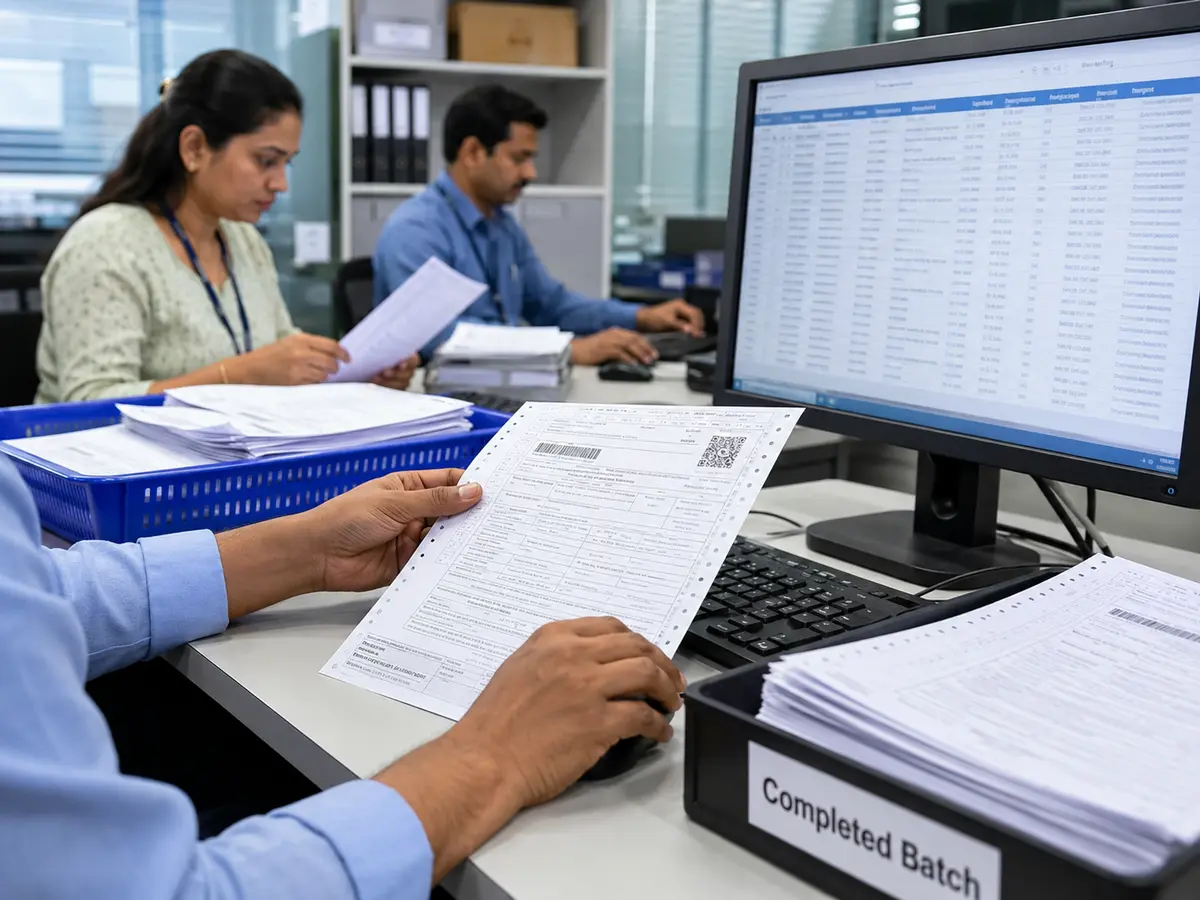
Shri Data Entry Services team working on Data Entry Services projects
5000+ Completed Projects
90% Returning Clients
16+ Years Experience
45+ Countries Served
50+ Professionals Team
Services We Offer

Data entry is successful when the destination is defined before the first value is captured

  • Source types and variations reviewed
  • Target fields mapped and documented
  • Permitted corrections separated from decisions
  • Mandatory values and formats confirmed
  • Quality checks matched to business consequence
  • Exceptions delivered with source references

A completed row is not automatically a usable record. Names may need a prescribed order, dates may require one format, identifiers may need leading zeroes and controlled fields may accept only approved values. If these requirements are discovered after production, the entire file can require rework.

We begin by understanding where the output will go and what the receiving process expects. A CRM import, product database, archive register and reporting workbook each impose different field, relationship and validation requirements. The source-to-destination map becomes the working basis for the project.

The same discipline protects meaning. Operators may standardise an approved date representation, but they should not invent a missing date. They may capture an invoice total, but they should not approve the invoice. They may record a category supplied by the client, but they should not make an unsupported policy decision to complete a blank field.

A broad service for mixed sources, recurring records and multi-department backlogs

Each capability is configured around the source, destination, authority and review requirements of the engagement.

01

Document-to-database entry

We capture defined fields from PDFs, images, forms, statements, reports and supplied business documents into spreadsheets, databases or import templates. Page references can be retained where the client needs to trace an entry back to its source.

02

Spreadsheet population and consolidation

Records from several workbooks or departmental files are mapped into one approved column structure. We preserve identifiers, flag conflicting versions and avoid treating a visually similar value as a verified match without an agreed rule.

03

CRM and operational record updates

Contacts, accounts, suppliers and other records can be added or maintained through an approved file or restricted system account. Possible duplicates, ownership changes and sensitive fields follow the client’s governance path.

04

Forms and questionnaire capture

Paper and digital form responses are entered according to the question code, option list and missing-response convention. Free-text comments remain faithful to the source unless editing is specifically authorised.

05

Product and catalog data support

Product identifiers, attributes, categories, variations and image references are prepared from authorised supplier or client sources. Unsupported claims and uncertain taxonomy decisions are returned to the merchandising owner.

06

Administrative and transaction-support records

Invoices, purchase documents, applications, logs and other operational records are captured for review or import. Approval, accounting, eligibility and policy decisions remain outside routine production entry.

07

Backlog conversion

Historical files are divided into controlled batches so urgent periods, departments or record types can move first. Batch notes show completed, held and excluded items instead of presenting the entire archive as uniformly processable.

08

Recurring data maintenance

Daily, weekly or monthly records can follow an agreed cut-off, source-release and delivery routine. Approved clarifications are added to the project instructions so the offshore workflow becomes more consistent over time.

Business System Compatibility

Data Entry Services: Direct Integration and Software Compatibility

Outputs are prepared around the field structure, controlled values and import requirements of your destination environment. Files can be delivered for review, staging or authorised import without forcing your team to rebuild the completed work.

Supported destinations

Structured output for the platforms your team already uses

Files are mapped to the client’s approved template, naming rules, identifiers and system structure before full production begins.

  • Microsoft ExcelControlled worksheets and import tables
  • Google SheetsShared review and operational files
  • SharePointLists, libraries and metadata columns
  • SalesforceCRM objects and approved fields
  • ERP / CRM SystemsClient-defined import templates
  • Custom SQLStaging and relational tables
Source continuity

References stay connected

Source IDs, filenames, record keys and approved relationships remain available for review and downstream traceability.

Import control

Fields are mapped before production

Mandatory fields, formats, controlled values, character limits and relationship keys are checked against the destination specification.

Pilot validation

Test the handoff with a representative batch

Rejected rows, unsupported values and mapping conflicts are returned with exact references so approved corrections can be incorporated before full-volume delivery.

Delivery formatsStructured for review, staging or import
  • CSV
  • XLSX
  • XML

Column order, encoding, date rules, multi-value handling and destination-specific requirements can follow the receiving system’s approved specification.

Compatibility means SDES prepares outputs to specifications supplied or approved by the client. Product names identify commonly used destination systems and do not imply endorsement, certification or partnership.

Process, Quality and Security

How a mixed-source data entry requirement becomes a controlled production process

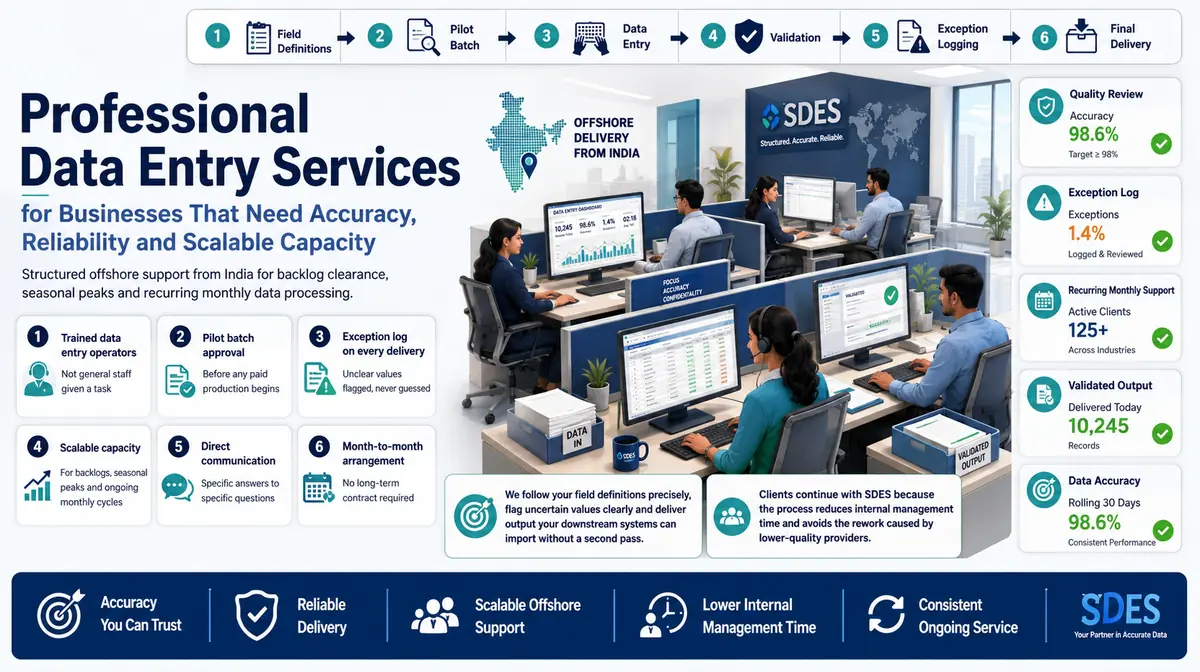
1. Establish the Destination

We identify the template, database, platform or operational use that the completed records must support. Required fields, formats and relationships are listed.

2. Profile the Sources

Representative files are reviewed for layout variation, readability, missing values, duplicate risk and recurring exception types.

3. Define Entry Authority

The client confirms which values may be standardised, which sources are trusted and which situations require an authorised decision.

4. Test the Field Map

A sample is processed against real files. Output usability, interpretation and exception notes are reviewed before the wider volume begins.

5. Run Batch Production and Review

Operators follow the approved guide while a separate review stage checks priority fields, missing requirements and instruction deviations.

6. Deliver Records and Exceptions

Clean output, held items and a batch summary arrive together. Approved feedback updates the instructions for the next release.

We organise the workflow around the record your next process needs

The input format does not determine the whole service. Field meaning, destination rules and decision ownership are equally important.

📂 Source formats we accept
  • PDFs, scanned images and photographed records
  • Excel, CSV and supplier spreadsheets
  • Digital forms and exported reports
  • Client portals, CRMs and approved databases
  • Target templates, field dictionaries and examples
📤 Delivery formats
  • Structured Excel or CSV files
  • Database and platform-ready import tables
  • Updated records in approved systems
  • Document or source-reference indexes
  • Exception registers and batch summaries

Representative files should include ordinary records and known difficult cases. Sampling only clean sources can produce an unrealistic estimate of processing effort, achievable accuracy and exception volume.

Quality requirements are confirmed by field and consequence. Identifiers, totals, dates, required relationships and controlled values may need different checks from narrative notes or low-risk descriptive fields.

Security begins with minimising the data and access involved. Files use the approved transfer route, direct-system permissions are restricted to agreed actions and retention requirements are documented before production.

No quality percentage, regulatory compliance status or security certification is implied without project-specific evidence. The quotation and operating instructions state the controls included for the engagement.

🔒 NDA Protected Before files are shared
🌐 GDPR Aware EU data handling
Defined Quality Target Confirmed by pilot
🛡️ Secure Transfer Encrypted file access
📋 Exception Log Every delivery
👥 Project Team Only Controlled access
Free accuracy test

Have several source types but one destination?

Share representative files, the target fields and the purpose of the completed record. We will identify whether one workflow can cover the requirement or whether specialist service paths should remain separate.

✓ No credit card required✓ No contract required✓ 24–48 hour return
Discuss the Data Workflow
Source sampleyour_sample_data.csv
Received
Verified deliveryverified_output.xlsx
Reviewed
▣ Encrypted transfer◉ Quality controlled
Why Outsource to SDES?

Why businesses use SDES for repeatable data work without transferring decision authority

Data Entry Services workflow and quality review
  • Project instructions written at field level
  • Trained operators assigned to suitable sources
  • Expert questions raised before they become batch-wide errors
  • Offshore capacity adjusted to actual volume
  • Source-linked exceptions kept outside clean output
  • One coordinator across connected data services

The purpose of a data entry outsourcing arrangement is to reduce routine production pressure without weakening control. Your process owners define the rules and review decisions. SDES supplies the trained capacity, documentation and quality stages needed to apply those rules consistently.

A broad data entry workflow is valuable when several departments or source formats feed one destination. If a task requires specialist handling—such as handwritten interpretation, logistics documents or complex Excel logic—we preserve that distinction rather than forcing it into a generic process. Clients can outsource connected production stages while keeping specialist review internal.

Start Your Project →
Industries We Support

Business records supported across distinct operating environments

eCommerce and Retail

Product, supplier, inventory and marketplace records prepared around catalog and platform rules.

Healthcare Administration

Forms and administrative records handled under approved privacy, access and escalation requirements.

Finance Operations

Invoice, statement and transaction-support fields captured while approval and accounting decisions remain internal.

Real Estate and Property

Listing, deed, title and portfolio information entered with document references retained.

Legal Operations

Matter, filing and contract records organised without replacing legal interpretation.

Logistics and Supply Chain

Shipment, carrier, proof-of-delivery and inventory records structured for operational use.

Case Studies

Relevant Project Experience

Multi-Department Operations Register

Project Name
Multi-Department Operations Register
Volume
7,994 records per month
Problem
Each department submitted a different spreadsheet, while the central database required one field structure and controlled status list. During the Multi-Department Operations Register in Australia review, without a controlled structure, the client could not separate records ready for use from those requiring an authorised decision.
Solution
A source map was defined for each department. Supported values entered the master template and conflicting statuses were routed to the responsible owner.
Outcome
The workflow created one predictable delivery file without allowing the offshore team to decide departmental conflicts. After completing Multi-Department Operations Register in Australia, the archive became easier to migrate, audit and retrieve without losing the link to the original source files.
Title
Business Operations Manager
Industry
Professional Services
Country
Australia

Supplier and Product Record Consolidation

Project Name
Supplier and Product Record Consolidation
Volume
73,592 records — completed in 6 weeks
Problem
Identifiers, units and attribute labels differed across the source files and could not be imported consistently. During the Supplier and Product Record Consolidation in United Kingdom review, without dependable product keys, routine updates could attach attributes, prices or assets to the wrong listing.
Solution
Exact identifiers and approved attribute mappings were applied; possible product matches and unsupported values remained in separate review queues. Within the Supplier and Product Record Consolidation in United Kingdom workflow, the team preserved supplier provenance and applied approved mappings only where the source supported the destination value.
Outcome
The delivery combined an import table, supplier clarification list and source-linked exceptions so the client could outsource repeatable consolidation safely. As a result of the Supplier and Product Record Consolidation in United Kingdom workflow, the client gained a repeatable catalog workflow in which ready records and supplier questions were clearly separated.
Title
Product Data Manager
Industry
eCommerce
Country
United Kingdom

Administrative Application Backlog

Project Name
Administrative Application Backlog
Volume
7,577 records — completed in 11 weeks
Problem
Internal specialists were spending review time locating and retyping basic application facts before assessment. Within Administrative Application Backlog in United States, the resulting uncertainty weakened segmentation and made routine follow-up more dependent on manual verification.
Solution
Routine fields were captured and indexed to the source package, while incomplete evidence and assessment questions stayed with client specialists. During production for Administrative Application Backlog in United States, representative searches were tested against the completed index to confirm that users could retrieve the intended source files.
Outcome
The expert reviewers received organised records and a focused exception queue instead of an unstructured backlog. Following delivery for Administrative Application Backlog in United States, cRM administrators received a clean import file plus a focused queue for duplicates, ownership questions and unsupported relationships.
Title
Programme Administration Lead
Industry
Business Services
Country
United States
FAQs

Questions about general data entry services

Which projects belong on the general Data Entry page rather than a specialist page?

Mixed-source, cross-department and broader record-capture requirements fit this service. Excel, online, offline, handwritten, logistics and document-specific work can use their dedicated workflows where those distinctions affect the method.

Will SDES complete missing values?

Only when an approved source and completion rule support the value. Unsupported or conflicting information is flagged for an authorised client decision.

Can the team work directly in our database or portal?

Potentially, using restricted permissions and approved actions. Access, audit, recovery and security requirements must be confirmed before production.

Which items are held for client review during Data Entry Services?

On Data Entry Services engagements, unreadable values, conflicting identifiers and decisions outside the approved guide are kept separate from clean structured document records. Every held item retains its source reference for the authorised reviewer.

📩 Request a Source Review
💬