India-Based Data Entry Outsourcing Support Serving USA, Canada, UK, Australia, Europe, New Zealand, Singapore, UAE
Pricing

A Reliable Data Entry Quote Starts With the Work Inside Each Record

Two files with the same row count can require very different amounts of work. A clean spreadsheet with six fixed fields is not comparable to a scanned document with handwriting, tables, missing references and values that must be checked against another source. That is why SDES does not publish a single promotional rate and pretend it fits every project.

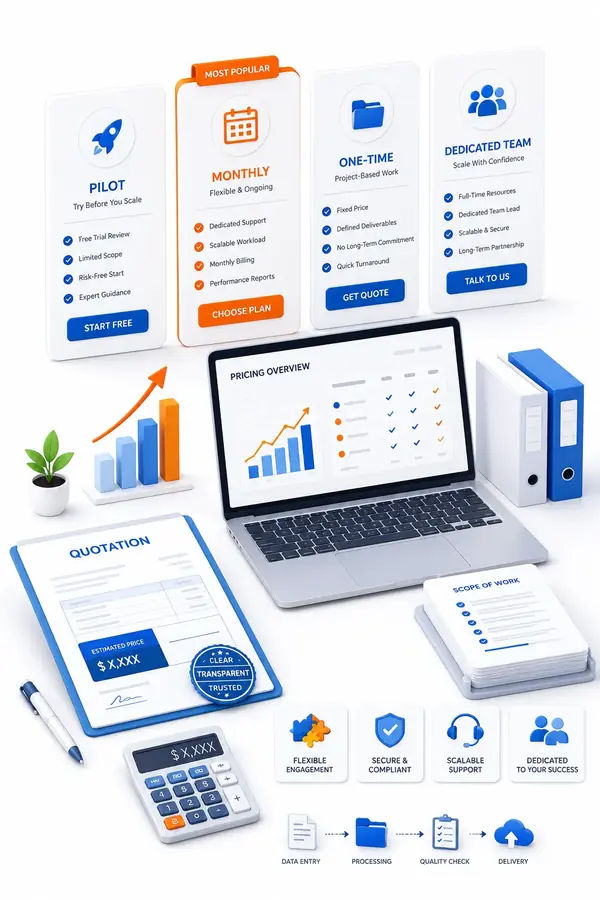
Our data entry services pricing is based on representative source files, the required output, field rules, review expectations, volume and delivery schedule. After examining those details, we recommend a per-record, hourly, batch or dedicated-capacity model and explain what the quotation includes.

This approach gives both teams a clearer commercial baseline. You know which assumptions support the price, and we know which source variations, corrections and exceptions belong within the agreed scope.

A professional quotation also distinguishes production from expert decisions. When you outsource repeatable work to an offshore team, the price should cover only the actions that team is authorised and equipped to perform.

Shri Data Entry Services team working on SDES Data Entry Pricing projects
5000+ Completed Projects
90% Returning Clients
16+ Years Experience
45+ Countries Served
50+ Professionals Team
Services We Offer

Price follows processing effort, review effort and delivery responsibility

  • Source readability and consistency
  • Number and type of fields
  • Validation and research requirements
  • Platform or template complexity
  • Exception frequency and decision path
  • Volume, schedule and turnaround

Source quality has an immediate effect on effort. Native spreadsheets and consistent digital forms can usually be processed faster than low-resolution images, mixed PDFs or handwritten records. If different source groups have different difficulty levels, they may be sampled and priced separately.

Field count is only one part of complexity. A short text field copied from a clear source is simpler than a product category selected from a controlled taxonomy, an invoice line checked against a purchase order or a contact compared with existing CRM accounts before creation.

Review requirements also matter. Some projects need format and completeness checks; others require source-to-output verification of priority fields, duplicate analysis, schema validation or a detailed exception register. The quotation should describe that quality work rather than hide it behind a vague rate.


✨ AI-Assisted

AI-assisted processing is one input into a small number of highly structured, high-volume projects, and where it applies it can shift the quote — typically less setup and review time on the repeatable portion of the work. It is confirmed during sample review, not assumed upfront, and it never replaces the human quality check before delivery.

Choose a pricing structure that matches how the work can be measured

The recommended model depends on whether records are consistent, variable, recurring or dependent on live-system activity.

01

Per-record pricing

Best suited to repeatable work with a stable source, defined fields and a consistent output. The record unit is agreed before production—for example, one form, product, invoice header, contact or indexed document. The rate reflects the fields and checks included in that unit.

02

Per-page or per-document pricing

Useful for conversion, transcription and indexing when page or document volume is more reliable than row count. Mixed page types, handwriting, tables and image quality are sampled so different effort bands can be identified before quotation.

03

Hourly pricing

Appropriate when processing time varies substantially, work takes place in a live platform, or the task includes investigation and multi-step navigation that cannot be represented fairly by one record rate. Activity and completed output should remain visible.

04

Fixed batch or project pricing

Suitable for a defined backlog with known sources, volume, output and acceptance conditions. The quotation states the included scope and how material changes—such as a new source type or extra validation—will be handled before additional work begins.

05

Recurring capacity pricing

Designed for weekly or monthly workflows where the client needs predictable availability rather than a one-time batch. Capacity, expected volume range, cut-off times, included activities and unused or excess workload rules are documented.

06

Pilot or paid discovery

A limited sample may be used to confirm interpretation and estimate production effort. Complex migrations, unfamiliar systems or highly variable sources may require a separately scoped discovery stage before a responsible full-project price can be issued.

Business System Compatibility

Data Entry Services Pricing: Direct Integration and Software Compatibility

Outputs are prepared around the field structure, controlled values and import requirements of your destination environment. Files can be delivered for review, staging or authorised import without forcing your team to rebuild the completed work.

Supported destinations

Structured output for the platforms your team already uses

Files are mapped to the client’s approved template, naming rules, identifiers and system structure before full production begins.

  • Microsoft ExcelControlled worksheets and import tables
  • Google SheetsShared review and operational files
  • SharePointLists, libraries and metadata columns
  • SalesforceCRM objects and approved fields
  • ERP / CRM SystemsClient-defined import templates
  • Custom SQLStaging and relational tables
Source continuity

References stay connected

Source IDs, filenames, record keys and approved relationships remain available for review and downstream traceability.

Import control

Fields are mapped before production

Mandatory fields, formats, controlled values, character limits and relationship keys are checked against the destination specification.

Pilot validation

Test the handoff with a representative batch

Rejected rows, unsupported values and mapping conflicts are returned with exact references so approved corrections can be incorporated before full-volume delivery.

Delivery formatsStructured for review, staging or import
  • CSV
  • XLSX
  • XML

Column order, encoding, date rules, multi-value handling and destination-specific requirements can follow the receiving system’s approved specification.

Compatibility means SDES prepares outputs to specifications supplied or approved by the client. Product names identify commonly used destination systems and do not imply endorsement, certification or partnership.

Process, Quality and Security

How SDES prepares a project-specific quotation

1. Review Representative Sources

We examine ordinary records and known difficult cases rather than pricing only the cleanest examples.

2. Define the Processing Unit

The parties agree what counts as a record, page, item, hour, batch or capacity period.

3. Map the Required Work

Entry, correction, validation, research, review, exception reporting and platform actions are listed.

4. Test Interpretation

A sample confirms field rules, source variation, output format and likely exception rate.

5. Issue the Quotation

The proposed rate, assumptions, included volume, schedule, invoicing and change conditions are documented.

6. Approve Before Production

Production begins only after the client confirms scope, commercial terms and any access or security requirements.

A quotation should state what is included, not just show a number

📂 Source formats we accept
  • Representative easy and difficult source samples
  • Target template or platform fields
  • Expected volume and arrival pattern
  • Validation and exception rules
  • Required delivery dates and review method
📤 Delivery formats
  • Written scope and commercial model
  • Included processing and review activities
  • Assumptions and source conditions
  • Delivery and invoicing schedule
  • Change-control and exception boundaries
Free accuracy test

Want a price that reflects your actual files?

Send representative source samples, the target format, approximate volume and deadline. Include difficult examples so the quotation accounts for the real workload rather than an ideal record.

✓ No credit card required✓ No contract required✓ 24–48 hour return
Request a Pricing Review
Source sampleyour_sample_data.csv
Received
Verified deliveryverified_output.xlsx
Reviewed
▣ Encrypted transfer◉ Quality controlled
Why Outsource to SDES?

What a responsible data entry quotation should make clear

SDES Data Entry Pricing workflow and quality review
  • What counts as one billable unit
  • Which fields and checks are included
  • How exceptions are handled
  • Which source conditions were assumed
  • What triggers a scope change
  • When invoices and deliveries occur

A low headline rate may exclude validation, difficult sources, corrections or exception reporting. Comparing quotations is easier when each provider describes the processing unit and included quality activities in the same level of detail.

The most affordable solution is the one that produces usable output with a reasonable amount of client review. Price per record matters, but so do correction effort, management time and the consequence of incorrect changes.

An expert commercial review will sometimes recommend a paid discovery stage or a smaller scope before full production. That is a more professional approach than offering an artificially low fixed price without understanding the offshore workflow.

Start Your Project →
Industries We Support

Pricing factors differ across operational workflows

eCommerce Catalogs

Category mapping, attributes, variations, images and platform validation affect effort per SKU.

Healthcare Administration

Access controls, source variation, priority identifiers and authorised review shape the workflow.

Finance Operations

Line items, coding rules, matching and exception treatment influence the processing unit.

Legal and Property

Document length, metadata depth, jurisdiction and source legibility affect indexing cost.

Logistics

Daily cut-offs, document types and system entry steps determine required capacity.

Research and CRM

Source verification, qualification criteria and duplicate checks affect time per usable record.

Case Studies

Relevant Project Experience

Consistent Product File Population

Project Name
Consistent Product File Population
Volume
44,363 records — completed in 12 weeks
Problem
The client needed budget certainty for repeatable SKU records with the same attribute structure.
Solution
A record unit was defined to include field population, image-reference checks and format validation; taxonomy decisions remained outside scope.
Outcome
A per-record model gave the client a transparent way to forecast each approved batch.
Title
Catalog Commercial Manager
Industry
eCommerce
Country
United Kingdom

Variable Historical Document Indexing

Project Name
Variable Historical Document Indexing
Volume
32,161 records — completed in 9 weeks
Problem
Document length, legibility and metadata availability varied too widely for one fair record rate.
Solution
The sources were grouped by difficulty and priced by page or document band with exception reporting included.
Outcome
The quotation reflected source variation without applying the difficult-file rate to the entire archive.
Title
Archive Programme Manager
Industry
Professional Services
Country
Australia

Recurring CRM Maintenance Window

Project Name
Recurring CRM Maintenance Window
Volume
35,547 records per month
Problem
The client needed dependable availability, but the number and complexity of updates changed each week.
Solution
A recurring-capacity model defined the operating window, included actions, expected range and treatment of excess work.
Outcome
The commercial structure matched service availability rather than forcing every CRM action into one artificial unit.
Title
Revenue Systems Manager
Industry
Business Software
Country
United States
Client Feedback

What Clients Say About Our Work

4.5/5

The quotation was easy to understand because clean catalogue records were separated from supplier files needing extra review. We could see exactly what assumptions sat behind the price. We genuinely appreciated the high quality and attention to detail.

Thomas E. Commercial Operations Manager · United Kingdom
4.0/5

Our archive contains everything from clean forms to damaged scans, so one flat rate never made sense. The scope explained the unit, checks and treatment of difficult pages clearly. Delivery was on time, and the communication remained clear throughout.

Grace Y. Archive Programme Manager · Australia
4.5/5

The weekly-capacity model gives us a dependable delivery window without locking us into undefined work. New request types and excess volume are discussed before they affect cost. Very good value for money—we would confidently outsource this work to SDES again.

Caleb N. Revenue Systems Manager · United States
FAQs

Questions about SDES pricing

Why are fixed rates not published on this page?

Source quality, fields, validation, platform steps and turnaround can change processing effort materially. A sample-based quotation is more accurate than a rate detached from the work.

Is per-record pricing always the lowest-cost option?

No. It works well for consistent records, but hourly, batch or recurring-capacity pricing can be fairer when work is variable or system-based.

Can you quote from screenshots instead of production files?

Screenshots can support an early discussion, but representative files and target fields are usually needed before a firm quotation.

What happens if the full batch differs from the sample?

Material differences are discussed before affected work proceeds. The agreed quotation should state assumptions and the change-control approach.

Are security and review included in the price?

The quotation identifies the handling and quality activities included. Additional controls or specialised expert review may affect scope and cost.

📩 Request a Project Quote
💬