India-Based Data Entry Outsourcing Support Serving USA, Canada, UK, Australia, Europe, New Zealand, Singapore, UAE
Data Extraction Services

Data Extraction Services That Pull Defined Facts Without Losing Their Source Context

The challenge in extraction is not simply locating a number. The value may belong to a particular entity, unit, date, table row or footnote. Once that relationship is lost, a technically accurate transcription can become operationally misleading.

Different sources demand different treatment. Multi-page tables need continuation rules, poor images may need OCR plus review and database fields may depend on joins or filters. SDES builds a professional field map for each source family, then assigns offshore capacity where the structure is stable enough for repeatable work.

Archives and recurring capture can be outsourced without delegating interpretation. Low-confidence text, broken table relationships and conflicting labels move to expert review. The extraction solution delivers structured values together with the page, record or source context needed to verify them.

Shri Data Entry Services team working on Data Extraction Services projects
5000+ Completed Projects
90% Returning Clients
16+ Years Experience
45+ Countries Served
50+ Professionals Team
Services We Offer

Extracted data remains useful when it can be traced back to the source

  • Source types and layouts profiled
  • Target fields and relationships defined
  • Page and record references retained
  • OCR and manual review roles separated
  • Repeating tables mapped correctly
  • Low-confidence values held

A value can be copied accurately and still lose meaning if its label, unit, date, entity or table row is detached. Extraction design should preserve the relationship that makes the field interpretable.

Documents often contain repeated headers, footnotes, merged cells and multi-page tables. Images can be skewed or unclear. Databases may require joins or filters. Representative samples are used to identify these structures before production.

OCR data extraction can accelerate suitable printed sources, but recognition output is not treated as final evidence. Priority fields and low-confidence values receive the agreed human checks, while illegible content remains flagged.
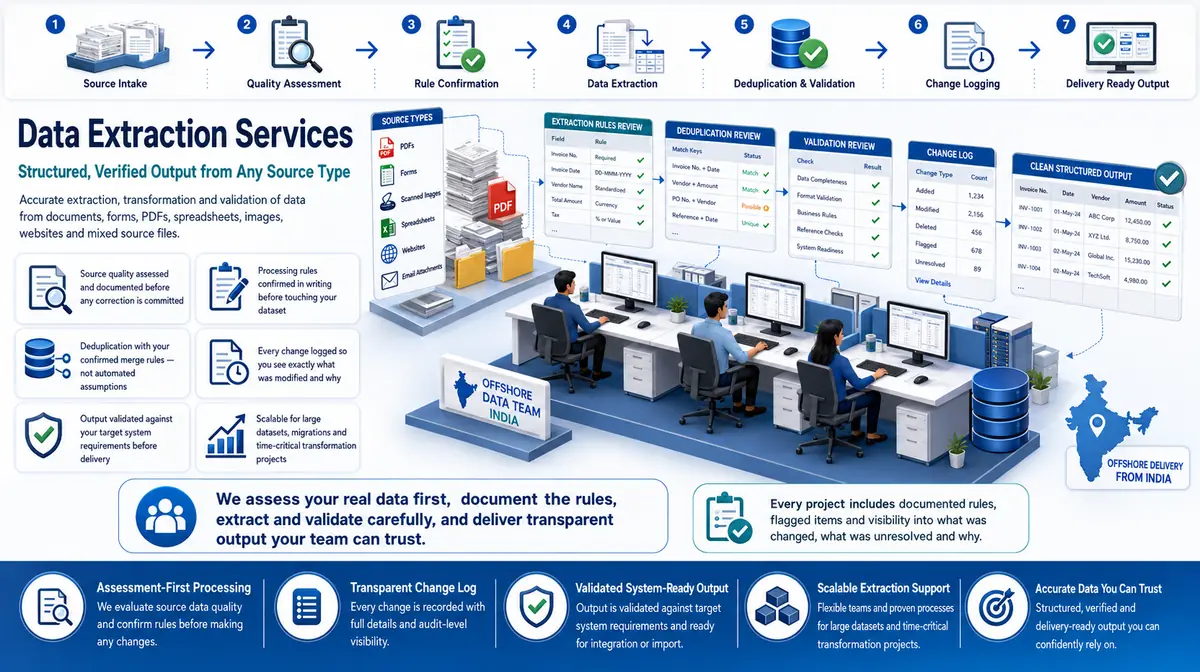

Defined field capture from documents, images, tables, databases and systems

The source structure and downstream purpose determine the extraction method and review level.

01

Document and PDF data extraction

Defined fields, headings and references are captured from reports, forms, statements and supplied PDFs.

02

Image and OCR extraction

Printed information is recognised and reviewed, with low-confidence or ambiguous values separated from accepted output.

03

Table data extraction

Rows, columns, units, headers and continuation relationships are reconstructed across pages or source sections.

04

Invoice data extraction

Approved supplier, date, reference, line and total fields are captured without performing accounting approval.

05

Database extraction

Authorised tables, fields, filters and joins are exported or prepared under client-defined system and data rules.

06

Structured and unstructured extraction

Narrative and semi-structured sources are mapped to defined fields without inventing unsupported categories.

Document System Compatibility

Data Extraction Services: Direct Integration and Software Compatibility

Outputs are prepared around the field structure, controlled values and import requirements of your destination environment. Files can be delivered for review, staging or authorised import without forcing your team to rebuild the completed work.

Supported destinations

DMS-compatible files and metadata for searchable repositories

Files are mapped to the client’s approved template, naming rules, identifiers and system structure before full production begins.

  • SharePointLibraries and metadata columns
  • OpenTextEnterprise content repositories
  • iManageLegal matter workspaces
  • NetDocumentsCloud document profiles
  • AlfrescoContent models and properties
  • Custom SQLStaging and relational tables
Source continuity

References stay connected

Source IDs, filenames, record keys and approved relationships remain available for review and downstream traceability.

Import control

Fields are mapped before production

Mandatory fields, formats, controlled values, character limits and relationship keys are checked against the destination specification.

Pilot validation

Test the handoff with a representative batch

Rejected rows, unsupported values and mapping conflicts are returned with exact references so approved corrections can be incorporated before full-volume delivery.

Delivery formatsStructured for review, staging or import
  • CSV
  • XLSX
  • XML

Column order, encoding, date rules, multi-value handling and destination-specific requirements can follow the receiving system’s approved specification.

Compatibility means SDES prepares outputs to specifications supplied or approved by the client. Product names identify commonly used destination systems and do not imply endorsement, certification or partnership.

Process, Quality and Security

How complex source material becomes a controlled field-level dataset

1. Profile the Sources

Layouts, quality, structure, variation and access constraints are reviewed.

2. Map Fields and Relationships

Labels, units, repeating groups and target fields are defined.

3. Choose Capture and Review

Manual entry, OCR, parsing and review roles are assigned by source and consequence.

4. Pilot Difficult Layouts

A sample tests tables, page continuations, ambiguity and low-quality images.

5. Extract and Validate

Accepted, low-confidence, missing and structurally invalid values remain separate.

6. Reconcile to Sources

Record counts, totals where applicable and source references are checked before delivery.

Extraction output should show how each value relates to the original source

A page, record or source reference provides the evidence needed for review and correction.

📂 Source formats we accept
  • PDF and image files
  • Database tables or exports
  • Field dictionary
  • Sample target format
  • Source hierarchy
  • Confidence and review rules
📤 Delivery formats
  • Structured extraction file
  • Source reference fields
  • Table reconstruction
  • Low-confidence queue
  • Missing-field log
  • Batch reconciliation

Pilot sources should include layout changes, repeated tables, handwritten annotations, poor scans, blank fields and conflicting labels.

Checks cover field label, entity, unit, date, relationship, source reference and confidence. A filled field is not accepted when the supporting source is unclear.

Source files, system access and extracted data are limited to the agreed task. Sensitive fields can be excluded or masked when they are unnecessary.

OCR and automated parsing results vary by source quality. The scope states where human review is applied rather than promising uniform performance across every layout.

🔒 NDA Protected Before files are shared
🌐 GDPR Aware EU data handling
Defined Quality Target Confirmed by pilot
🛡️ Secure Transfer Encrypted file access
📋 Exception Log Every delivery
👥 Project Team Only Controlled access
Free accuracy test

Which facts need to be separated from your documents or systems?

Share representative redacted sources, required fields and the destination format. We will identify structure, confidence and review requirements.

✓ No credit card required✓ No contract required✓ 24–48 hour return
Discuss Data Extraction
Source sampleyour_sample_data.csv
Received
Verified deliveryverified_output.xlsx
Reviewed
▣ Encrypted transfer◉ Quality controlled
Why Outsource to SDES?

Why businesses outsource extraction production while retaining interpretation

Data Extraction Services workflow and quality review
  • Professional field mapping
  • Expert escalation for ambiguous structures
  • Offshore capacity for large archives
  • Source references retained
  • OCR output reviewed by risk
  • Client owns interpretation

A data extraction solution should reduce manual retrieval without hiding uncertainty. SDES retains relevant source context and keeps low-confidence values outside clean output.

The client retains accounting, legal, clinical and analytical interpretation. Our team applies the approved field map, allowing organisations to outsource extraction work without converting production capture into unsupported judgement.

Start Your Project →
Industries We Support

Extraction adapted to the structure of each record family

Finance Administration

Invoices, statements and transaction-support fields.

Healthcare Administration

Approved document fields under privacy and clinical boundaries.

Legal Operations

Matter, filing and contract fields without legal interpretation.

Property

Lease, deed, inspection and portfolio information.

Manufacturing

Supplier, asset, quality and maintenance records.

Retail

Product tables, catalogues and supplier sheets.

Case Studies

Relevant Project Experience

Multi-Page Supplier Table Extraction

Project Name
Multi-Page Supplier Table Extraction
Volume
11,098 records — completed in 6 weeks
Problem
Tables continued across pages with changing headers and units.
Solution
Table structures and continuation rules were mapped; unmatched rows and units entered review.
Outcome
The proposed offshore workflow produced source-linked product tables without flattening uncertain relationships.
Title
Product Data Manager
Industry
Manufacturing
Country
Germany

Invoice Field Capture Queue

Project Name
Invoice Field Capture Queue
Volume
36,940 records per month
Problem
Supplier layouts varied and several totals included adjustments not consistently labelled.
Solution
Supported header, line and total fields were extracted while accounting interpretation stayed with finance.
Outcome
The professional AP team received structured facts and a focused ambiguity queue.
Title
Accounts Operations Lead
Industry
Distribution
Country
Australia

Property Document Index Dataset

Project Name
Property Document Index Dataset
Volume
66,511 records — completed in 12 weeks
Problem
Asset references and effective dates appeared in different document sections.
Solution
Approved fields retained page references, while conflicting dates went to expert property reviewers.
Outcome
The extraction solution created a traceable register without deciding document precedence.
Title
Portfolio Information Director
Industry
Real Estate
Country
United Kingdom
FAQs

Questions about data extraction

Is OCR used for every document?

No. The method depends on source quality, layout, volume and field consequence. OCR may assist suitable sources while manual or additional review handles difficult content.

Can page references be retained?

Yes. Page, file, record or source identifiers can be included where traceability is required and available.

Can data be extracted directly from a database?

Potentially, using authorised tables, queries, filters and access. System ownership and permissions must be confirmed before extraction.

Which items are held for client review during Data Extraction Services?

Data Extraction Services work separates unreadable values, conflicting identifiers, unsupported classifications and out-of-guide decisions from clean research and collected data. The source reference for each held item stays attached for review.

📩 Review an Extraction Sample
💬