India-Based Data Entry Outsourcing Support Serving USA, Canada, UK, Australia, Europe, New Zealand, Singapore, UAE
Data Collection Services

Data Collection Services That Build a Dataset Around a Defined Question and Evidence Standard

The first record in a collection project should not be gathered until the final dataset has a purpose. A list built for market sizing needs different inclusion evidence from a supplier directory, a product monitor or a survey-response file—even when several fields appear identical.

We turn that purpose into a collection protocol: the entity, geographic and time boundaries, approved sources, required evidence and missing-value statuses. Professional collectors then work across market, company, product, directory or survey sources, with offshore capacity added according to the source volume and refresh cycle.

A client may outsource the repeatable search and capture while keeping research interpretation internal. Borderline entities and conflicting evidence are not forced into a clean row. Expert reviewers receive a dataset solution that shows what qualified, what was excluded and what still needs a decision.

Shri Data Entry Services team working on Data Collection Services projects
5000+ Completed Projects
90% Returning Clients
16+ Years Experience
45+ Countries Served
50+ Professionals Team
Services We Offer

A collection project should explain why every entity and field is included

  • Research question documented
  • Population and exclusion rules defined
  • Source rights and authority reviewed
  • Field evidence standard agreed
  • Freshness and geography represented
  • Missing values distinguished from no result

A large dataset is not automatically a relevant dataset. If a market study concerns active distributors in a defined region, inactive entities, adjacent industries and unverified locations can distort the result even when their individual fields are accurate.

The collection brief defines the entity, inclusion criteria, exclusions, sources, fields and evidence. It also explains how to record a value that cannot be found, conflicts across sources or appears outdated. A blank, a negative finding and an unresolved search should not share one status.

Market research data collection and competitor data collection may use the same public website but answer different questions. One workflow might capture company size and location; another might collect product ranges and public pricing. The purpose controls the field design.
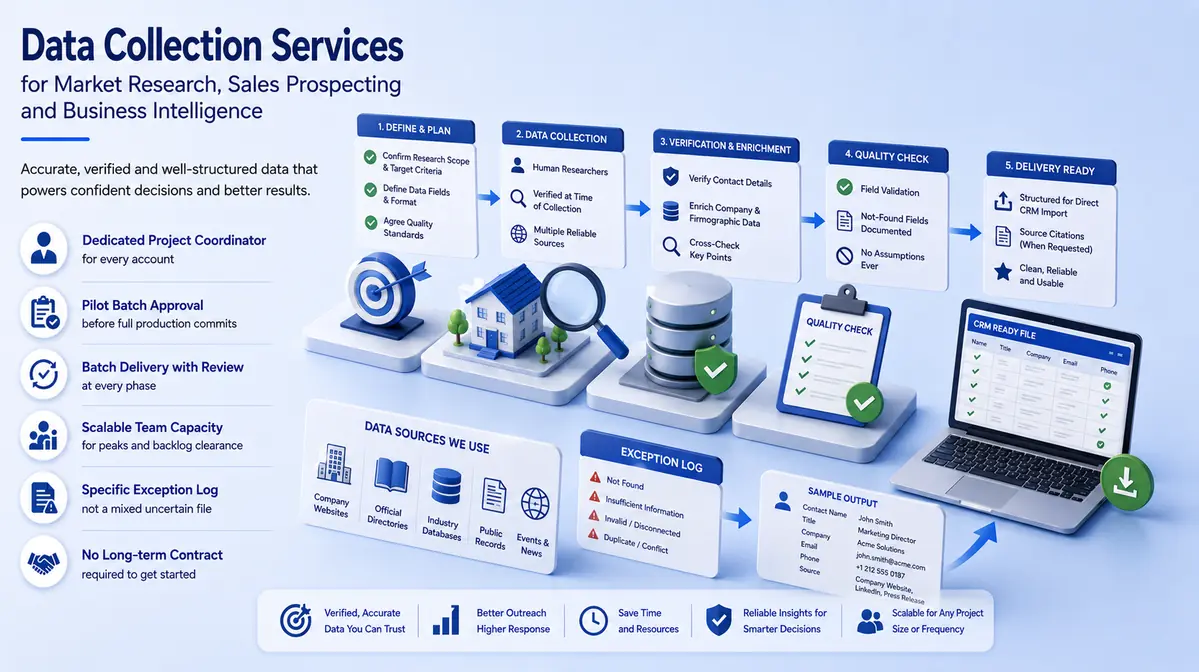
Structured gathering across market, company, product, directory and survey contexts

Every collection stream uses a source list, inclusion rule and evidence requirement appropriate to its purpose.

01

Business and company data collection

Approved company facts, locations, classifications and public operating details are captured with source and date evidence.

02

Market research data collection

Defined entities, market attributes and observable indicators are compiled for client analysis without converting facts into strategic conclusions.

03

Product and competitor data collection

Public product, feature, availability and pricing facts are gathered from permitted sources using comparable field definitions.

04

Directory data collection

Listings are screened against inclusion criteria, deduplicated as candidates and structured into client-approved fields.

05

Survey data collection support

Approved survey responses and metadata are compiled using question codes, missing-response rules and submission references.

06

Recurring web data collection

Specified sources are revisited on an agreed schedule, with collection dates and detected changes retained.

Research Tool Compatibility

Data Collection Services: Direct Integration and Software Compatibility

Outputs are prepared around the field structure, controlled values and import requirements of your destination environment. Files can be delivered for review, staging or authorised import without forcing your team to rebuild the completed work.

Supported destinations

Structured datasets for research, analysis and enrichment tools

Files are mapped to the client’s approved template, naming rules, identifiers and system structure before full production begins.

  • Microsoft ExcelControlled research workbooks
  • Google SheetsShared review datasets
  • SPSSCoded variable structures
  • QualtricsSurvey response imports
  • AirtableLinked research records
  • Custom SQLAnalysis-ready tables
Source continuity

References stay connected

Source IDs, filenames, record keys and approved relationships remain available for review and downstream traceability.

Import control

Fields are mapped before production

Mandatory fields, formats, controlled values, character limits and relationship keys are checked against the destination specification.

Pilot validation

Test the handoff with a representative batch

Rejected rows, unsupported values and mapping conflicts are returned with exact references so approved corrections can be incorporated before full-volume delivery.

Delivery formatsStructured for review, staging or import
  • CSV
  • XLSX
  • TSV

Column order, encoding, date rules, multi-value handling and destination-specific requirements can follow the receiving system’s approved specification.

Compatibility means SDES prepares outputs to specifications supplied or approved by the client. Product names identify commonly used destination systems and do not imply endorsement, certification or partnership.

Process, Quality and Security

How a research question becomes a repeatable collection protocol

1. Define the Question

The intended decision, audience and limitations of the dataset are recorded.

2. Set Population Boundaries

Entities, geography, period, inclusions and exclusions are made testable.

3. Approve Sources and Evidence

Permitted sources, field support and collection-date requirements are confirmed.

4. Pilot Borderline Cases

A sample tests ambiguous entities, conflicting values and unavailable information.

5. Collect in Controlled Batches

Included, excluded, held and no-result records remain separate through production.

6. Review Coverage and Drift

Source access, missingness, exceptions and approved protocol changes are reported.

Collection evidence should travel with the data

A value without a source, date and scope context may be difficult to defend or refresh.

📂 Source formats we accept
  • Research question
  • Entity and inclusion definition
  • Approved source list
  • Field dictionary
  • Geography and time window
  • Validation and evidence rules
📤 Delivery formats
  • Structured dataset
  • Source URL register
  • Collection timestamps
  • Missing and conflicting evidence log
  • Candidate duplicate list
  • Coverage summary

Pilot samples should include near-boundary entities, missing fields, conflicting sources, inaccessible pages and genuine negative findings.

Validation distinguishes source-supported facts, formatted values, researched values and unresolved evidence. Coverage is not improved by filling a field without support.

Collection uses client-approved sources and access methods. Authentication, restricted content, personal information and prohibited automation require separate review.

No dataset is described as exhaustive unless the population and coverage evidence justify that claim. The delivery records known limitations and the collection period.

🔒 NDA Protected Before files are shared
🌐 GDPR Aware EU data handling
Defined Quality Target Confirmed by pilot
🛡️ Secure Transfer Encrypted file access
📋 Exception Log Every delivery
👥 Project Team Only Controlled access
Free accuracy test

What business question should the dataset support?

Share the entity, geography, period, required fields and example sources. We will help translate the requirement into a testable collection brief.

✓ No credit card required✓ No contract required✓ 24–48 hour return
Discuss Data Collection
Source sampleyour_sample_data.csv
Received
Verified deliveryverified_output.xlsx
Reviewed
▣ Encrypted transfer◉ Quality controlled
Why Outsource to SDES?

Why teams outsource evidence-led collection while retaining research interpretation

Data Collection Services workflow and quality review
  • Professional collection protocols
  • Expert review of boundary cases
  • Offshore capacity for large source sets
  • Source and date retained
  • Missingness represented honestly
  • Client owns analysis and decisions

A data collection solution should be reproducible. SDES records what was searched, which evidence supported the value and why an entity was included, excluded or held.

The client retains research design, interpretation and decision-making. Our team applies the approved protocol, allowing organisations to outsource data gathering services without presenting production work as independent market advice.

Start Your Project →
Industries We Support

Collection programmes shaped by different evidence needs

Market Research

Companies, categories, locations and observable market indicators.

Retail and eCommerce

Products, availability, features and public pricing facts.

Manufacturing

Suppliers, distributors, products and operating locations.

Property

Listings, developments, agencies and public market records.

Education

Institutions, programmes and publicly available course information.

B2B Technology

Companies, products, roles and public ecosystem information.

Case Studies

Relevant Project Experience

Regional Distributor Landscape

Project Name
Regional Distributor Landscape
Volume
26,161 records — completed in 8 weeks
Problem
Directory entries mixed manufacturers, resellers, inactive firms and unrelated service providers.
Solution
Inclusion evidence, operating region and business role were captured from approved sources; borderline entities entered review.
Outcome
The proposed offshore workflow produced a source-linked population without presenting it as expert market interpretation.
Title
Research Programme Lead
Industry
Industrial Technology
Country
Germany

Public Product Feature Monitor

Project Name
Public Product Feature Monitor
Volume
31,950 pages per month
Problem
Product families and option labels changed frequently, making direct comparisons inconsistent.
Solution
Comparable fields and collection dates were defined, while unmatched features remained in a separate evidence queue.
Outcome
The professional product team received a refreshable dataset and visible definition gaps.
Title
Product Intelligence Manager
Industry
eCommerce
Country
United Kingdom

Education Programme Directory

Project Name
Education Programme Directory
Volume
77,466 records — completed in 10 weeks
Problem
Course pages used different terminology and several listings lacked clear active dates.
Solution
Approved programme, location and delivery fields were collected; uncertain availability returned to client reviewers.
Outcome
The resulting solution preserved source context and allowed the client to decide publication eligibility.
Title
Programme Data Director
Industry
Education
Country
Australia
FAQs

Questions about data collection services

Can SDES decide which companies belong in the dataset?

Only by applying client-approved inclusion and exclusion rules. Borderline entities are returned with evidence for an authorised research decision.

Do you record where each value came from?

Source URL, document reference and collection date can be retained when required by the protocol and permitted by the source.

Is a blank field the same as information not existing?

No. Not found, not applicable, inaccessible, conflicting and genuinely absent should use separate statuses when those distinctions matter.

Which items are held for client review during Data Collection Services?

On Data Collection Services engagements, unreadable values, conflicting identifiers and decisions outside the approved guide are kept separate from clean research and collected data. Every held item retains its source reference for the authorised reviewer.

📩 Review a Collection Brief
💬