India-Based Data Entry Outsourcing Support Serving USA, Canada, UK, Australia, Europe, New Zealand, Singapore, UAE
Medical Forms Scanning Services

Medical Forms Scanning That Preserves Page Completeness, Legibility and Record Context

A scanned medical form is useful only when every relevant page is present, readable, correctly oriented and connected to the appropriate batch or patient reference. Our professional medical forms scanning services control those fundamentals before a digital file reaches an archive or healthcare system.

An expert setup review confirms document custody, approved transport, preparation rules, image settings, colour requirements, duplex handling, file naming, indexing fields, retention and exception ownership. The delivery team then digitises authorised forms while clinical interpretation, patient matching exceptions and disposal authority remain with the client.

Healthcare organisations outsource backlog conversion and recurring scanning when paper volume obstructs retrieval or migration. The solution delivers quality-checked images, document indexes and a separate queue for missing pages, illegible marks, uncertain identifiers and damaged originals.

Shri Data Entry Services team working on Medical Forms Scanning Services projects
5000+ Completed Projects
90% Returning Clients
16+ Years Experience
45+ Countries Served
50+ Professionals Team
Services We Offer

Verify sequence, sides, attachments and identifiers—not resolution alone

  • Custody logged
  • Staples and folds checked
  • Duplex rule applied
  • Page count reconciled
  • Identifier verified
  • Original disposition approved

Patient packets may contain double-sided pages, small labels, attached cards, handwritten additions or several form types under one cover sheet. Missing a reverse side or joining two patients into one PDF creates a record problem that image enhancement cannot fix.

We document receipt and preparation, then capture under approved settings for the source material. Quality review checks page count, orientation, clipping, readability, blank-page treatment and the relationship between image files and index records.

Dedicated offshore capacity supports high-volume conversion. The documented workflow keeps damaged, unidentified and clinically ambiguous material outside completed batches until qualified client personnel resolve it.
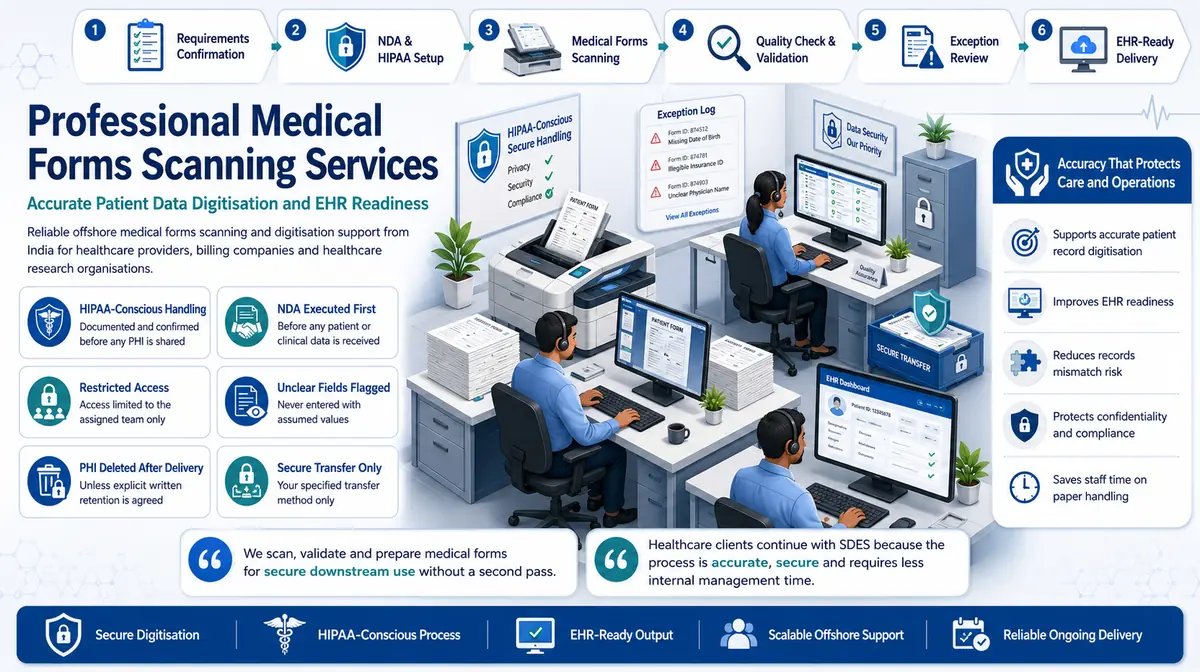

Healthcare documents digitised from controlled receipt through indexed delivery

The client’s custody, privacy, image, indexing and retention requirements control each batch.

01

Secure receipt and document preparation

Authorised batches are logged by container, folder or client reference. Staples, clips, folds, labels, small attachments and page condition are handled under documented preparation rules, with damaged items recorded.

02

Patient and administrative form scanning

Intake, registration, insurance, consent, authorisation, referral and other approved forms are captured at the required colour, resolution and duplex settings. Source order is retained unless a different arrangement is authorised.

03

Clinical and historical document digitisation

Approved chart pages, reports, correspondence and legacy records are scanned without interpreting their clinical content. Special sizes, faint originals and mixed media receive separate capture or exception treatment.

04

Image enhancement and readability review

Permitted deskewing, rotation, cropping, contrast and background cleanup improve usability without altering substantive marks. Faint handwriting, obscured text and incomplete signatures are flagged rather than reconstructed.

05

Document separation, naming and indexing

Multi-form packets are separated under approved document rules and named using patient, form, date, provider, location or batch metadata. Uncertain identifiers block final patient association.

06

OCR-assisted capture and delivery validation

OCR may support searchable files or selected field capture, but extracted text is reviewed against the image where required. File counts, index rows, checksums or other approved controls are reconciled before delivery.

Document System Compatibility

Medical Forms Scanning Services: Direct Integration and Software Compatibility

Outputs are prepared around the field structure, controlled values and import requirements of your destination environment. Files can be delivered for review, staging or authorised import without forcing your team to rebuild the completed work.

Supported destinations

DMS-compatible files and metadata for searchable repositories

Files are mapped to the client’s approved template, naming rules, identifiers and system structure before full production begins.

  • SharePointLibraries and metadata columns
  • OpenTextEnterprise content repositories
  • iManageLegal matter workspaces
  • NetDocumentsCloud document profiles
  • AlfrescoContent models and properties
  • Custom SQLStaging and relational tables
Source continuity

References stay connected

Source IDs, filenames, record keys and approved relationships remain available for review and downstream traceability.

Import control

Fields are mapped before production

Mandatory fields, formats, controlled values, character limits and relationship keys are checked against the destination specification.

Pilot validation

Test the handoff with a representative batch

Rejected rows, unsupported values and mapping conflicts are returned with exact references so approved corrections can be incorporated before full-volume delivery.

Delivery formatsStructured for review, staging or import
  • CSV
  • XLSX
  • XML

Column order, encoding, date rules, multi-value handling and destination-specific requirements can follow the receiving system’s approved specification.

Compatibility means SDES prepares outputs to specifications supplied or approved by the client. Product names identify commonly used destination systems and do not imply endorsement, certification or partnership.

Process, Quality and Security

A medical scanning workflow from documented custody to verified digital handoff

1. Log Receipt and Custody

Containers, folders, counts, authorised scope, handling, return and retention requirements are recorded.

2. Prepare and Classify Sources

The setup review applies page preparation, duplex, attachment, document separation and exception rules.

3. Pilot Mixed Document Types

Faint, coloured, double-sided, small-format, damaged and multi-form examples test capture settings.

4. Scan and Index Batches

The delivery team captures approved pages and maintains document, patient and batch relationships.

5. Inspect Images and Coverage

Legibility, clipping, orientation, sequence, blank pages, file counts and index agreement are checked.

6. Deliver and Resolve Custody

Approved files, indexes and exceptions are transferred, while originals follow authorised disposition.

📂 Source formats we accept
  • Authorised paper forms and chart batches
  • Custody and transport instructions
  • Scanning resolution, colour and file standards
  • Document separation and blank-page rules
  • File naming and indexing schema
  • Retention, return, destruction and exception authority
📤 Delivery formats
  • Quality-checked PDF, TIFF or image files
  • Searchable OCR files where approved
  • Document and patient index
  • Batch custody and coverage register
  • Image quality report
  • Missing, damaged, illegible and identity exception log

Quality checks cover custody reference, page count, front and reverse capture, resolution, colour mode, orientation, clipping, readability, blank-page handling, sequence, file name, index values and agreement between source, image and delivery totals.

OCR confidence does not establish clinical or legal accuracy. Where searchable text or field extraction is included, relevant values are checked against the image and uncertain text remains flagged.

The production team prepares digital images and indexes. An expert client owner approves patient-match exceptions, clinical interpretation, document validity, retention, return, destruction and final upload to the health record.

🔒 NDA Protected Before files are shared
🌐 GDPR Aware EU data handling
Defined Quality Target Confirmed by pilot
🛡️ Secure Transfer Encrypted file access
📋 Exception Log Every delivery
👥 Project Team Only Controlled access
Free accuracy test

Need patient forms digitised and made EHR-ready?

Share a sample of your form types and EHR import requirements. We process a free sample batch so you can verify field accuracy, exception handling and output format.

✓ No credit card required✓ No contract required✓ 24–48 hour return
Get a Free Processing Sample
Source sampleyour_sample_data.csv
Received
Verified deliveryverified_output.xlsx
Reviewed
▣ Encrypted transfer◉ Quality controlled
Why Outsource to SDES?

Why medical scanning quality includes custody and completeness

Medical Forms Scanning Services workflow and quality review
  • Document custody
  • Duplex safeguards
  • Image fidelity
  • Page-count reconciliation
  • Patient-index controls
  • Scalable digitisation capacity

Healthcare and HIM teams outsource professional medical forms scanning when paper conversion volume delays retrieval, migration and authorised administrative workflows.

The documented workflow gives the delivery team controlled preparation and capture tasks while patient matching, clinical interpretation, retention, destruction and final repository authority remain with qualified client owners.

Start Your Project →
Industries We Support

Medical forms scanning adapted to varied documents and care settings

Hospitals and Health Systems

High-volume paper charts, administrative packets and departmental forms digitised under enterprise indexing rules.

Medical and Specialty Practices

Intake, consent, insurance, referral and historical forms prepared for approved practice repositories.

Diagnostic and Imaging Centres

Authorised requisitions, reports and supporting paperwork scanned with patient and service-date metadata.

Health Information Management

Chart-conversion batches separated, indexed and reconciled for qualified HIM review and system upload.

Healthcare Research

Approved questionnaires, consent records and study forms digitised under protocol and identifier requirements.

Insurers and Administrators

Authorised claim, enrolment and supporting medical documents scanned under purpose-limited workflows.

Case Studies

Relevant Project Experience

Historical Practice Chart Conversion

Project Name
Historical Practice Chart Conversion
Volume
3.6 million pages from 58,000 patient folders — completed in 3 weeks
Problem
Folders contained mixed page sizes, double-sided forms and loose diagnostic attachments whose order had to be preserved.
Solution
A controlled preparation and custody register tracked each folder, while capture profiles handled standard, small and faint documents separately.
Outcome
The practice network received indexed image batches and a bounded queue for unidentified attachments and damaged originals.
Title
Health Information Director
Industry
Multi-Site Medical Practice
Country
United States

Hospital Consent Form Digitisation

Project Name
Hospital Consent Form Digitisation
Volume
480,000 forms across 22 departments — completed in 3 weeks
Problem
Carbon copies, faint signatures and inconsistent patient labels made completeness difficult to verify from file counts alone.
Solution
The delivery team applied department-specific duplex and quality checks. The solution routed uncertain identity and signature visibility to expert hospital reviewers.
Outcome
The hospital gained searchable, indexed forms without representing faint or missing signatures as valid.
Title
Clinical Records Operations Manager
Industry
Hospital Network
Country
Australia

Research Questionnaire Archive

Project Name
Research Questionnaire Archive
Volume
190,000 multi-page study forms — completed in 4 weeks
Problem
Several studies used similar forms but different participant identifiers, retention schedules and page-separation rules.
Solution
Professional scanning maintained protocol-specific batches, index schemas and custody instructions while retaining source sequence.
Outcome
Research teams received study-specific digital archives plus explicit exceptions for incomplete packets and unmatched identifiers.
Title
Research Data Services Lead
Industry
Academic Healthcare Research
Country
Canada
FAQs

Form identity, legibility and patient-linking decisions

Can you scan double-sided and mixed-size medical forms?

Yes. Duplex, page-size, colour and attachment rules are confirmed during setup and tested on representative source documents.

Does OCR replace image-quality review?

No. OCR can support search or field capture, but page completeness and relevant extracted text still require validation against the source image.

What should we provide when we outsource medical forms scanning?

Provide authorised documents, custody requirements, scan specifications, preparation and separation rules, indexing fields, secure-transfer method, retention or return instructions and named exception owners.

Which items are held for client review during Medical Forms Scanning Services?

On Medical Forms Scanning Services engagements, unreadable values, conflicting identifiers and decisions outside the approved guide are kept separate from clean healthcare administrative records. Every held item retains its source reference for the authorised reviewer.

📩 Get a Free Processing Sample
💬