
India-Based Data Entry Outsourcing Support Serving USA, Canada, UK, Australia, Europe, New Zealand, Singapore, UAE
Insurance Claims Processing Services

Insurance Claims Processing Support That Keeps Administrative Work Separate From Adjudication

A healthcare claim passes through several distinct controls: patient and subscriber identity, provider data, service details, coding, payer requirements, electronic edits and adjudication. Our professional insurance claims processing services support the authorised administrative stages without treating data entry as coverage or payment authority.

An expert setup review confirms claim type, payer rules, approved source hierarchy, required fields, code ownership, submission route, status responses and correction authority. The delivery team then prepares and tracks supported records while diagnosis selection, procedure coding, medical necessity, coverage and adjudication remain with qualified parties.

Providers, billing companies and administrators outsource claim preparation and follow-up when recurring volume delays review and resolution. The solution supplies traceable claim records, pre-submission validation and a reasoned exception queue for rejected, denied, incomplete or clinically dependent items.

Shri Data Entry Services team working on Claim Processing Services projects
5000+ Completed Projects
90% Returning Clients
16+ Years Experience
45+ Countries Served
50+ Professionals Team
Services We Offer

Track where the claim failed before deciding who has authority to resolve it

  • Claim type identified
  • Payer destination verified
  • Code source retained
  • Submission reference recorded
  • Response classified
  • Owner assigned

A front-end rejection may involve missing or invalid transaction data, while a denial follows payer processing and may concern coverage, policy or documentation. Combining these outcomes in one “failed” queue creates unnecessary rework and unsafe corrections.

We preserve the claim, batch, payer and response references, then classify the next action under client-approved rules. Administrative corrections can proceed within authority; coding, clinical and appeal questions return to their designated owners.

Dedicated offshore capacity supports repetitive preparation and status maintenance. The documented workflow keeps every correction tied to source evidence and prevents operators from changing substantive claim information merely to make an edit pass.
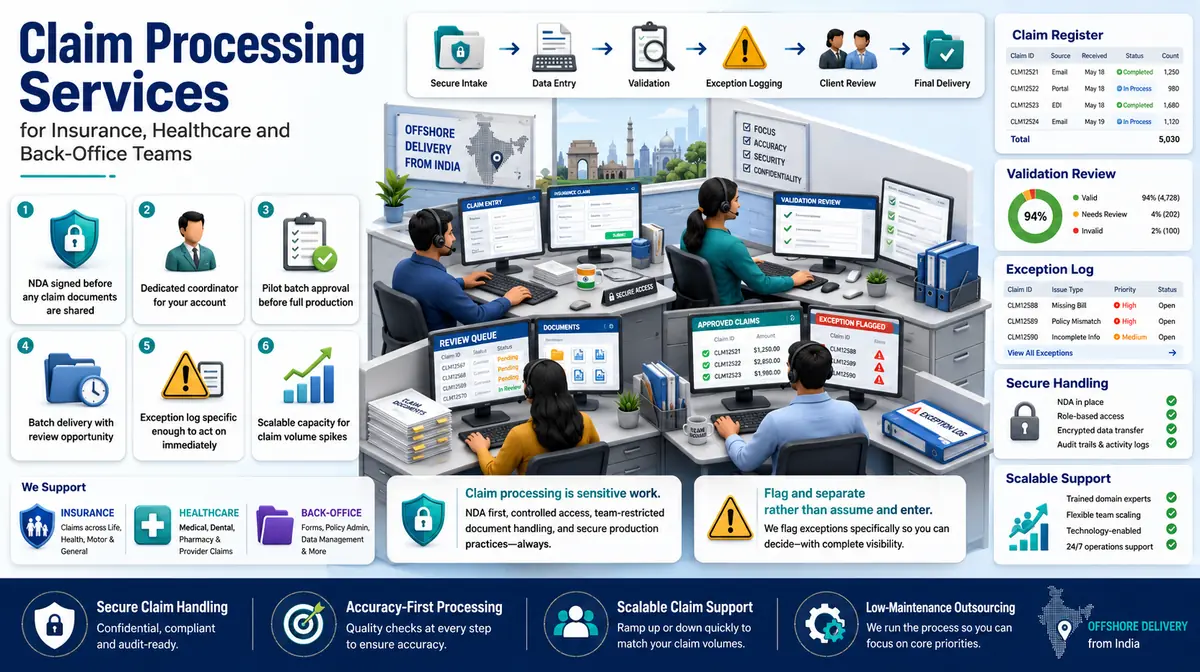

Administrative claim support from source assembly through status and exception control

The payer, transaction, client workflow and authorised coding sources govern every claim batch.

01

Patient, subscriber and payer data entry

Approved patient demographics, member and group identifiers, relationship, coordination references and payer destination fields are entered from registration and eligibility sources. Conflicts remain exceptions before claim preparation.

02

Provider, encounter and service-line preparation

Authorised provider identifiers, service dates, place of service, charges, units and supplied diagnosis or procedure codes are captured into the designated claim workflow. Operators do not select codes from clinical documentation.

03

Professional and institutional claim support

Approved fields are prepared for the applicable professional or institutional workflow, including client-authorised CMS-1500, CMS-1450/UB-04 or electronic claim data. Current payer and transaction requirements control field use.

04

Pre-submission validation and batch control

Required fields, formats, payer identifiers, provider references, line totals, duplicate risk and supplied code placement are checked before authorised submission. Batch and claim references are retained for response reconciliation.

05

Acknowledgement and claim-status tracking

Accepted, rejected, pending, paid or denied statuses are entered from authorised clearinghouse or payer responses. Claim-status inquiries and responses are recorded under the client’s process and access permissions.

06

Rejection, denial and resubmission routing

Administrative edit failures are corrected only from approved evidence. Denials, coding questions, coverage matters, medical-necessity issues and appeal decisions are routed to qualified client personnel with the relevant reason and source.

Healthcare System Compatibility

Insurance Claims Processing Services: Direct Integration and Software Compatibility

Outputs are prepared around the field structure, controlled values and import requirements of your destination environment. Files can be delivered for review, staging or authorised import without forcing your team to rebuild the completed work.

Supported destinations

Administrative data prepared for approved healthcare environments

Files are mapped to the client’s approved template, naming rules, identifiers and system structure before full production begins.

  • EpicClient-approved import structures
  • Oracle Health / CernerPatient and document fields
  • athenahealthAdministrative record templates
  • eClinicalWorksApproved demographic fields
  • NextGenMigration and staging files
  • Secure SQL DatabaseControlled staging tables
Source continuity

References stay connected

Source IDs, filenames, record keys and approved relationships remain available for review and downstream traceability.

Import control

Fields are mapped before production

Mandatory fields, formats, controlled values, character limits and relationship keys are checked against the destination specification.

Pilot validation

Test the handoff with a representative batch

Rejected rows, unsupported values and mapping conflicts are returned with exact references so approved corrections can be incorporated before full-volume delivery.

Delivery formatsStructured for review, staging or import
  • CSV
  • XLSX
  • HL7

Column order, encoding, date rules, multi-value handling and destination-specific requirements can follow the receiving system’s approved specification.

Compatibility means SDES prepares outputs to specifications supplied or approved by the client. Product names identify commonly used destination systems and do not imply endorsement, certification or partnership.

Process, Quality and Security

A claim-processing workflow from authorised source data to controlled resolution queues

1. Define Claim and Payer Scope

Claim types, payers, transactions, source systems, required fields, submission route and owners are documented.

2. Separate Decision Authority

The setup review distinguishes administrative corrections from coding, clinical, coverage and appeal decisions.

3. Pilot Claim Outcomes

Clean claims, missing fields, front-end rejections, payer denials and coordination cases test the workflow.

4. Prepare and Track Claims

The delivery team processes authorised fields and retains claim, batch, payer and source references.

5. Reconcile Responses

Accepted, rejected, pending, paid and denied claims are matched back to submitted records.

6. Release Corrections and Escalations

Supported administrative work and items requiring qualified review move through separate queues.

We work with the claim documents you already receive

Claim documents arrive in mixed formats and varying quality. We review source material at the start of every project to plan the processing approach and identify any document quality issues that need to be addressed before full production.

📂 Source formats we accept
  • Patient registration and insurance records
  • Approved encounter and charge sources
  • Provider and payer master files
  • Client-authorised diagnosis and procedure codes
  • Claim templates, companion rules and system workflow
  • Acknowledgements, status responses and denial records
📤 Delivery formats
  • Prepared claim-entry dataset
  • Pre-submission validation report
  • Claim and batch tracking register
  • Acknowledgement and status file
  • Administrative correction batch
  • Coding, clinical, coverage and denial exception queue

Quality checks cover patient and subscriber identity, payer, provider identifiers, service dates, supplied codes, units, charges, required fields, line and batch totals, duplicate risk, submission reference, response status and correction evidence.

Electronic claim standards define transaction structure, but payer edits and coverage policies can add requirements. Current payer instructions, clearinghouse responses and client-approved rules are used rather than relying on generic assumptions.

The production team handles authorised administrative data. An expert client owner approves diagnosis and procedure codes, modifiers, medical necessity, coverage interpretation, corrected substantive information, appeals and final claim submission.

🔒 NDA Protected Before files are shared
🌐 GDPR Aware EU data handling
Defined Quality Target Confirmed by pilot
🛡️ Secure Transfer Encrypted file access
📋 Exception Log Every delivery
👥 Project Team Only Controlled access
Free accuracy test

Claim backlog slowing your review team down?

Choose a claim batch containing ordinary submissions, supporting documents and several known exceptions. The pilot will test claim and payer references, field capture, document association and routing without allowing operators to make coding, coverage or clinical decisions.

✓ No credit card required✓ No contract required✓ 24–48 hour return
Request a Free Pilot Batch
Source sampleyour_sample_data.csv
Received
Verified deliveryverified_output.xlsx
Reviewed
▣ Encrypted transfer◉ Quality controlled
Why Outsource to SDES?

Why claims support needs disciplined ownership at every edit and response

Claim Processing Services workflow and quality review
  • Source-based entry
  • Payer-specific rules
  • Batch traceability
  • Rejection classification
  • Clinical boundaries
  • Scalable status maintenance

Revenue-cycle teams outsource specialised insurance claims processing support when preparation, acknowledgements and administrative follow-up consume specialist time.

The documented workflow gives the delivery team controlled production tasks while code assignment, coverage interpretation, medical necessity, adjudication, appeals and final submission authority remain with qualified client owners.

Start Your Project →
Industries We Support

Claims-processing support adapted to different healthcare billing environments

Different claim types have different data structures, compliance requirements and review workflows. We adapt our processing approach to the document types and sensitivity requirements of each sector.

Physician and Specialty Practices

Physician claim preparation, administrative validation and status tracking aligned with practice workflows.

Hospitals and Facilities

Institutional claim source fields, batch controls and response routing prepared under authorised revenue-cycle rules.

Medical Billing Organisations

Multi-client claim queues maintained with separate payer rules, access, coding authority and escalation paths.

Health Plans and Administrators

Authorised claim intake and administrative indexing supported without making benefit or adjudication decisions.

Healthcare Technology Providers

Claim migration, test-data preparation and processing-result reconciliation handled under client-controlled environments.

DME and Ancillary Providers

Supplier identifiers, service details and payer-specific administrative requirements captured from approved sources.

Case Studies

Relevant Project Experience

Professional Claim Rejection Recovery

Project Name
Professional Claim Rejection Recovery
Volume
38,000 claims per month
Problem
Clearinghouse responses were stored separately from claim records, leaving front-end rejections mixed with payer denials and unresolved for days. For the Professional Claim Rejection Recovery in United States workload, administrative reviewers needed dependable patient, provider and document references before the records could enter the next workflow stage.
Solution
A controlled tracking model linked batch, claim and response identifiers, then routed administrative edit failures separately from coding and coverage decisions. Within the Professional Claim Rejection Recovery in United States workflow, patient and document identifiers were checked together so supporting files remained connected to the correct administrative record.
Outcome
The billing organisation gained focused correction queues without allowing operators to alter unsupported claim content. After completing Professional Claim Rejection Recovery in United States, patient and document relationships were easier to retrieve because confirmed identifiers remained consistent across the delivery.
Title
Vice President of Claims Operations
Industry
Medical Billing Services
Country
United States

Institutional Claim Data Preparation

Project Name
Institutional Claim Data Preparation
Volume
14,500 inpatient and outpatient claims per month
Problem
Facility, attending-provider and service-line information arrived from different systems with inconsistent cut-off times. For the Institutional Claim Data Preparation in Australia workload, administrative reviewers needed dependable patient, provider and document references before the records could enter the next workflow stage.
Solution
The delivery team applied an approved source hierarchy and held conflicting fields before claim assembly. The solution returned clinically dependent items for expert revenue-integrity review.
Outcome
The hospital received more traceable preparation batches and a clear list of records awaiting authoritative source updates. As a result of the Institutional Claim Data Preparation in Australia workflow, the backlog became a controlled review workflow with complete records separated from items requiring authorised attention.
Title
Hospital Revenue Cycle Director
Industry
Acute Care Hospital
Country
Australia

Multi-Payer Status Reconciliation

Project Name
Multi-Payer Status Reconciliation
Volume
460,000 active claims across 36 payers — completed in 5 weeks
Problem
Status descriptions varied by portal and clearinghouse, making pending, rejected, denied and paid claims difficult to prioritise consistently. Within Multi-Payer Status Reconciliation in Canada, incorrect references or inconsistent formats could delay matching and move exceptions into later accounting stages.
Solution
Structured processing mapped authorised response categories while retaining the original payer message and observation date. For Multi-Payer Status Reconciliation in Canada, entity, supplier, date, amount and reference fields received targeted checks, with unsupported accounting decisions held outside the upload file.
Outcome
Managers gained comparable work queues and preserved the detail needed for qualified denial and appeal review. After completing Multi-Payer Status Reconciliation in Canada, the structured delivery reduced repeated source lookup while preserving accounting decisions for authorised reviewers.
Title
Claims Administration Manager
Industry
Healthcare Administration
Country
Canada
FAQs

Claim identity, document association and escalation decisions

Will your team select diagnosis or procedure codes?

No. We enter codes supplied or approved through the client’s qualified workflow. Coding decisions and clinical interpretation remain with authorised specialists.

Can you distinguish rejected claims from denied claims?

Yes. Front-end or transaction rejections, payer denials and other statuses are tracked separately using the original response and client-approved classifications.

What should we provide when we outsource insurance claims processing?

Provide authorised sources, claim types, payer and provider masters, supplied coding workflow, system access, validation rules, response files, correction authority and escalation owners.

Which items are held for client review during Claim Processing Services?

Claim Processing Services work separates unreadable values, conflicting identifiers, unsupported classifications and out-of-guide decisions from clean healthcare administrative records. The source reference for each held item stays attached for review.

📩 Get a Free Pilot Batch
💬