India-Based Data Entry Outsourcing Support Serving USA, Canada, UK, Australia, Europe, New Zealand, Singapore, UAE
Book Conversion Services

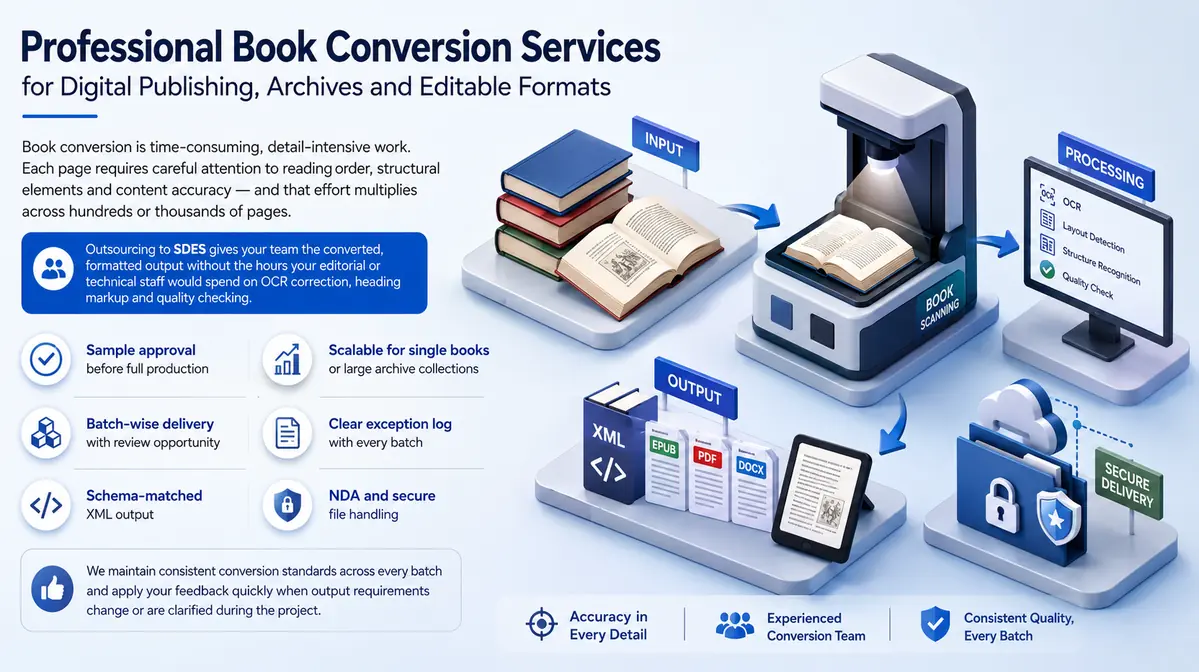
Book Conversion Services for Digital Publishing and Archives

A printed page has a fixed shape; an eBook must reorganise itself across screens without losing chapter hierarchy, notes, images or reading order. The production route therefore follows the publication rather than a generic EPUB template.

The workflow covers OCR correction, heading structure, navigation, metadata, image placement and linked references from print, PDF or Word sources. Checks cover representative chapters, footnotes, tables and special characters before the complete title is assembled.

Publishers and archives can outsource individual titles or catalogue backlogs while retaining editorial and rights authority. Delivery is a validated digital edition for the intended platform, accompanied by documented exceptions that need publisher review.

Shri Data Entry Services team working on Book Conversion Services projects
5000+ Completed Projects
90% Returning Clients
16+ Years Experience
45+ Countries Served
50+ Professionals Team
Services We Offer

Choose a digital structure that respects how the book is meant to be read

  • Reflowable or fixed layout selected
  • Chapter hierarchy mapped
  • Notes and references linked
  • Images and captions paired
  • Metadata package confirmed
  • EPUB validation completed

A novel, textbook, illustrated children’s title and reference manual should not share one conversion method. Reflowable EPUB prioritises adaptable reading, while fixed layout protects compositions whose meaning depends on precise placement.

Typography, chapters, tables, notes, illustrations and navigation are evaluated before production. Print, PDF and Word sources are rebuilt as a digital publication rather than treated as a long stream of extracted text.

Publishers can assign catalogue production to the delivery team while their editors retain rights, wording and design authority. The result is a validated title package plus a clear list of source, accessibility or rendering decisions requiring publisher approval.

Book conversion matched to content, device behaviour and distribution channel

Every title is assessed individually before its production route is approved.

01

Reflowable EPUB conversion

Novels, nonfiction and text-led titles receive semantic headings, responsive paragraphs, linked navigation, notes and device-adaptable images.

02

Fixed-layout EPUB conversion

Illustrated, educational and design-dependent books retain approved page composition while reading order, navigation and accessibility require separate attention.

03

Print and scanned book digitisation

Scanned pages pass through OCR and correction, with chapters, paragraphs, notes and page references rebuilt from the source evidence.

04

PDF or Word to EPUB

Existing digital manuscripts are cleaned of unstable layout artefacts and transformed into semantic publication structure rather than copied formatting.

05

Book XML and HTML conversion

Chapters, sections, figures, tables, notes and metadata are mapped to supplied publishing schemas or reusable web content structures.

06

Metadata and distribution package preparation

Title, contributor, language, identifier, cover, navigation and required assets are assembled under the distributor or publisher specification.

Document System Compatibility

Book Conversion Services: Direct Integration and Software Compatibility

Outputs are prepared around the field structure, controlled values and import requirements of your destination environment. Files can be delivered for review, staging or authorised import without forcing your team to rebuild the completed work.

Supported destinations

DMS-compatible files and metadata for searchable repositories

Files are mapped to the client’s approved template, naming rules, identifiers and system structure before full production begins.

  • SharePointLibraries and metadata columns
  • OpenTextEnterprise content repositories
  • iManageLegal matter workspaces
  • NetDocumentsCloud document profiles
  • AlfrescoContent models and properties
  • Custom SQLStaging and relational tables
Source continuity

References stay connected

Source IDs, filenames, record keys and approved relationships remain available for review and downstream traceability.

Import control

Fields are mapped before production

Mandatory fields, formats, controlled values, character limits and relationship keys are checked against the destination specification.

Pilot validation

Test the handoff with a representative batch

Rejected rows, unsupported values and mapping conflicts are returned with exact references so approved corrections can be incorporated before full-volume delivery.

Delivery formatsStructured for review, staging or import
  • CSV
  • XLSX
  • XML

Column order, encoding, date rules, multi-value handling and destination-specific requirements can follow the receiving system’s approved specification.

Compatibility means SDES prepares outputs to specifications supplied or approved by the client. Product names identify commonly used destination systems and do not imply endorsement, certification or partnership.

Process, Quality and Security

A title-by-title route from source audit to reading-device acceptance

1. Read the Publication

Genre, audience, layout dependence, notes, images and distribution targets are assessed.

2. Choose the Digital Model

Reflowable, fixed layout, XML, HTML or archive output is confirmed with the publisher.

3. Map Semantic Structure

Parts, chapters, headings, figures, tables, notes and navigation receive explicit treatment.

4. Build a Representative Chapter

A difficult sample tests typography, images, references and reading order.

5. Convert and Assemble

The production team creates the title and links its metadata and assets.

6. Validate and Device-Test

Technical validation and representative reading environments reveal navigation or rendering defects.

We work with complex layouts and mixed content types

Before starting any project, we review source material for quality issues — scan resolution, page completeness, language consistency, multi-column layouts, footnote density and special content. This shapes the workflow and prevents quality issues later.

📂 Source formats we accept
  • Scanned book pages (TIFF, JPEG, PDF)
  • Printed books and physical manuscripts
  • PDF books and digital documents
  • Word manuscripts and publishing layouts
  • Legacy digital files and older formats
📤 Delivery formats
  • Microsoft Word (structured heading styles)
  • XML (BITS, JATS or custom schema)
  • HTML for web or online library use
  • Plain text with structural markers
  • Searchable PDF or archive-ready formats

Final output format is confirmed before production starts. If you have a specific style guide, schema, naming convention or file structure, we follow it. If not, we recommend a practical format based on how the converted content will be used.

Text is checked against the supplied source, with special attention to names, numbers, notes, captions and characters affected by OCR or encoding.

Navigation, reading order, image placement, links and representative font behaviour are reviewed in the target format.

Technical validation results are resolved against the publication design. Publisher decisions remain documented when a source feature cannot transfer directly.

🔒 NDA Protected Before files are shared
🌐 GDPR Aware EU data handling
Defined Quality Target Confirmed by pilot
🛡️ Secure Transfer Encrypted file access
📋 Exception Log Every delivery
👥 Project Team Only Controlled access
Free accuracy test

Have a book or archive collection to convert?

Send us a sample chapter or a few pages from your source material. We convert them into your target format at no cost so you can review structural accuracy and formatting quality before committing to the full project.

✓ No credit card required✓ No contract required✓ 24–48 hour return
Request a Free Sample Conversion
Source sampleyour_sample_data.csv
Received
Verified deliveryverified_output.xlsx
Reviewed
▣ Encrypted transfer◉ Quality controlled
Why Outsource to SDES?

Why book conversion requires publishing judgement beyond file export

Book Conversion Services workflow and quality review
  • Title-specific route
  • Semantic chapters
  • Linked notes
  • Image handling
  • Accessibility awareness
  • Capacity for catalogue backlogs

Conversion must preserve the reading experience while adapting the source to digital behaviour. That balance depends on publication structure and platform constraints.

Publishers can assign repeatable production without transferring editorial control. Exceptions remain visible before distribution rather than surfacing as reader complaints.

Start Your Project →
Industries We Support

Book Conversion Across Publishing, Education and Research

Book conversion needs vary by industry. Publishers need production-ready files. Libraries need searchable archives. Educators need accessible digital content. We adapt accordingly.

Trade Publishers

Backlist and new-release titles prepared for reflowable and fixed-layout distribution.

Education and Academic Publishing

Textbooks, monographs and learning titles with figures, notes, references and complex navigation.

Libraries and Archives

Scanned collections digitised for search, preservation and controlled digital access.

Independent Authors and Digital Imprints

Validated EPUB packages prepared from Word, PDF or print-ready sources.

Case Studies

Relevant Project Experience

Academic Monograph Backlist

Project Name
Academic Monograph Backlist
Volume
320 titles and 96,000 pages — completed in 4 weeks
Problem
Scanned books contained footnotes, equations and multilingual characters that raw OCR distorted.
Solution
The delivery team corrected text, rebuilt semantic chapters and linked notes under a title checklist.
Outcome
The press received searchable EPUB and archive files with unresolved source damage documented.
Title
Digital Publishing Manager
Industry
Academic Publishing
Country
United Kingdom

Illustrated Children’s Series

Project Name
Illustrated Children’s Series
Volume
48 fixed-layout titles — completed in 3 weeks
Problem
Text, artwork and reading order changed unpredictably across devices.
Solution
Production anchored approved compositions while defining navigation, alternative descriptions and device test cases.
Outcome
The series passed distributor validation with consistent page behaviour.
Title
Production Director
Industry
Children’s Publishing
Country
Australia

Independent Imprint EPUB Pipeline

Project Name
Independent Imprint EPUB Pipeline
Volume
35–50 titles per month
Problem
Word manuscripts used unstable manual formatting and inconsistent metadata.
Solution
A repeatable route normalised source styles, built reflowable EPUB and returned editorial exceptions separately.
Outcome
The imprint shortened release preparation without transferring final publishing authority.
Title
Editorial Operations Lead
Industry
Digital Publishing
Country
Canada
FAQs

Questions clients ask before starting a book conversion project

Should my title use reflowable or fixed-layout EPUB?

The decision depends on whether meaning relies on exact page composition, along with platform and accessibility requirements.

Can scanned books be converted?

Yes. Source quality is sampled first, and OCR output receives manual correction and structural reconstruction.

Do you validate the final EPUB?

Yes. Technical validation and representative device checks are included under the approved acceptance criteria.

Which items are held for client review during Book Conversion Services?

Book Conversion Services work separates unreadable values, conflicting identifiers, unsupported classifications and out-of-guide decisions from clean document conversion output. The source reference for each held item stays attached for review.

📩 Send a Sample Chapter
💬