India-Based Data Entry Outsourcing Support Serving USA, Canada, UK, Australia, Europe, New Zealand, Singapore, UAE
Product Catalog Data Entry

Product Catalog Data Entry That Gives Every Item a Consistent Place in the Assortment

A catalog is more than a collection of product rows. It is a system of identifiers, categories, attributes, relationships, media and editions that allows buyers and internal teams to find the right item. Our professional product catalog data entry services build those connections from approved source material.

An expert setup review defines the catalog scope, master identifiers, taxonomy, category schemas, units, controlled values, product relationships and source precedence. The delivery team then converts supplier files, PDFs and legacy exports into structured records while assortment and taxonomy approval remain with client owners.

Brands, distributors and retailers outsource catalog creation or migration when inconsistent supplier information is delaying publishing and syndication. The solution delivers a governed product master, mapping evidence and a separate exception queue for duplicate identities, obsolete values and missing category data.

Shri Data Entry Services team working on Catalog Data Entry Services projects
5000+ Completed Projects
90% Returning Clients
16+ Years Experience
45+ Countries Served
50+ Professionals Team
Services We Offer

Define how products are grouped and described before thousands of rows enter the master

  • Catalog population scoped
  • Master key confirmed
  • Taxonomy approved
  • Category schema assigned
  • Edition status recorded
  • Source precedence retained

Two suppliers may describe the same attribute as capacity, volume or size, while using different units and product identifiers. Loading those columns directly creates a catalog that looks populated but cannot support reliable filters, comparison or syndication.

We map source fields to category-specific schemas and controlled values. Core identity is separated from channel content, and historic, discontinued or replacement records are handled through explicit status rules rather than removed from context.

Controlled production converts large assortments while the documented workflow protects the catalog model. Reviewers receive structured products plus a concise list of mapping, identity and taxonomy questions.
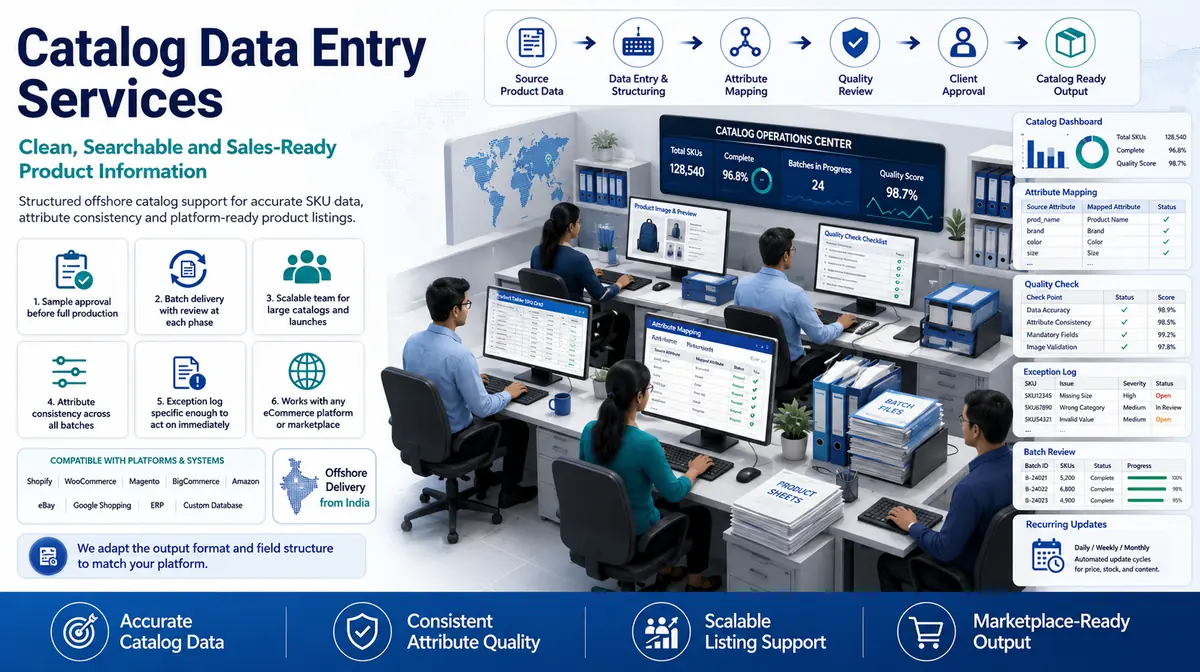

Product masters built from mixed supplier, document and legacy sources

The catalog remains traceable to source and reusable beyond a single sales channel.

01

Supplier catalog consolidation

Supplier spreadsheets, exports and price lists are inventoried, mapped and combined using approved product keys. Supplier-specific columns and terms are normalised without losing source references or forcing uncertain duplicate matches.

02

Taxonomy and category mapping

Products are assigned to approved departments, categories and subcategories using identifiers, specifications and client rules. Borderline products are routed to merchandising owners rather than placed in the nearest generic category.

03

Category-specific attribute entry

Required and optional attributes are entered under the schema for each category, with approved units, controlled values and formatting. Irrelevant attributes are not copied merely because they exist in a source file.

04

PDF and print catalog conversion

Product tables, descriptions, specifications, model references, page citations and image labels are captured from PDF or scanned catalogs into searchable structured records. Layout is interpreted through the agreed field model.

05

Catalog relationship maintenance

Product families, variants, accessories, replacement items, compatible products, bundles and supersession references are linked from approved evidence. Similar names alone are not sufficient to establish a relationship.

06

Catalog editions and master-file preparation

Current, future, discontinued and archived records are managed through defined status and effective-date fields. Master datasets are prepared for PIM, ERP, store, distributor or channel imports.

Commerce Platform Compatibility

Product Catalog Data Entry Services: Direct Integration and Software Compatibility

Outputs are prepared around the field structure, controlled values and import requirements of your destination environment. Files can be delivered for review, staging or authorised import without forcing your team to rebuild the completed work.

Supported destinations

Catalog and product files prepared for multichannel commerce

Files are mapped to the client’s approved template, naming rules, identifiers and system structure before full production begins.

  • ShopifyProducts, variants and collections
  • WooCommerceCatalog and attribute imports
  • AmazonSeller and marketplace templates
  • eBayListings and item specifics
  • Magento / Adobe CommerceCatalog and store-view fields
  • PIM / ERP SystemsClient-defined product schemas
Source continuity

References stay connected

Source IDs, filenames, record keys and approved relationships remain available for review and downstream traceability.

Import control

Fields are mapped before production

Mandatory fields, formats, controlled values, character limits and relationship keys are checked against the destination specification.

Pilot validation

Test the handoff with a representative batch

Rejected rows, unsupported values and mapping conflicts are returned with exact references so approved corrections can be incorporated before full-volume delivery.

Delivery formatsStructured for review, staging or import
  • CSV
  • XLSX
  • XML

Column order, encoding, date rules, multi-value handling and destination-specific requirements can follow the receiving system’s approved specification.

Compatibility means SDES prepares outputs to specifications supplied or approved by the client. Product names identify commonly used destination systems and do not imply endorsement, certification or partnership.

Process, Quality and Security

A catalog-building workflow from source inventory to governed master data

1. Inventory Sources and Editions

Suppliers, files, catalog periods, identifiers, product families and destination systems are documented.

2. Design the Catalog Mapping

The setup review defines master keys, taxonomy, schemas, units, statuses, relationships and source precedence.

3. Pilot Across Categories

Simple, configurable, technical and poorly structured products test the model and exception rules.

4. Convert and Normalise Records

The delivery team captures source-supported data and retains supplier, page or system references.

5. Check Catalog Completeness Before Channel Delivery

Keys, categories, attributes, units, duplicates, relationships, statuses and record counts are reviewed.

6. Release the Master and Questions

Approved catalog records and issues requiring product or taxonomy ownership are delivered separately.

Catalog Sources Accepted and Channel-Ready Outputs

Product data arrives from multiple suppliers in different formats with different levels of completeness. We review what is available, structure it for your platform and flag gaps before they cause upload errors.

📂 Source formats we accept
  • Supplier spreadsheets and data exports
  • PDF, scanned and printed catalogs
  • Legacy PIM, ERP and catalog files
  • Approved taxonomy and attribute schemas
  • Product images and document libraries
  • Channel or master-data import templates
📤 Delivery formats
  • Governed product catalog master
  • Supplier-to-master field map
  • Taxonomy and category dataset
  • Category attribute records
  • Product relationship register
  • Duplicate, mapping and missing-data exception log

Before any large project, we review sample files and identify data gaps. This upfront planning reduces surprises during production and creates a documented process reusable for future product onboarding, seasonal updates and catalog maintenance cycles.

Catalog quality checks cover master-key uniqueness, category validity, required attributes, controlled terms, units, product relationships, status history and agreement between source and output counts.

Duplicate detection identifies candidates; it does not automatically merge records. Supplier identifiers, specifications, brands and packaging must support any consolidation decision.

The production team builds source-supported catalog records. An expert client owner approves taxonomy, product identity, relationships, assortment status and final master publication.

🔒 NDA Protected Before files are shared
🌐 GDPR Aware EU data handling
Defined Quality Target Confirmed by pilot
🛡️ Secure Transfer Encrypted file access
📋 Exception Log Every delivery
👥 Project Team Only Controlled access
Free accuracy test

Need your product catalog cleaned up or built from scratch?

Provide two or more source files together with the intended catalog structure. The pilot will demonstrate field mapping, product identity rules, taxonomy treatment and the exception register before the complete assortment is consolidated.

✓ No credit card required✓ No contract required✓ 24–48 hour return
Request a Free Sample Batch
Source sampleyour_sample_data.csv
Received
Verified deliveryverified_output.xlsx
Reviewed
▣ Encrypted transfer◉ Quality controlled
Why Outsource to SDES?

Why catalog scale requires a reusable data model rather than another channel spreadsheet

Catalog Data Entry Services workflow and quality review
  • Master-key controls
  • Category-specific schemas
  • Source precedence
  • Edition and status history
  • Relationship validation
  • Scalable catalog capacity

Catalog and merchandising teams outsource professional catalog data entry when supplier conversion and master maintenance are consuming time needed for assortment and customer experience.

The documented workflow gives the delivery team a stable model while taxonomy, assortment, product relationships, commercial status and publishing approval remain with client owners.

Start Your Project →
Industries We Support

Catalog structures adapted to different products, specifications and relationships

Different business types have different catalog structures, attribute vocabularies and platform requirements. We adapt the data entry approach to your product type and business model.

Industrial and MRO Distribution

Part numbers, technical attributes, units, compatibility and replacement relationships structured across deep catalogs.

Retail and Consumer Products

Categories, variants, materials, dimensions, care, packs and media organised for browsing and syndication.

Electronics and Components

Models, capacities, interfaces, regional specifications, accessories and compatibility maintained by exact identity.

Medical and Laboratory Supplies

Approved specifications, packaging, references and supporting documents organised without unsupported claims.

Furniture and Building Products

Materials, finishes, dimensions, collections, installation documents and related components captured consistently.

Publishers and Catalog Agencies

Client product sources converted into governed print, digital and channel datasets with page-level traceability.

Case Studies

Relevant Project Experience

Industrial Catalog Master Rebuild

Project Name
Industrial Catalog Master Rebuild
Volume
680,000 products from 92 supplier catalogs — completed in 3 weeks
Problem
The distributor’s search and filters relied on supplier-specific categories and more than 4,000 uncontrolled attribute labels.
Solution
A professional catalog map aligned approved categories, units and attribute schemas while retaining each supplier’s part and source references.
Outcome
The company received a reusable product master and a focused queue for duplicate, compatibility and taxonomy decisions.
Title
Director of Catalog Strategy
Industry
MRO Distribution
Country
United States

Furniture PDF Catalog Conversion

Project Name
Furniture PDF Catalog Conversion
Volume
310 catalogs and 74,000 product configurations — completed in 6 weeks
Problem
Dimensions, materials, finishes and collection relationships were locked in designed PDFs and varied between editions.
Solution
The delivery team captured page-referenced product and option data under edition-specific rules. The solution routed conflicting current and archived values for specialist review.
Outcome
The brand gained structured current records without losing the historic catalog context behind discontinued finishes.
Title
Product Information Manager
Industry
Furniture Manufacturing
Country
Italy

Medical Supply Taxonomy Migration

Project Name
Medical Supply Taxonomy Migration
Volume
155,000 products across 1,900 categories — completed in 12 weeks
Problem
A legacy structure mixed intended use, product form and department, making required specifications inconsistent.
Solution
Professional data entry applied the approved new taxonomy and category schemas from manufacturer evidence, leaving ambiguous clinical classifications to client specialists.
Outcome
The distributor received migration-ready records with clearer attributes and no invented medical claims.
Title
Master Data Programme Lead
Industry
Medical Supplies
Country
United Kingdom
FAQs

Catalog ownership, taxonomy and source-priority decisions

How is catalog data entry different from one marketplace upload?

A catalog master uses reusable identity, taxonomy, attribute and relationship structures. Marketplace files are destination-specific outputs derived from that governed data.

Can you convert product specifications from PDF catalogs?

Yes. Fields, tables, page references and edition rules are agreed first. Unclear layouts or conflicting editions are reported for review.

What should we provide when we outsource catalog data entry?

Provide source catalogs, identifier rules, taxonomy, category schemas, controlled units, relationship rules, status logic, destination formats and named data owners.

What should a Catalog Data Entry Services pilot contain?

Provide Supplier spreadsheets and data exports, PDF, scanned and printed catalogs, Legacy PIM, ERP and catalog files. The pilot should include ordinary records and known exceptions so field interpretation, review rules and delivery structure can be confirmed before production.

📩 Get a Free Sample Batch
💬