India-Based Data Entry Outsourcing Support Serving USA, Canada, UK, Australia, Europe, New Zealand, Singapore, UAE
Patient Records Data Entry Services

Patient Records Data Entry That Keeps Identity, Chronology and Source Evidence Together

Patient information often arrives across registration forms, referrals, insurance documents, historical charts and system exports. Combining those sources safely requires more than copying fields: the person, date, context and source must remain clear. Our professional patient records data entry services preserve those connections.

An expert setup review defines patient-matching criteria, record scope, source precedence, date rules, permitted fields, amendment restrictions and escalation owners. The delivery team then enters authorised data without resolving clinical contradictions, changing diagnoses or determining whether historical information remains current.

Practices, health systems and migration teams outsource patient-record backlogs when volume delays onboarding, retrieval and authorised administration. The solution delivers structured records with source references and a separate queue for duplicate candidates, conflicting histories, uncertain dates and clinically dependent decisions.

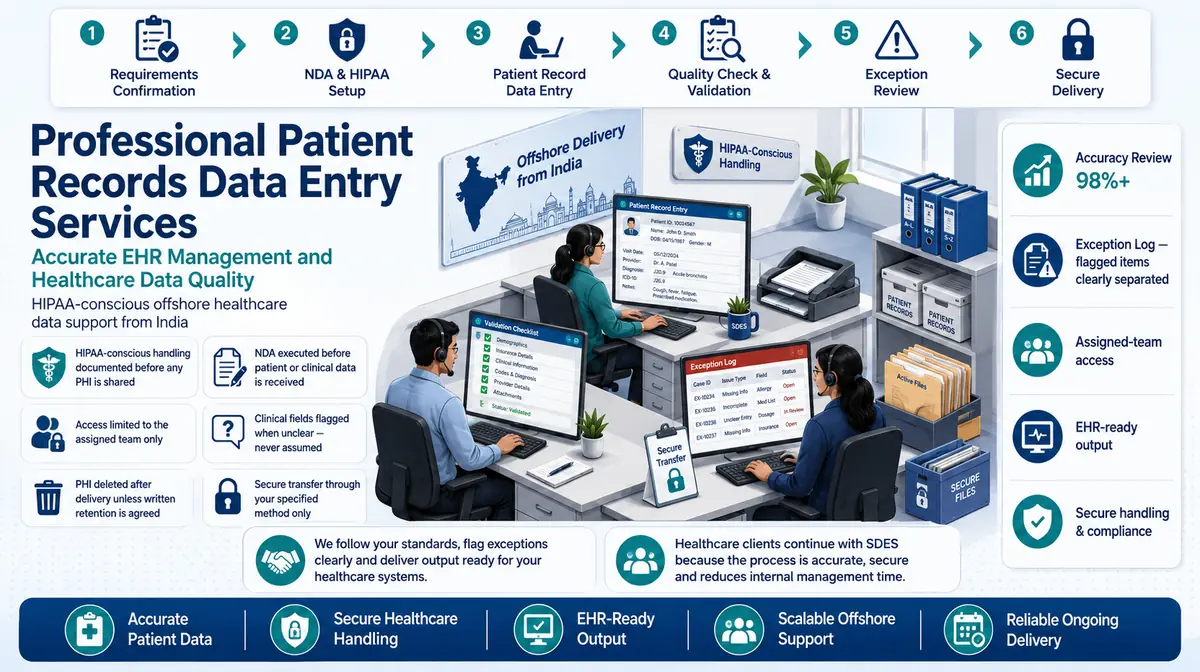
Shri Data Entry Services team working on Patient Records Data Entry Services projects
5000+ Completed Projects
90% Returning Clients
16+ Years Experience
45+ Countries Served
50+ Professionals Team
Services We Offer

Preserve who supplied the information, when it applied and whether it has been clinically verified

  • Patient identity supported
  • Source type recorded
  • Effective date retained
  • Historical status clear
  • Clinical verification excluded
  • Amendment owner assigned

A medication or condition listed on an old intake form is historical evidence, not automatic confirmation of a current clinical state. Likewise, a new address does not always authorise overwriting every earlier record or payer file.

We place approved information in the client-designated record structure and retain document date, source and status where required. Contradictory entries are presented together for qualified review rather than silently choosing the most recent-looking value.

Dedicated offshore capacity supports large conversion and intake workloads. The documented workflow limits operators to source-based entry while clinicians, HIM teams and authorised administrators control verification, amendment and patient-chart decisions.

Patient information organised around identity, source, effective date and authorised use

The client’s patient-master rules and record policy govern every field and update.

01

Patient demographic and contact entry

Approved name, date of birth, address, phone, email, emergency contact, preferred language and responsible-party fields are entered from authorised sources. Conflicting identity or contact information remains an exception.

02

Insurance and guarantor record entry

Subscriber, member, group, plan, relationship, guarantor and relevant administrative fields are captured from supplied insurance records. Coverage interpretation and eligibility decisions remain outside the entry role.

03

Source-based history transcription

Permitted medical, surgical, family, social, medication or allergy history fields are transferred exactly from designated forms or legacy records. Operators do not determine clinical meaning, current status or reconciliation.

04

Referral, provider and care-administration data

Approved referring provider, assigned practitioner, facility, referral reference, preferred pharmacy and administrative care fields are entered under the client’s workflow. Missing or conflicting relationships are routed for review.

05

Paper and legacy patient-record migration

Historical charts, spreadsheets and legacy exports are organised into staging files or approved destination fields with original patient and source IDs retained. Active, historical and unresolved information remains distinguishable.

06

Patient-master and record exception review

Potential duplicates, mismatched identifiers, conflicting dates, incomplete packets and uncertain source-to-patient associations are documented. Formal merges and substantive amendments require authorised client approval.

Healthcare System Compatibility

Patient Records Data Entry Services: Direct Integration and Software Compatibility

Outputs are prepared around the field structure, controlled values and import requirements of your destination environment. Files can be delivered for review, staging or authorised import without forcing your team to rebuild the completed work.

Supported destinations

Administrative data prepared for approved healthcare environments

Files are mapped to the client’s approved template, naming rules, identifiers and system structure before full production begins.

  • EpicClient-approved import structures
  • Oracle Health / CernerPatient and document fields
  • athenahealthAdministrative record templates
  • eClinicalWorksApproved demographic fields
  • NextGenMigration and staging files
  • Secure SQL DatabaseControlled staging tables
Source continuity

References stay connected

Source IDs, filenames, record keys and approved relationships remain available for review and downstream traceability.

Import control

Fields are mapped before production

Mandatory fields, formats, controlled values, character limits and relationship keys are checked against the destination specification.

Pilot validation

Test the handoff with a representative batch

Rejected rows, unsupported values and mapping conflicts are returned with exact references so approved corrections can be incorporated before full-volume delivery.

Delivery formatsStructured for review, staging or import
  • CSV
  • XLSX
  • HL7

Column order, encoding, date rules, multi-value handling and destination-specific requirements can follow the receiving system’s approved specification.

Compatibility means SDES prepares outputs to specifications supplied or approved by the client. Product names identify commonly used destination systems and do not imply endorsement, certification or partnership.

Process, Quality and Security

A patient-record workflow from identity confirmation to source-aware handoff

1. Define Record Purpose

Patients, sources, fields, systems, permitted use, access, retention and review owners are documented.

2. Establish Identity and Chronology

The setup review defines matching fields, source priority, effective dates, historical status and prohibited changes.

3. Pilot Conflicting Records

Duplicate candidates, old histories, insurance changes, name changes and undated documents test the rules.

4. Enter Source-Based Information

The delivery team processes approved fields while retaining patient, date, source and status context.

5. Review Record Integrity

Identifiers, chronology, field placement, required values, duplicates, counts and exceptions are checked.

6. Release Records and Decisions

Completed entries and items requiring clinical, HIM, privacy or administrative authority are separated.

📂 Source formats we accept
  • Patient registration and intake forms
  • Insurance and guarantor documents
  • Referral and provider records
  • Paper charts and scanned historical files
  • Legacy patient-system exports
  • Matching, chronology and amendment policies
📤 Delivery formats
  • Structured patient record dataset
  • Patient demographic and insurance file
  • Historical source-entry register
  • Legacy-to-current patient crosswalk
  • Coverage and batch quality report
  • Identity, chronology and clinical-review exception queue

Quality checks cover patient identifiers, name and date formats, source document, effective or document date, historical status, insurance references, provider relationships, required-field coverage, duplicate risk and agreement between received and completed records.

Data-entry completeness does not establish clinical validity. Historical medications, allergies, diagnoses and other health information remain attributed to their source until qualified client personnel verify or reconcile them.

The production team enters authorised source data. An expert client owner approves patient merges, clinical verification, medication and allergy reconciliation, diagnosis changes, formal amendments, disclosures and final record status.

🔒 NDA Protected Before files are shared
🌐 GDPR Aware EU data handling
Defined Quality Target Confirmed by pilot
🛡️ Secure Transfer Encrypted file access
📋 Exception Log Every delivery
👥 Project Team Only Controlled access
Free accuracy test

Need patient records entered accurately with consistent HIPAA-conscious handling?

Share your EHR platform and a sample of your patient record sources. We process a free pilot and return the output for your review before any paid production begins.

✓ No credit card required✓ No contract required✓ 24–48 hour return
Get a Free Pilot
Source sampleyour_sample_data.csv
Received
Verified deliveryverified_output.xlsx
Reviewed
▣ Encrypted transfer◉ Quality controlled
Why Outsource to SDES?

Why patient records need provenance as well as completeness

Patient Records Data Entry Services workflow and quality review
  • Patient-match safeguards
  • Historical status
  • Source hierarchy
  • Chronology controls
  • Amendment boundaries
  • Scalable record capacity

Healthcare teams outsource professional patient records data entry when intake, conversion and backlog volume reduces time available for patient-facing and qualified record work.

The documented workflow gives the delivery team controlled source-entry tasks while patient merges, clinical verification, diagnosis changes, medication reconciliation, formal amendments and final chart authority remain with qualified owners.

Start Your Project →
Industries We Support

Patient-record support adapted to different populations and record sources

Primary and Multi-Specialty Practices

Registration, insurance, referral and authorised history fields organised for ongoing patient administration.

Hospitals and Health Networks

Large patient-master and legacy-record batches processed under enterprise identity and chart policies.

Specialty and Allied Health Clinics

Source-specific patient and referral records entered without extending into clinical interpretation.

Health Information Management

Historical record conversion, crosswalks and exception queues prepared for qualified HIM decisions.

Healthcare Technology Implementers

Migration staging and patient-master datasets prepared for client-controlled system transitions.

Authorised Healthcare Research

Protocol-approved participant and source fields entered under consent, identifier and de-identification rules.

Case Studies

Relevant Project Experience

New Patient Intake Consolidation

Project Name
New Patient Intake Consolidation
Volume
74,000 intake packets across 31 clinics — completed in 6 weeks
Problem
Demographic, insurance and referral information arrived on separate forms with overlapping but occasionally conflicting patient fields.
Solution
A controlled source hierarchy preserved each document reference and routed identity conflicts before patient-record creation.
Outcome
Clinics received structured onboarding batches without allowing older forms to overwrite uncertain current information.
Title
Director of Patient Administration
Industry
Outpatient Medical Network
Country
United States

Historical Record Conversion

Project Name
Historical Record Conversion
Volume
48,000 patients and 3.1 million legacy values — completed in 10 weeks
Problem
Old charts mixed current and historical medication, allergy and condition information without consistent effective dates.
Solution
The delivery team transferred approved values with source date and historical status. The solution reserved clinical reconciliation for expert practice personnel.
Outcome
The migration team gained source-aware records rather than an apparently current clinical profile assembled from old documents.
Title
Clinical Information Migration Lead
Industry
Primary Care Group
Country
Australia

Patient Master Exception Review

Project Name
Patient Master Exception Review
Volume
260,000 patient profiles from five acquired clinics — completed in 11 weeks
Problem
Name variations, changed addresses and recycled local chart numbers created thousands of possible duplicate candidates.
Solution
structured review applied approved identity combinations and presented uncertain pairs with source evidence instead of merging them.
Outcome
The health network reduced its review backlog while retaining qualified authority over every chart merge.
Title
Health Information Governance Manager
Industry
Integrated Care Network
Country
Canada
FAQs

Questions to resolve before patient-record entry begins

Do you verify that historical clinical information is still current?

No. We preserve and enter approved source information with its context. Clinical verification and reconciliation remain with qualified client personnel.

Can your team merge duplicate patient records?

We can identify and document candidates under approved matching rules, but formal chart merges require authorised client review and approval.

What should we provide when we outsource patient records data entry?

Provide authorised source records, patient-matching policy, field dictionary, chronology and source rules, system workflow, amendment limits, access controls and named clinical, HIM and administrative owners.

What should a Patient Records Data Entry Services pilot contain?

Provide Patient registration and intake forms, Insurance and guarantor documents, Referral and provider records. The pilot should include ordinary records and known exceptions so field interpretation, review rules and delivery structure can be confirmed before production.

📩 Get a Free Pilot
💬