India-Based Data Entry Outsourcing Support Serving USA, Canada, UK, Australia, Europe, New Zealand, Singapore, UAE
Product Data Cleansing Services

Product Data Cleansing That Fixes Catalog Problems Without Rewriting Product Truth

Catalog defects often hide inside records that look complete. The same colour appears under several spellings, units are mixed, retired values remain active, and near-duplicate products share enough details to invite an unsafe merge. Our professional product data cleansing services expose those issues before correcting them.

An specialist review establishes the product identity rules, trusted source order, taxonomy, controlled vocabularies, unit standards and authority for each correction type. The delivery team then cleans supported fields while commercial claims, assortment decisions, regulated information and ambiguous merges remain with the catalog owner.

Retailers, manufacturers and distributors outsource backlog cleanup or recurring quality maintenance when unreliable product data weakens filters, search, reporting and downstream feeds. The solution provides corrected records, before-and-after evidence and an exception queue for values that cannot be resolved responsibly.

Shri Data Entry Services team working on Product Data Cleansing Services projects
5000+ Completed Projects
90% Returning Clients
16+ Years Experience
45+ Countries Served
50+ Professionals Team
Services We Offer

Correct what evidence supports and keep unresolved product facts visible

  • Identity rules defined
  • Source precedence approved
  • Standard values documented
  • Units controlled
  • Merge authority assigned
  • Original values retained

A blank field is obvious; a plausible but incorrect value is harder to detect. Copying a specification from a similar model or merging two products because their names resemble each other can make a catalog appear cleaner while reducing its accuracy.

We profile completeness, conformity, consistency, uniqueness and referential integrity by product family. Each issue is assigned a permitted action: normalise, correct from an approved source, link to a master value, suppress under an owner rule or return for review.

Controlled production applies approved decisions at volume. The documented workflow retains original values and source references, allowing quality teams to audit important transformations and reverse a correction when business rules change.
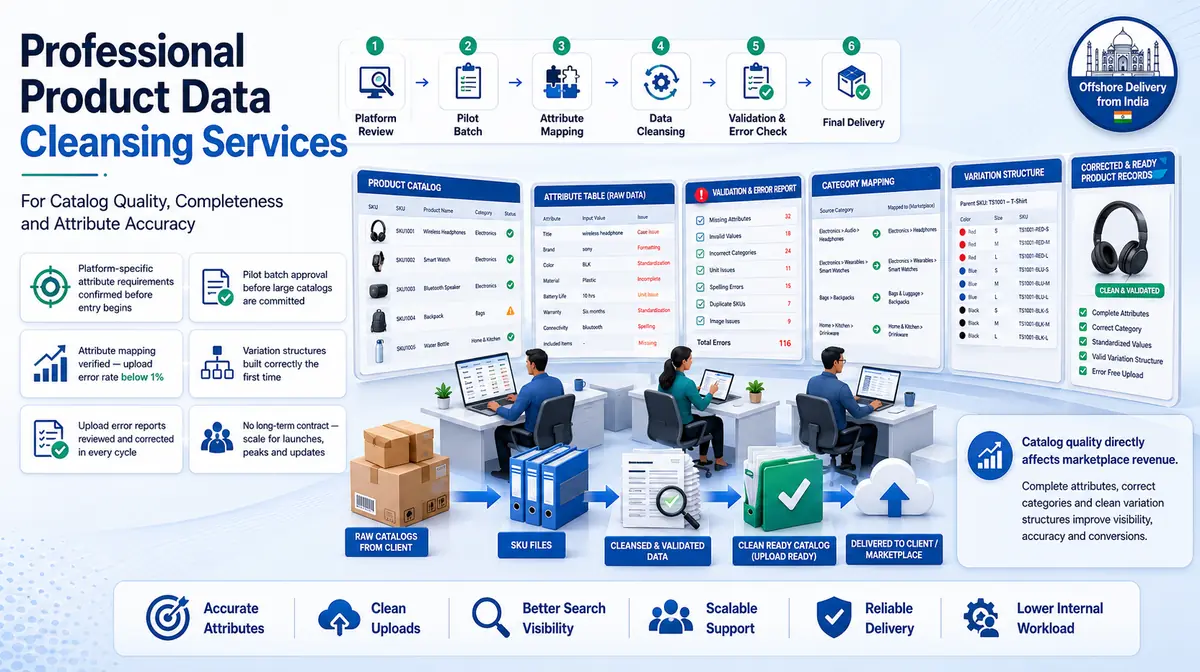

Quality corrections matched to the type and risk of each catalog defect

Every change follows an approved rule, reference source or named owner decision.

01

Catalog profiling and defect inventory

Products are assessed for missing required fields, invalid formats, inconsistent terms, duplicate identifiers, orphan relationships, taxonomy conflicts and stale values. Findings are grouped by category, source and business impact before correction begins.

02

Attribute and controlled-value standardisation

Approved colours, materials, sizes, brands, boolean values and other controlled terms are aligned to one vocabulary. Source nuances are retained where they represent genuine product differences rather than spelling or formatting variation.

03

Units, dimensions and numeric normalisation

Measurements, decimal formats, currencies, pack quantities and technical values are converted only under documented rules. Original value, source unit, converted value and rounding treatment remain available for verification.

04

Duplicate and near-duplicate product review

SKU, GTIN, manufacturer part number, model, title and attribute fingerprints identify duplicate candidates. Exact cases follow approved resolution rules; uncertain matches remain separate and are presented with the evidence needed for owner review.

05

Missing, invalid and obsolete value handling

Supported gaps are completed from approved supplier, manufacturer or internal sources. Invalid and retired values are corrected or mapped where authorised, while unavailable facts remain explicitly missing instead of being inferred.

06

Taxonomy and relationship correction

Category assignments, parent-child links, bundles, product-media relationships and cross-references are checked for structural integrity. Changes that affect navigation, merchandising or sellable identity require the appropriate business approval.

Commerce Platform Compatibility

Product Data Cleansing Services: Direct Integration and Software Compatibility

Outputs are prepared around the field structure, controlled values and import requirements of your destination environment. Files can be delivered for review, staging or authorised import without forcing your team to rebuild the completed work.

Supported destinations

Catalog and product files prepared for multichannel commerce

Files are mapped to the client’s approved template, naming rules, identifiers and system structure before full production begins.

  • ShopifyProducts, variants and collections
  • WooCommerceCatalog and attribute imports
  • AmazonSeller and marketplace templates
  • eBayListings and item specifics
  • Magento / Adobe CommerceCatalog and store-view fields
  • PIM / ERP SystemsClient-defined product schemas
Source continuity

References stay connected

Source IDs, filenames, record keys and approved relationships remain available for review and downstream traceability.

Import control

Fields are mapped before production

Mandatory fields, formats, controlled values, character limits and relationship keys are checked against the destination specification.

Pilot validation

Test the handoff with a representative batch

Rejected rows, unsupported values and mapping conflicts are returned with exact references so approved corrections can be incorporated before full-volume delivery.

Delivery formatsStructured for review, staging or import
  • CSV
  • XLSX
  • XML

Column order, encoding, date rules, multi-value handling and destination-specific requirements can follow the receiving system’s approved specification.

Compatibility means SDES prepares outputs to specifications supplied or approved by the client. Product names identify commonly used destination systems and do not imply endorsement, certification or partnership.

Process, Quality and Security

A product cleansing workflow from quality baseline to controlled correction release

1. Profile the Catalog

Products, sources, categories, identifiers, relationships and known quality concerns are inventoried.

2. Approve Cleansing Rules

The setup review defines source precedence, standard values, units, duplicate thresholds and correction authority.

3. Test High-Risk Defects

Near duplicates, conflicting identifiers, unit conversions and category changes are piloted before scale.

4. Apply Traceable Corrections

The delivery team cleans supported values while preserving original data, source and applied rule.

5. Verify SKU, Attribute and Variant Relationships

Completeness, conformity, uniqueness, relationships and source-to-output counts are checked by batch.

6. Release Data and Exceptions

Approved corrections, quality metrics and unresolved decisions are delivered as separate controlled outputs.

📂 Source formats we accept
  • Product catalog and PIM exports
  • Supplier and manufacturer source files
  • SKU, GTIN and part-number registers
  • Taxonomy and controlled-value dictionaries
  • Unit and formatting standards
  • Known issue lists and correction authority matrix
📤 Delivery formats
  • Cleaned product master file
  • Catalog quality profile
  • Standardised attribute dataset
  • Duplicate candidate and resolution register
  • Before-and-after change log
  • Unresolved evidence and owner-decision queue

Quality control compares original and corrected values, approved dictionaries, identifier uniqueness, unit conversions, required-field coverage, relationship integrity and product counts. Material changes receive a reason code and source reference.

Automated similarity scores can identify candidates but do not establish product identity by themselves. Ambiguous duplicate, compatibility, taxonomy and specification decisions remain visible for qualified owner review.

The production team applies approved cleansing rules. An expert client owner approves product merges, deletions, regulated values, commercial claims, taxonomy policy and final updates to live systems.

🔒 NDA Protected Before files are shared
🌐 GDPR Aware EU data handling
Defined Quality Target Confirmed by pilot
🛡️ Secure Transfer Encrypted file access
📋 Exception Log Every delivery
👥 Project Team Only Controlled access
Free accuracy test

Need your product catalog audited and cleaned for quality and completeness?

Share a sample of your product catalog. We run a free audit on the sample and report back on quality issue types and frequencies before you decide on the full project scope.

✓ No credit card required✓ No contract required✓ 24–48 hour return
Get a Free Catalog Audit Sample
Source sampleyour_sample_data.csv
Received
Verified deliveryverified_output.xlsx
Reviewed
▣ Encrypted transfer◉ Quality controlled
Why Outsource to SDES?

Why catalog cleanup needs evidence, not cosmetic consistency

Product Data Cleansing Services workflow and quality review
  • Source-based corrections
  • Reversible change history
  • Controlled vocabularies
  • Duplicate safeguards
  • Relationship validation
  • Scalable quality maintenance

Data teams outsource professional product data cleansing when accumulated supplier feeds, migrations and manual updates have made catalog quality difficult to manage internally.

The documented workflow gives an offshore production team precise correction authority while product identity, claims, assortment, taxonomy policy and final system changes remain with authorised catalog owners.

Start Your Project →
Industries We Support

Product cleansing adapted to the defects that matter in each catalog

Retail and eCommerce

Titles, brands, variants, filters, prices and media relationships checked across fast-changing consumer catalogs.

Manufacturing and Industrial Supply

Part numbers, technical units, compatibility, supersession and document links cleaned without merging distinct components.

Medical and Laboratory Products

Device, consumable and equipment fields corrected from approved sources without inventing regulated or clinical claims.

Electronics and Technology

Model, region, capacity, interface and compatibility values reconciled at exact identifier level.

Home and Furniture

Dimensions, materials, finishes, pack structures and assembly references normalised by product and variant.

Distributors and Marketplaces

Multi-supplier duplicates, naming differences and taxonomy conflicts resolved through documented source precedence.

Case Studies

Relevant Project Experience

Multi-Supplier Attribute Cleanup

Project Name
Multi-Supplier Attribute Cleanup
Volume
312,000 products and 4.8 million attribute values — completed in 9 weeks
Problem
Forty-two supplier feeds used conflicting colour, material, size and unit conventions, weakening filters and producing thousands of apparent values.
Solution
A professional category-level vocabulary mapped supported synonyms, retained legitimate distinctions and logged every conversion against its original value.
Outcome
The retailer received a controlled attribute master and a focused queue for terms that required merchandising decisions.
Title
Director of Product Information
Industry
Home Improvement Retail
Country
United Kingdom

Industrial Duplicate Risk Review

Project Name
Industrial Duplicate Risk Review
Volume
690,000 part records from nine acquisitions — completed in 8 weeks
Problem
Legacy systems reused short part descriptions and sometimes recycled internal numbers, making name-only deduplication unsafe.
Solution
The delivery team combined manufacturer number, brand, technical attributes, supersession and document evidence. The solution separated exact duplicates from probable and unresolved candidates for expert engineering review.
Outcome
Confirmed duplication was reduced without collapsing components that differed by rating, material or equipment compatibility.
Title
Master Data Programme Lead
Industry
Industrial Distribution
Country
Germany

Marketplace Catalog Quality Recovery

Project Name
Marketplace Catalog Quality Recovery
Volume
145,000 active and archived SKUs — completed in 9 weeks
Problem
Repeated channel imports had introduced missing variant values, stale categories and product-image links pointing to retired SKUs.
Solution
Professional cleansing applied approved lifecycle, relationship and taxonomy rules while preserving an audit copy of every previous value.
Outcome
The brand gained channel-ready batches, measurable completeness gains and a clearly owned list of unresolved source gaps.
Title
Global Catalog Operations Manager
Industry
Consumer Products
Country
United States
FAQs

What counts as a correctable product-data defect?

Will you automatically merge every likely duplicate?

No. Exact cases can follow approved rules, but uncertain candidates remain separate with comparison evidence for an authorised product owner.

Can you fill missing specifications during cleansing?

Only when an approved source supports the value. Otherwise, the missing field is reported with the source or decision needed to resolve it.

What should we provide when we outsource product data cleansing?

Provide catalog exports, source files, identity rules, taxonomy, standard values, unit conventions, known issues, correction authority and named approvers.

How is quality checked for Product Data Cleansing Services?

For Product Data Cleansing Services, the depth of checking follows the operational risk carried by catalog and product records — required fields, identifiers, controlled values, cross-field relationships and source correspondence. The pilot batch is where this review method gets confirmed.

📩 Get a Free Catalog Audit Sample
💬