
India-Based Data Entry Outsourcing Support Serving USA, Canada, UK, Australia, Europe, New Zealand, Singapore, UAE
Shopify Product Data Entry Services

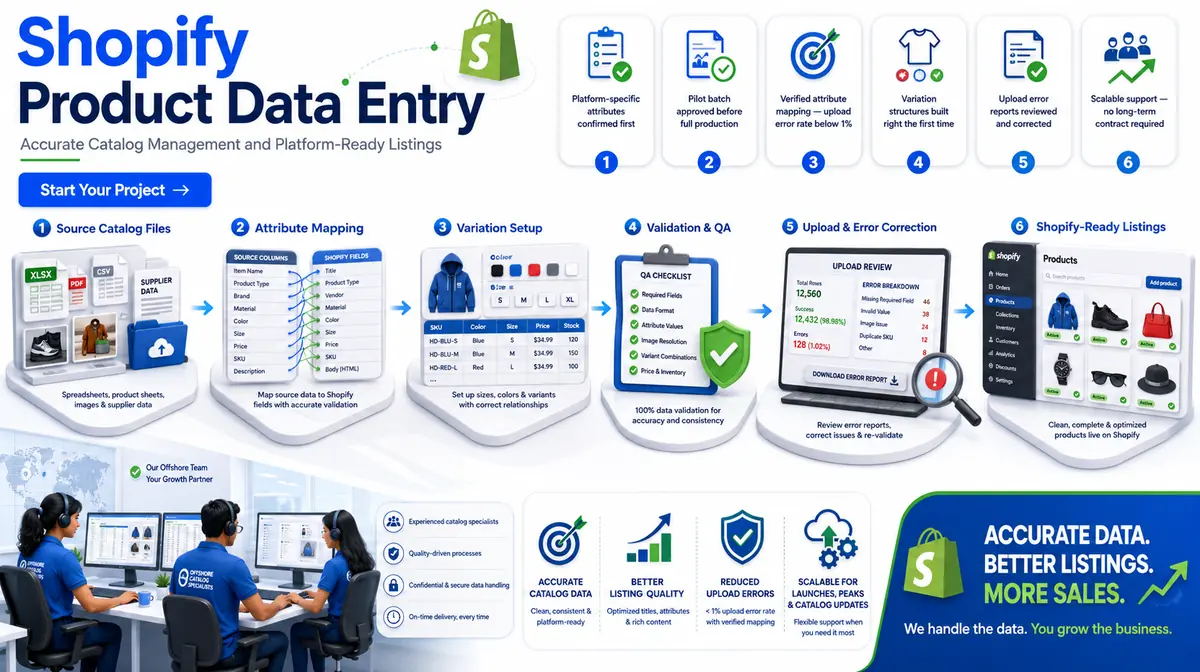
Shopify Product Data Entry That Keeps Storefront Content and Variant Operations Aligned

A Shopify product page combines shared product content with variant-level price, inventory, identifiers and option values. If those layers are mixed, customers can select one option while operational data points to another. Our professional Shopify product data entry services preserve the distinction throughout onboarding and maintenance.

An expert setup review defines handles, products, collections, Shopify categories, category or custom metafields, options, variants, media and sales-channel status. The delivery team then prepares approved records while assortment, pricing, inventory policy, theme behaviour and publication remain with store owners.

Merchants outsource migration, product launch or recurring catalog work when internal teams need more time for merchandising and growth. The solution delivers source-referenced Shopify records, reconciled import results and a separate queue for duplicate handles, invalid variants and unsupported content.

Shri Data Entry Services team working on Shopify Product Data Entry Services projects
5000+ Completed Projects
90% Returning Clients
16+ Years Experience
45+ Countries Served
50+ Professionals Team
Services We Offer

Keep shared content at product level and operational differences attached to the correct variant

  • Handle strategy approved
  • Shopify category assigned
  • Options defined
  • Variant SKU unique
  • Metafield definition matched
  • Channel status controlled

Title, description and vendor usually describe the product, while SKU, barcode, price, stock and shipping information can differ by variant. Images may belong to the whole product or support a particular option. A reliable Shopify catalog keeps those relationships clear.

We map supplier and legacy fields into the store’s approved product model, including standard categories, product types, collections, tags and metafield definitions. Option combinations are generated only from supported variants, and hidden or draft records remain under client-controlled status rules.

Controlled production supports large catalogs while the documented workflow protects store logic. Import failures, overwrites and incomplete variants are reconciled against the source instead of being discovered later on the storefront.
Products prepared for Shopify admin, CSV migration and ongoing store maintenance

The working structure follows the store’s current configuration, applications and sales-channel requirements.

01

Shopify product record creation

Approved title, description, vendor, handle, product type, Shopify category, tags, status and other store fields are prepared from brand and supplier sources. Duplicate or conflicting handles are held before import.

02

Variant and option data entry

Option names and values are organised into valid product variants with SKU, barcode, price, compare-at price, inventory, weight and other approved variant data. Every sellable combination is checked against source evidence.

03

Collection and merchandising field setup

Products are assigned to manual collections or supplied conditions and merchandising fields under client rules. Collection strategy, sort order and storefront promotion remain merchant decisions.

04

Category and custom metafield population

Shopify categories, category metafields and approved custom metafields are populated using their definitions and value types. Product specifications are not forced into unrelated text fields simply to make them visible.

05

Product media and alt-text association

Approved images and other supported media are matched to the correct product or variant, ordered according to the client’s brief and supplied with accurate descriptive alt text where requested.

06

Shopify CSV migration and result review

Product and variant rows are prepared in the applicable Shopify import structure, including handles and image URLs where used. Imported, failed and warned records are reconciled before the batch is closed.

Commerce Platform Compatibility

Shopify Product Data Entry Services: Direct Integration and Software Compatibility

Outputs are prepared around the field structure, controlled values and import requirements of your destination environment. Files can be delivered for review, staging or authorised import without forcing your team to rebuild the completed work.

Supported destinations

Catalog and product files prepared for multichannel commerce

Files are mapped to the client’s approved template, naming rules, identifiers and system structure before full production begins.

  • ShopifyProducts, variants and collections
  • WooCommerceCatalog and attribute imports
  • AmazonSeller and marketplace templates
  • eBayListings and item specifics
  • Magento / Adobe CommerceCatalog and store-view fields
  • PIM / ERP SystemsClient-defined product schemas
Source continuity

References stay connected

Source IDs, filenames, record keys and approved relationships remain available for review and downstream traceability.

Import control

Fields are mapped before production

Mandatory fields, formats, controlled values, character limits and relationship keys are checked against the destination specification.

Pilot validation

Test the handoff with a representative batch

Rejected rows, unsupported values and mapping conflicts are returned with exact references so approved corrections can be incorporated before full-volume delivery.

Delivery formatsStructured for review, staging or import
  • CSV
  • XLSX
  • XML

Column order, encoding, date rules, multi-value handling and destination-specific requirements can follow the receiving system’s approved specification.

Compatibility means SDES prepares outputs to specifications supplied or approved by the client. Product names identify commonly used destination systems and do not imply endorsement, certification or partnership.

Process, Quality and Security

A Shopify onboarding workflow from store-model review to import reconciliation

1. Inspect the Store Model

Markets, channels, products, collections, metafields, applications, permissions and publication owners are documented.

2. Align Shopify Products, Options and Variants

The setup review defines handles, categories, options, SKUs, inventory, media, metafields and source precedence.

3. Pilot Complex Products

Simple items, multi-option variants, metafields, multiple images and incomplete sources test the model.

4. Prepare Shopify Records

The delivery team captures approved data and maintains product, variant and media relationships.

5. Validate and Import Under Authority

Required fields, handles, option combinations, SKUs, values and image sources are checked before import.

6. Reconcile Store Results

Imported, skipped, failed and changed records are matched to the batch and exceptions are returned.

📂 Source formats we accept
  • Supplier and brand product data
  • Legacy store or platform exports
  • Shopify product CSV structure
  • Approved categories, collections and tags
  • Metafield definitions and value rules
  • Product and variant media libraries
📤 Delivery formats
  • Shopify-ready product CSV
  • Product and variant master file
  • Collection and category mapping
  • Metafield population file
  • Product-to-media relationship register
  • Import, duplicate and missing-data exception log

Quality checks cover handles, titles, categories, option names and values, variant SKU uniqueness, barcodes, prices, inventory fields, metafield types, media relationships and source-to-output counts.

Shopify features, CSV structures and store configurations evolve. The applicable store export or official documentation is reviewed for the working batch rather than relying on an old reusable template.

The production team prepares supported Shopify data. An expert merchant owner approves assortment, claims, categories, collections, prices, inventory policy, application effects and publication.

🔒 NDA Protected Before files are shared
🌐 GDPR Aware EU data handling
Defined Quality Target Confirmed by pilot
🛡️ Secure Transfer Encrypted file access
📋 Exception Log Every delivery
👥 Project Team Only Controlled access
Free accuracy test

Ready to improve your Shopify catalog quality?

Send us 20-50 products from your supplier source files and your target platform requirements. We prepare sample listings at no cost so you can review attribute accuracy, formatting and category placement before committing to the full project volume.

✓ No credit card required✓ No contract required✓ 24–48 hour return
Request Free Sample Listings
Source sampleyour_sample_data.csv
Received
Verified deliveryverified_output.xlsx
Reviewed
▣ Encrypted transfer◉ Quality controlled
Why Outsource to SDES?

Why Shopify catalog scale requires control over variants, definitions and import effects

Shopify Product Data Entry Services workflow and quality review
  • Handle continuity
  • Variant uniqueness
  • Category-aware attributes
  • Metafield validation
  • Import reconciliation
  • Scalable store capacity

Shopify merchants outsource professional product data entry when migration and recurring catalog updates are slowing merchandising and launch schedules.

The documented workflow lets the delivery team prepare supported store records while product selection, pricing, collection strategy, inventory policy, theme presentation and publication remain with the merchant.

Start Your Project →
Industries We Support

Shopify catalog support adapted to different products and storefront structures

Fashion and Apparel

Size, colour, style and material variants linked with option-specific SKUs, barcodes, prices and media.

Beauty and Consumer Goods

Ingredients, shades, packs, routines, subscriptions and approved custom fields organised by product.

Furniture and Homeware

Dimensions, finishes, materials, shipping fields, collections and assembly documents maintained consistently.

Electronics and Accessories

Models, capacities, interfaces, compatibility and warranty references attached to exact variants.

Tools and Specialist Products

Part numbers, specifications, units and technical metafields organised for search and filtering.

Agencies and Multi-Brand Stores

Client or supplier data converted into store-specific products with separate approval and publishing ownership.

Case Studies

Relevant Project Experience

Shopify Replatforming Product Migration

Project Name
Shopify Replatforming Product Migration
Volume
58,000 products and 176,000 variants — completed in 11 weeks
Problem
The legacy export mixed product and variant attributes, reused SKUs and stored specifications in unstructured HTML.
Solution
A professional mapping separated shared content, variant operations, categories and approved metafields before Shopify CSV preparation.
Outcome
The retailer received controlled import batches and a focused queue for duplicate SKUs, unsupported options and incomplete media.
Title
eCommerce Transformation Manager
Industry
Fashion Retail
Country
Canada

Category Metafield Catalog Upgrade

Project Name
Category Metafield Catalog Upgrade
Volume
24,000 active products — completed in 12 weeks
Problem
Important filter attributes were stored in tags and inconsistent custom fields, limiting catalog navigation and reuse.
Solution
The delivery team applied approved Shopify categories and mapped supported values into category or custom metafield definitions. The solution routed taxonomy conflicts for expert merchandising review.
Outcome
The store gained structured attributes without silently converting ambiguous tags into product facts.
Title
Product Experience Director
Industry
Home and Lifestyle
Country
United Kingdom

Seasonal Variant Launch Programme

Project Name
Seasonal Variant Launch Programme
Volume
12 launches and 31,000 new variants — completed in 2 weeks
Problem
Option combinations, images, prices and availability changed until shortly before each release, causing overwrite and publication risks.
Solution
Professional data entry used release-specific source registers, draft statuses and variant-level reconciliation before authorised activation.
Outcome
The merchant gained repeatable launch files with unresolved commercial changes separated from completed catalog records.
Title
Digital Merchandising Lead
Industry
Sportswear
Country
Australia
FAQs

Product status, variants and collection decisions in Shopify

Can you migrate products with variants and multiple images by CSV?

Yes, where the applicable Shopify import structure supports the required fields. Product, variant and image row relationships are tested before full migration.

Can you populate Shopify category metafields?

Yes. The product category and metafield definitions must be approved first, and values must match their expected type and permitted structure.

What should we provide when we outsource Shopify product data entry?

Provide store scope, source data, handle and SKU rules, categories, collections, option logic, metafield definitions, media, access permissions and publication owners.

Can Shopify Product Data Entry Services follow our existing template or platform fields?

Yes, when the destination fields, accepted values, identifiers and permitted actions are confirmed. Delivery can be prepared as Shopify-ready product CSV, Product and variant master file, with unresolved records excluded from upload-ready output.

📩 Get Free Sample Listings
💬