India-Based Data Entry Outsourcing Support Serving USA, Canada, UK, Australia, Europe, New Zealand, Singapore, UAE
Product Data Matching Services

Product Data Matching That Separates True Equivalence From Look-Alike Products

Matching two product records is easy when both carry the same reliable GTIN. It becomes risky when one source uses a supplier code, another shortens the model, and a third omits the pack size or regional suffix. Our professional product data matching services compare the evidence that defines the sellable item, not merely similar titles.

An expert setup establishes identifier authority, normalisation rules, blocking fields, comparison attributes, confidence bands and the decisions permitted at each threshold. The delivery team then builds and reviews candidates while uncertain identity, compatibility and substitution questions remain with qualified product owners.

Retailers, marketplaces and manufacturers outsource cross-source matching when supplier onboarding, catalog consolidation or price analysis exceeds internal capacity. The solution delivers confirmed links, rejected candidates and review-ready pairs with the reasons behind every classification.

Shri Data Entry Services team working on Product Data Matching Services projects
5000+ Completed Projects
90% Returning Clients
16+ Years Experience
45+ Countries Served
50+ Professionals Team
Services We Offer

Match records at the exact product, variant, pack and regional level required by the business use

  • Match purpose defined
  • Identifier trust ranked
  • Blocking fields selected
  • Variants isolated
  • Thresholds approved
  • Non-matches retained

The same underlying model may appear with different titles across suppliers, yet two listings with nearly identical names may represent different voltage, generation, capacity or pack quantity. The acceptable match level therefore depends on what the result will drive.

We normalise comparison fields without erasing meaningful differences, then combine exact identifiers, brand, manufacturer number, model tokens and category-specific attributes. Candidate pairs receive evidence and a status rather than a concealed yes-or-no decision.

Structured production review makes large candidate sets manageable. The documented workflow keeps automatic acceptance narrow, routes borderline cases to trained reviewers and reserves business-sensitive equivalence decisions for authorised client specialists.
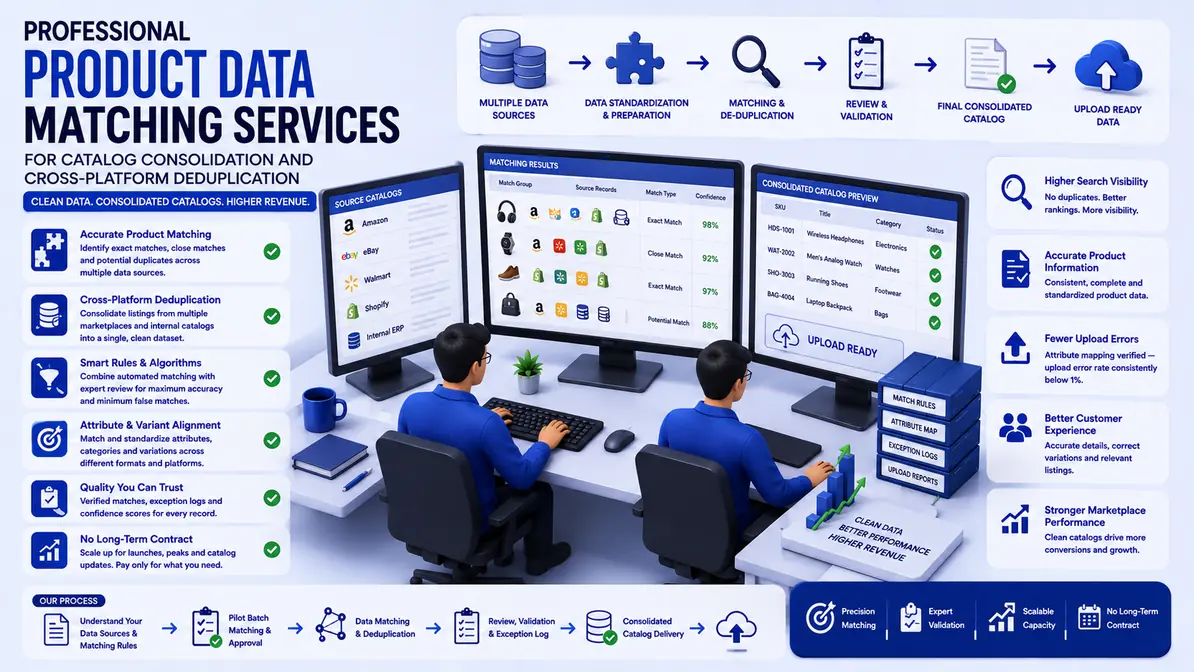

Evidence-based matching for source integration, catalog control and market comparison

Rules are designed around the intended use of the link and the cost of a false match.

01

Exact identifier and key matching

GTIN, UPC, EAN, ISBN, manufacturer part number, internal SKU and approved supplier keys are cleaned and compared under defined trust rules. Reused, malformed or conflicting identifiers are excluded from automatic acceptance.

02

Title, brand and model comparison

Names are tokenised and normalised for punctuation, casing and approved abbreviations while brand, model family and distinguishing suffixes remain explicit. Title similarity supports a match but does not override contradictory identity evidence.

03

Category-specific attribute matching

Relevant attributes such as capacity, dimensions, material, voltage, fitment, edition or dosage are compared according to the category. Missing values reduce confidence; incompatible values can block a candidate entirely.

04

Variant, multipack and bundle alignment

Parent families are separated from sellable variants, pack counts and bundles before linking. The same base product in a different colour, quantity, region or included-component configuration is classified at the approved granularity.

05

Duplicate and cross-catalog candidate review

Candidate groups from suppliers, PIM systems, marketplaces or acquired catalogs are presented with side-by-side evidence. Reviewers confirm, reject or escalate each pair without deleting or merging source records.

06

Confidence scoring and exception delivery

Match outcomes are divided into approved confidence bands with rule-level reasons. Confirmed links, definite non-matches and unresolved pairs are delivered separately so downstream systems do not treat uncertainty as fact.

Commerce Platform Compatibility

Product Data Matching Services: Direct Integration and Software Compatibility

Outputs are prepared around the field structure, controlled values and import requirements of your destination environment. Files can be delivered for review, staging or authorised import without forcing your team to rebuild the completed work.

Supported destinations

Catalog and product files prepared for multichannel commerce

Files are mapped to the client’s approved template, naming rules, identifiers and system structure before full production begins.

  • ShopifyProducts, variants and collections
  • WooCommerceCatalog and attribute imports
  • AmazonSeller and marketplace templates
  • eBayListings and item specifics
  • Magento / Adobe CommerceCatalog and store-view fields
  • PIM / ERP SystemsClient-defined product schemas
Source continuity

References stay connected

Source IDs, filenames, record keys and approved relationships remain available for review and downstream traceability.

Import control

Fields are mapped before production

Mandatory fields, formats, controlled values, character limits and relationship keys are checked against the destination specification.

Pilot validation

Test the handoff with a representative batch

Rejected rows, unsupported values and mapping conflicts are returned with exact references so approved corrections can be incorporated before full-volume delivery.

Delivery formatsStructured for review, staging or import
  • CSV
  • XLSX
  • XML

Column order, encoding, date rules, multi-value handling and destination-specific requirements can follow the receiving system’s approved specification.

Compatibility means SDES prepares outputs to specifications supplied or approved by the client. Product names identify commonly used destination systems and do not imply endorsement, certification or partnership.

Process, Quality and Security

A product matching workflow from identity design to review-ready links

1. Define the Match Purpose

The intended use, required granularity, source systems, product families and false-match risk are documented.

2. Design Evidence Rules

The setup review ranks identifiers, normalises comparison fields and approves blocks, weights and thresholds.

3. Calibrate Known Examples

Confirmed matches, difficult non-matches, variants and sparse records test how the rules behave.

4. Build and Review Candidates

The delivery team evaluates candidate pairs and records supporting, missing and contradictory evidence.

5. Audit Match Decisions

Sampled outcomes, confidence bands, category patterns and reviewer consistency are checked by batch.

6. Release Links and Exceptions

Confirmed matches, rejections and owner-review pairs are delivered with reasons and source references.

📂 Source formats we accept
  • Catalog and supplier product exports
  • GTIN, SKU and manufacturer-number files
  • Approved brand and model dictionaries
  • Category-specific comparison attributes
  • Variant, pack and bundle definitions
  • Known matches, non-matches and review authority
📤 Delivery formats
  • Confirmed product match table
  • Cross-source product ID map
  • Rejected candidate register
  • Confidence score and reason dataset
  • Variant and pack alignment file
  • Ambiguous-pair review queue

Quality review measures precision on sampled decisions, false-match patterns, threshold behaviour, identifier conflicts, category-specific contradictions, variant separation and agreement between match status and recorded evidence.

A confidence score is meaningful only when its rules and training examples match the current catalog. Thresholds are calibrated by category and use case rather than copied unchanged across unrelated product families.

The production team evaluates approved evidence. An expert client owner approves equivalence policy, substitutions, compatibility, master-record selection, destructive merges and use of unresolved candidates.

🔒 NDA Protected Before files are shared
🌐 GDPR Aware EU data handling
Defined Quality Target Confirmed by pilot
🛡️ Secure Transfer Encrypted file access
📋 Exception Log Every delivery
👥 Project Team Only Controlled access
Free accuracy test

Need product data matched across multiple sources or platforms?

Share sample files from the sources you need matched and describe your consolidation objectives. We run a free sample matching process so you can review accuracy and confidence scoring before committing to the full project.

✓ No credit card required✓ No contract required✓ 24–48 hour return
Get a Free Matching Sample
Source sampleyour_sample_data.csv
Received
Verified deliveryverified_output.xlsx
Reviewed
▣ Encrypted transfer◉ Quality controlled
Why Outsource to SDES?

Why dependable matching requires explicit tolerance for uncertainty

Product Data Matching Services workflow and quality review
  • Purpose-based granularity
  • Identifier hierarchy
  • Category evidence
  • False-match controls
  • Reasoned confidence bands
  • Scalable human review

Data and commerce teams outsource professional product data matching when cross-source comparison and exception review consume the time of catalog specialists.

The documented workflow lets the delivery team handle structured candidate evaluation while compatibility, substitution, product-family policy and consequential merge decisions remain with authorised owners.

Start Your Project →
Industries We Support

Product matching adapted to the evidence available in each market

Retail and Marketplaces

Supplier and marketplace listings matched at SKU, variant and pack level for catalog consolidation and offer comparison.

Industrial Parts

Manufacturer numbers, technical ratings, supersession and equipment compatibility used to distinguish similar components.

Electronics

Model, region, generation, capacity, connectivity and included components compared before records are linked.

Medical and Laboratory Supply

Approved identifiers, sizes, pack structures and device or consumable specifications matched without inferring equivalence.

Home and Building Products

Dimensions, finish, material, configuration and package details used to align exact sellable products.

Publishing and Media

ISBN, edition, format, language, contributor and release details separate equivalent works from distinct products.

Case Studies

Relevant Project Experience

Marketplace Offer-to-Catalog Matching

Project Name
Marketplace Offer-to-Catalog Matching
Volume
2.3 million seller offers against 410,000 catalog products — completed in 5 weeks
Problem
Seller titles varied widely, and reused barcodes created false candidates across pack quantities and regional versions.
Solution
A professional hierarchy combined trusted identifiers with brand, model, pack and category attributes; conflicting barcode cases were blocked from automatic acceptance.
Outcome
The marketplace received explainable product links and a compact queue for offers lacking enough identity evidence.
Title
Catalog Intelligence Director
Industry
Online Marketplace
Country
Singapore

Automotive Parts Cross-Reference

Project Name
Automotive Parts Cross-Reference
Volume
860,000 supplier records and 6.4 million vehicle links — completed in 5 weeks
Problem
Suppliers represented superseded and compatible parts differently, making title similarity unsuitable for exact-item matching.
Solution
The delivery team compared manufacturer number, brand, technical dimensions and approved supersession data. The solution kept exact identity separate from compatibility and routed borderline cases to expert parts reviewers.
Outcome
The distributor consolidated duplicate source records without declaring interchangeable parts solely from shared fitment.
Title
Product Data Programme Manager
Industry
Automotive Aftermarket
Country
United States

Book Catalog Merger

Project Name
Book Catalog Merger
Volume
1.1 million records from four acquired businesses — completed in 12 weeks
Problem
Records mixed editions, bindings, languages and reprints under shortened titles, while some ISBN fields contained formatting errors.
Solution
Professional matching normalised valid ISBNs and combined contributor, publisher, edition, language and format evidence for records without dependable identifiers.
Outcome
The publisher gained a cross-system title map that preserved distinct editions and exposed unresolved legacy records.
Title
Metadata Integration Lead
Industry
Publishing
Country
Canada
FAQs

Which identifiers are sufficient to establish a product match?

Can products be matched when a reliable barcode is unavailable?

Often, yes. Brand, manufacturer number, model and category attributes can support a match, but missing evidence lowers confidence and may require owner review.

Do you merge the matched records?

Not unless explicitly authorised. Standard delivery links source identifiers and records match status; destructive merging remains a separate controlled decision.

What should we provide when we outsource product data matching?

Provide source catalogs, identifiers, brand and model rules, relevant attributes, variant and pack definitions, known examples, thresholds and review owners.

What should a Product Data Matching Services pilot contain?

Provide Catalog and supplier product exports, GTIN, SKU and manufacturer-number files, Approved brand and model dictionaries. The pilot should include ordinary records and known exceptions so field interpretation, review rules and delivery structure can be confirmed before production.

📩 Get a Free Matching Sample
💬