
India-Based Data Entry Outsourcing Support Serving USA, Canada, UK, Australia, Europe, New Zealand, Singapore, UAE
Accounts Payable & Receivable

Accounts Payable and Receivable Data Entry Built Around What Is Owed, Paid and Still Unresolved

Payables and receivables are connected by timing, evidence and responsibility. A supplier invoice entered twice can trigger an incorrect payment; a customer receipt left unapplied can make a settled account appear overdue. Our professional AP and AR data entry services keep the source, account, document and status relationships visible.

An expert setup maps supplier and customer masters, invoice fields, purchase-order references, allocation rules, credit handling and approval states. The delivery team then processes source-supported records while payment release, credit approval, collection decisions, write-offs and financial sign-off remain with authorised client personnel.

Companies outsource recurring queues or transaction backlogs when internal AP and AR specialists need more time for supplier issues, customer communication, working-capital review and exceptions. The solution delivers controlled entries, reconciled batch totals and separate items requiring commercial or accounting judgement.

Shri Data Entry Services team working on Accounts Payable and Receivable Data Entry Services projects
5000+ Completed Projects
90% Returning Clients
16+ Years Experience
45+ Countries Served
50+ Professionals Team
Services We Offer

Keep payment obligations and customer balances accurate without treating AP and AR as the same workflow

  • Counterparty verified
  • Document number checked
  • Amount and currency balanced
  • Allocation evidence retained
  • Approval status recorded
  • Exceptions assigned

Accounts payable begins with an obligation supported by a supplier document and, where applicable, a purchase order, receipt or approval. Accounts receivable begins with an authorised charge and continues through invoice delivery, customer payment, deductions, credits and unresolved balances. The fields may look similar, but their controls and owners differ.

We configure separate intake, validation and exception rules for each ledger. Supplier duplicate checks should not be confused with customer cash allocation; a pricing discrepancy is not handled like an unidentified receipt. This prevents a generic data-entry queue from obscuring the business reason an item remains open.

Controlled production can absorb high transaction volumes while preserving authority boundaries. The documented workflow makes completed records usable and leaves reviewers a concise queue of mismatches, missing support and decisions they actually need to make.
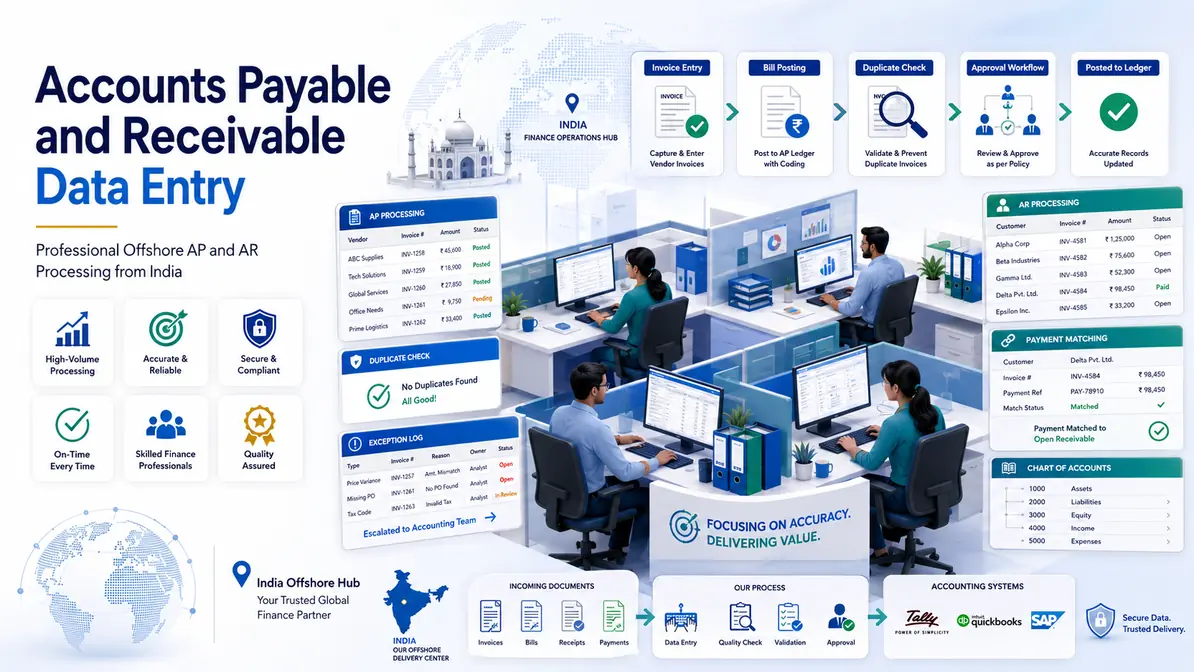

Operational data support for the full invoice-to-payment and billing-to-cash record cycle

Each workstream retains its own masters, evidence, status logic and approval route.

01

Supplier invoice intake and entry

Supplier, invoice number, entity, dates, currency, purchase-order reference, line values, tax and approved coding are captured from bills and supporting documents. Duplicate-risk invoices, missing legal-entity details and arithmetic differences are held before posting.

02

Purchase-order and receipt matching support

Invoice lines are compared with supplied purchase orders and goods or service receipt evidence using client-defined tolerances. Quantity, price, tax and reference differences are documented for the buyer, requester or AP owner rather than resolved through operator judgement.

03

Payment-status and supplier record updates

Approved payment references, dates, methods and statuses are recorded against the relevant payable items. The service supports payment-register accuracy but does not select payments, change supplier banking details or authorise the release of funds.

04

Customer billing data preparation

Authorised sales orders, delivery records, milestones, time files or billing schedules are converted into customer invoice inputs with account, dates, currency, line description, tax and revenue references. Commercial approval remains with the client.

05

Remittance and cash application entry

Customer remittances and bank receipts are matched to invoice references under approved allocation rules. Partial payments, consolidated receipts, deductions and unidentified cash are separated for receivables review.

06

Ageing and dispute-record maintenance

Open-item statuses, promised dates, dispute categories, credit notes and approved collection notes are updated from authorised sources. The team records decisions and communication outcomes but does not negotiate disputes or determine write-offs.

Finance Software Compatibility

Accounts Payable Data Entry: Direct Integration and Software Compatibility

Outputs are prepared around the field structure, controlled values and import requirements of your destination environment. Files can be delivered for review, staging or authorised import without forcing your team to rebuild the completed work.

Supported destinations

Review-ready records for accounting and ERP workflows

Files are mapped to the client’s approved template, naming rules, identifiers and system structure before full production begins.

  • QuickBooksVendor, invoice and account fields
  • XeroBills, contacts and reference data
  • SageAccounting import templates
  • NetSuiteERP records and relationship keys
  • Dynamics 365Finance staging structures
  • Custom SQLControlled finance tables
Source continuity

References stay connected

Source IDs, filenames, record keys and approved relationships remain available for review and downstream traceability.

Import control

Fields are mapped before production

Mandatory fields, formats, controlled values, character limits and relationship keys are checked against the destination specification.

Pilot validation

Test the handoff with a representative batch

Rejected rows, unsupported values and mapping conflicts are returned with exact references so approved corrections can be incorporated before full-volume delivery.

Delivery formatsStructured for review, staging or import
  • CSV
  • XLSX
  • IIF

Column order, encoding, date rules, multi-value handling and destination-specific requirements can follow the receiving system’s approved specification.

Compatibility means SDES prepares outputs to specifications supplied or approved by the client. Product names identify commonly used destination systems and do not imply endorsement, certification or partnership.

Process, Quality and Security

A controlled AP and AR cycle from document receipt to ledger-owner review

1. Separate the Ledger Rules

Supplier and customer masters, status definitions, tolerances, permissions and escalation owners are documented independently.

2. Map the Transaction Evidence

The setup review connects invoice, order, receipt, bank and remittance fields to the required system records.

3. Test Normal and Exceptional Items

A pilot includes credits, partial receipts, possible duplicates, unmatched documents and unidentified cash.

4. Process Source-Supported Records

The delivery team captures approved fields, retains document references and applies only documented matching or allocation rules.

5. Balance the Batches

Document counts, invoice values, payment totals, receipt amounts and matched or unmatched positions are reconciled.

6. Return Decisions to Their Owners

Posting-ready records and held exceptions are separated for AP, AR, procurement, sales or finance approval.

We process AP and AR data from the documents your business already receives

Supplier invoices and customer billing documents arrive in many formats. We process them all accurately into your accounting system or output format.

📂 Source formats we accept
  • Supplier invoices, credits and approvals
  • Purchase orders and receipt evidence
  • Customer orders and billing schedules
  • Bank receipts and customer remittances
  • Payment registers and credit notes
  • AP and AR ageing or open-item exports
📤 Delivery formats
  • Validated AP and AR entry batches
  • Source-linked invoice and receipt registers
  • Matched and unmatched item schedules
  • Cash application worksheet
  • Updated ageing support records
  • Duplicate, discrepancy and allocation exception log

Before starting any AP or AR data entry project, we review a sample of your source documents, confirm the coding structure and agree the exception handling process with your accounting team.

AP controls may include supplier and invoice-number duplicate checks, invoice arithmetic, purchase-order references, tax totals and batch values. AR controls may include invoice allocation, remittance totals, unapplied amounts and agreement with bank evidence.

Supplier bank-detail changes, payment release and customer credit decisions sit outside routine data entry. Access permissions and workflow statuses are configured so production completion cannot be mistaken for financial authorisation.

The production team records what the source supports. An expert client owner reviews price or quantity differences, disputed charges, unidentified receipts, deductions, credit requests and items that exceed approved tolerances.

🔒 NDA Protected Before files are shared
🌐 GDPR Aware EU data handling
Defined Quality Target Confirmed by pilot
🛡️ Secure Transfer Encrypted file access
📋 Exception Log Every delivery
👥 Project Team Only Controlled access
Free accuracy test

Ready to remove invoice and transaction processing from your accounting team's schedule?

Share a sample of your AP or AR source documents, your accounting platform and your monthly volume estimate. We provide a specific, transparent quote within the agreed response window and include a free pilot batch so your team can verify coding accuracy, field mapping and exception handling before committing to production.

✓ No credit card required✓ No contract required✓ 24–48 hour return
Get a Free AP/AR Pilot
Source sampleyour_sample_data.csv
Received
Verified deliveryverified_output.xlsx
Reviewed
▣ Encrypted transfer◉ Quality controlled
Why Outsource to SDES?

Why AP and AR capacity should improve visibility rather than accelerate weak records

Accounts Payable and Receivable Data Entry Services workflow and quality review
  • Separate AP and AR controls
  • Counterparty-master checks
  • Duplicate-risk identification
  • Allocation evidence
  • Balanced batch summaries
  • Scalable transaction capacity

Finance teams outsource professional AP and AR data entry when repetitive capture and matching reduce the time available for supplier resolution, cash collection and working-capital analysis.

The documented workflow gives the delivery team sufficient rules to complete supported work while keeping payment authority, customer negotiations, banking changes, credits and write-offs with named client owners.

Start Your Project →
Industries We Support

AP and AR support shaped by the documents and settlement patterns of each sector

Manufacturing and Distribution

High-volume supplier bills, purchase-order matches, freight charges, customer invoices and credit adjustments across entities.

Retail and eCommerce

Marketplace settlements, supplier invoices, refunds, payment fees and multi-channel customer receipt records.

Property and Facilities

Property-level supplier charges, recurring contracts, tenant billing, service charges and receipt allocation.

Transport and Logistics

Carrier invoices, fuel and toll records, shipment billing, accessorial charges and customer remittances.

Healthcare Operations

Non-clinical supplier invoices, facility expenses, approved customer or partner billing and restricted financial records.

Project-Based Businesses

Milestone, time and expense billing inputs alongside contractor invoices and project-specific allocations.

Case Studies

Relevant Project Experience

Purchase-to-Pay Intake Stabilisation

Project Name
Purchase-to-Pay Intake Stabilisation
Volume
31,000 supplier invoices per month
Problem
Invoices arrived through email, supplier portals and scanned mail, creating duplicate submissions and incomplete purchase-order references before AP review. For the Purchase-to-Pay Intake Stabilisation in United States workload, channel teams had to compare supplier sources manually, slowing publication and increasing the risk of inconsistent product records.
Solution
A professional intake register normalised source channels, supplier identities and invoice keys; approved matching fields were captured while tolerance failures remained separate. Within the Purchase-to-Pay Intake Stabilisation in United States workflow, the team preserved supplier provenance and applied approved mappings only where the source supported the destination value.
Outcome
AP reviewers received balanced posting batches and one duplicate or mismatch queue instead of searching across three intake channels. Following delivery for Purchase-to-Pay Intake Stabilisation in United States, the client received a clean operational file, a source-linked exception register and clearer ownership of the remaining decisions.
Title
Procure-to-Pay Operations Head
Industry
Food Distribution
Country
United States

Customer Cash Allocation Recovery

Project Name
Customer Cash Allocation Recovery
Volume
86,000 receipts across nine months — completed in 4 weeks
Problem
Consolidated payments and inconsistent remittance references left a large unapplied-cash balance even though many customers had provided allocation evidence. Within Customer Cash Allocation Recovery in United Kingdom, the resulting uncertainty weakened segmentation and made routine follow-up more dependent on manual verification.
Solution
The delivery team linked bank references, remittance files and open-item exports under agreed confidence rules. The solution returned multi-account and deduction cases for specialist review.
Outcome
Supported receipts moved into allocation-ready files while genuinely unidentified cash remained visible and traceable. After completing Customer Cash Allocation Recovery in United Kingdom, the archive became easier to migrate, audit and retrieve without losing the link to the original source files.
Title
Accounts Receivable Director
Industry
Business Supplies
Country
United Kingdom

Property AP and Tenant AR Desk

Project Name
Property AP and Tenant AR Desk
Volume
12,400 transactions per month
Problem
Property codes, supplier bills and tenant receipts were maintained in separate regional worksheets with inconsistent status labels. During the Property AP and Tenant AR Desk in Australia review, without dependable product keys, routine updates could attach attributes, prices or assets to the wrong listing.
Solution
Professional master tables aligned property, counterparty and status values before recurring data entry began; payment and credit authority stayed with regional finance teams. For Property AP and Tenant AR Desk in Australia, entity, supplier, date, amount and reference fields received targeted checks, with unsupported accounting decisions held outside the upload file.
Outcome
The group gained comparable property-level AP and AR schedules plus a clearly owned exception register. Following delivery for Property AP and Tenant AR Desk in Australia, finance personnel received review-ready records with source-linked exceptions, allowing matching and approval work to continue more efficiently.
Title
Property Finance Manager
Industry
Commercial Real Estate
Country
Australia
FAQs

Questions to settle before AP and AR records move into production

Can your team authorise supplier payments or customer credits?

No. We record approved information and workflow status. Payment release, bank-detail changes, credit approval, write-offs and commercial decisions remain with authorised client personnel.

How are possible duplicate invoices handled?

Approved matching fields—such as supplier, invoice number, date, amount and entity—are compared. Suspected duplicates are held with their source references for AP review.

What is needed when we outsource cash application data entry?

Provide bank receipt evidence, customer remittances, open-item data, allocation rules, tolerance limits, exception owners and the required system or output format.

Can Accounts Payable and Receivable Data Entry Services follow our existing template or platform fields?

Yes, when the destination fields, accepted values, identifiers and permitted actions are confirmed. Delivery can be prepared as Validated AP and AR entry batches, Source-linked invoice and receipt registers, with unresolved records excluded from upload-ready output.

📩 Get a Free Pilot
💬