
India-Based Data Entry Outsourcing Support Serving USA, Canada, UK, Australia, Europe, New Zealand, Singapore, UAE
CRM Database Management

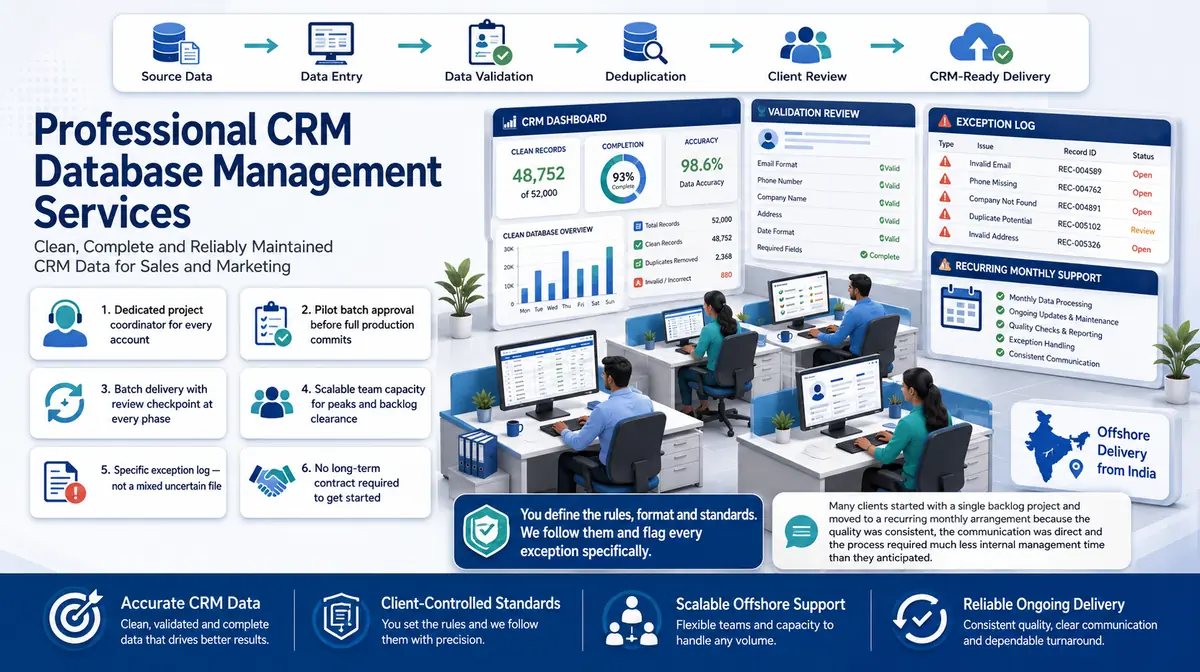
CRM Database Management Services That Preserve Relationships, Ownership and Sales Context

Sales teams stop trusting a CRM gradually. First, a contact appears under the wrong company. Then an opportunity loses its owner, an activity is attached to an unrelated record or a custom field develops several meanings. The database still looks populated, but users begin checking information elsewhere before acting.

Our professional CRM database management work starts by reconstructing how the client’s records are meant to relate. Objects, ownership, lifecycle definitions, update authority and source precedence are documented together. Only then does the offshore production team begin cleansing, enrichment, migration preparation or recurring maintenance.

A company may outsource the repeatable record work without handing over commercial judgement. Duplicate candidates, uncertain associations and unsupported stage changes move to named owners. That division gives expert sales and operations teams a governed solution for restoring confidence in the CRM instead of another cosmetic cleanup.

Shri Data Entry Services team working on CRM Database Management Services projects
5000+ Completed Projects
90% Returning Clients
16+ Years Experience
45+ Countries Served
50+ Professionals Team
Services We Offer

Clean fields are not enough when the customer relationships are wrong

  • Contact-to-account rules confirmed
  • Owners and territories preserved
  • Lifecycle and pipeline definitions documented
  • Custom fields assigned clear meaning
  • Duplicate authority separated from matching
  • Source and update date retained

A contact can be spelled correctly and still be unusable if it belongs to the wrong company or sits outside the account hierarchy. An opportunity can contain every required field and still mislead the forecast if its stage was advanced without evidence. CRM quality depends on relationships and business meaning, not only populated cells.

We identify which source controls each record family. A signed customer form, approved sales note, marketing platform, billing record and website may provide different facts. The workflow states when a value may update the CRM, when it should enrich an empty field and when a conflict must return to the record owner.

Contact deduplication also requires restraint. Similar names or domains can indicate a duplicate, a subsidiary, a shared mailbox or two different people. Candidates can be grouped and supported with evidence, but merges and survivorship decisions follow client-approved governance.

Maintenance across identity, relationships, pipeline and activity history

Every capability is configured around the client’s object model and authorised sources.

01

Contact and account maintenance

Names, roles, companies, addresses and approved relationship fields are added or updated without breaking existing ownership or hierarchy.

02

Lead database management

Lead records are entered, enriched and routed using confirmed source, status and assignment rules; qualification decisions remain with sales.

03

Sales pipeline data entry

Approved opportunity values, stages, amounts, dates and activity references are maintained without advancing commercial decisions unsupported by evidence.

04

CRM data cleansing

Formats, missing values, outdated records and controlled fields are reviewed against approved rules and sources.

05

Duplicate candidate preparation

Exact and probable matches are identified using record identifiers, email, domain, company and relationship evidence for authorised review.

06

CRM migration and validation

Source fields, objects and relationships are mapped into import-ready files, with rejected values and unresolved associations separated.

CRM Software Compatibility

CRM Database Management Services: Direct Integration and Software Compatibility

Outputs are prepared around the field structure, controlled values and import requirements of your destination environment. Files can be delivered for review, staging or authorised import without forcing your team to rebuild the completed work.

Supported destinations

Field-mapped records for customer and sales platforms

Files are mapped to the client’s approved template, naming rules, identifiers and system structure before full production begins.

  • SalesforceObjects, owners and custom fields
  • HubSpotContacts, companies and deals
  • Zoho CRMModules and approved layouts
  • Dynamics 365Entities and relationship keys
  • PipedrivePeople, organisations and pipelines
  • Custom CRM / SQLStaging and import tables
Source continuity

References stay connected

Source IDs, filenames, record keys and approved relationships remain available for review and downstream traceability.

Import control

Fields are mapped before production

Mandatory fields, formats, controlled values, character limits and relationship keys are checked against the destination specification.

Pilot validation

Test the handoff with a representative batch

Rejected rows, unsupported values and mapping conflicts are returned with exact references so approved corrections can be incorporated before full-volume delivery.

Delivery formatsStructured for review, staging or import
  • CSV
  • XLSX
  • JSON

Column order, encoding, date rules, multi-value handling and destination-specific requirements can follow the receiving system’s approved specification.

Compatibility means SDES prepares outputs to specifications supplied or approved by the client. Product names identify commonly used destination systems and do not imply endorsement, certification or partnership.

Process, Quality and Security

How customer data moves through a governed CRM maintenance cycle

1. Map Objects and Relationships

Contacts, companies, leads, opportunities, activities and custom records are placed in the client’s relationship model.

2. Rank Sources and Owners

Authoritative sources and accountable record owners are identified for each field family.

3. Define Update and Merge Rights

Permitted edits, enrichment, candidate matching and prohibited changes are documented.

4. Test Real CRM Exceptions

A pilot includes duplicates, missing associations, ownership conflicts and rejected controlled values.

5. Process by Record Queue

New, update, enrich, review and held records remain distinguishable through production.

6. Reconcile and Improve

Import results, rejected records, exception themes and approved feedback update the working guide.

CRM inputs should be interpreted through the object model before they become updates

The same value can mean something different depending on the object, source and record owner.

📂 Source formats we accept
  • CRM exports
  • Approved contact and account sources
  • Lead lists
  • Sales activity records
  • Field dictionary
  • Migration or update rules
📤 Delivery formats
  • Import-ready CRM files
  • Updated approved records
  • Duplicate candidate queue
  • Relationship exception log
  • Validation report
  • Migration reconciliation

Representative data should include subsidiaries, shared domains, former contacts, reassigned owners, reopened opportunities and custom-field exceptions.

CRM validation checks required identifiers, relationships, controlled values, dates and owner references. A syntactically valid import is not treated as proof that the business relationship is correct.

Access can be restricted by object, record, field and action where the platform permits it. Export, deletion, merge, bulk update and user-administration rights should remain unavailable unless required and approved.

This page does not imply universal compliance, savings or accuracy. The engagement defines the platform controls, sample review, migration reconciliation and exception handling used for the actual scope.

🔒 NDA Protected Before files are shared
🌐 GDPR Aware EU data handling
Defined Quality Target Confirmed by pilot
🛡️ Secure Transfer Encrypted file access
📋 Exception Log Every delivery
👥 Project Team Only Controlled access
Free accuracy test

Does your CRM contain data but still fail to provide a dependable customer view?

Share a redacted field list, object structure, sample records and the business problem affecting users. We will map the relationships and decision boundary before recommending work.

✓ No credit card required✓ No contract required✓ 24–48 hour return
Discuss CRM Data Management
Source sampleyour_sample_data.csv
Received
Verified deliveryverified_output.xlsx
Reviewed
▣ Encrypted transfer◉ Quality controlled
Why Outsource to SDES?

Why organisations outsource repeatable CRM maintenance while preserving commercial ownership

CRM Database Management Services workflow and quality review
  • Professional object-level instructions
  • Expert escalation for relationship conflicts
  • Offshore capacity for recurring queues
  • Duplicate candidates never merged silently
  • Source and owner context retained
  • Sales decisions remain internal

A CRM database management solution should make the system easier to trust, not simply fuller. SDES connects each routine update to a source, object and ownership rule, then keeps uncertain records outside the clean production queue.

Sales, marketing and service leaders retain qualification, stage, territory and commercial decisions. Our team applies approved maintenance rules, allowing businesses to outsource CRM data cleansing and customer record updates without transferring responsibility for the customer relationship.

Start Your Project →
Industries We Support

CRM records shaped by different customer journeys

B2B Technology

Account hierarchies, contacts, opportunities and subscription relationships.

Professional Services

Clients, engagements, referrals and business-development activities.

Real Estate

Prospects, properties, viewings and transaction-stage records.

Financial Services

Approved client and activity data without advice or transaction authority.

Manufacturing

Accounts, distributors, products and long-cycle opportunities.

Retail and eCommerce

Customer, campaign and service records linked to approved sources.

Case Studies

Relevant Project Experience

B2B Account Relationship Repair

Project Name
B2B Account Relationship Repair
Volume
71,585 records — completed in 4 weeks
Problem
Contacts were attached to local entities while opportunities and contracts used parent records inconsistently. Within B2B Account Relationship Repair in United States, the resulting uncertainty weakened segmentation and made routine follow-up more dependent on manual verification.
Solution
Account relationships were mapped from approved identifiers; uncertain companies and ownership conflicts entered a review queue. Within the B2B Account Relationship Repair in United States workflow, source-to-field rules were documented so contacts, organisations, activities and statuses entered the correct CRM objects.
Outcome
The project created a clearer account structure without allowing the offshore team to decide commercial ownership. After completing B2B Account Relationship Repair in United States, sales and service teams could use more consistent account histories without unsafe automatic merges.
Title
Revenue Operations Director
Industry
Business Software
Country
United States

Consulting Pipeline Hygiene Cycle

Project Name
Consulting Pipeline Hygiene Cycle
Volume
38,182 records per month
Problem
Stages, expected dates and meeting records were maintained differently across practice teams. During the Consulting Pipeline Hygiene Cycle in United Kingdom review, possible duplicates and inconsistent identifiers created a risk of merging separate customers or fragmenting one account history.
Solution
Approved stage evidence and activity sources were defined by practice, while unsupported forecast changes stayed with partners. For Consulting Pipeline Hygiene Cycle in United Kingdom, confirmed identifiers controlled updates, while duplicate, ownership and relationship decisions remained with authorised CRM administrators.
Outcome
The professional operations team could review exceptions instead of inspecting every routine CRM update. After completing Consulting Pipeline Hygiene Cycle in United Kingdom, sales and service teams could use more consistent account histories without unsafe automatic merges.
Title
Business Development Operations Lead
Industry
Consulting
Country
United Kingdom

Property Contact Duplicate Review

Project Name
Property Contact Duplicate Review
Volume
53,578 records — completed in 6 weeks
Problem
Shared households, repeat enquiries and agent-created records produced high similarity but not always true duplicates. For the Property Contact Duplicate Review in Australia workload, sales and service users could not rely on ownership, relationship or activity fields without checking the original sources.
Solution
Candidates were grouped using contact, property and source evidence; expert branch owners retained merge authority. For Property Contact Duplicate Review in Australia, confirmed identifiers controlled updates, while duplicate, ownership and relationship decisions remained with authorised CRM administrators.
Outcome
The resulting workflow separated likely duplicates from valid related contacts and preserved enquiry history. After completing Property Contact Duplicate Review in Australia, sales and service teams could use more consistent account histories without unsafe automatic merges.
Title
CRM Programme Manager
Industry
Real Estate
Country
Australia
FAQs

Questions about CRM database management

Can SDES merge duplicate CRM records?

Candidates can be identified and documented. Merge and survivorship actions should follow client-approved rules because similar records may represent related people, subsidiaries or separate histories.

Can pipeline stages be updated?

Yes, when the evidence and permitted stage transition are defined. Qualification, forecast judgement and commercial decisions remain with authorised sales owners.

Can you migrate data between CRM platforms?

Yes. Source objects, fields, relationships and controlled values are mapped, tested through sample imports and reconciled against accepted and rejected records.

How is quality checked for CRM Database Management Services?

Quality checks for CRM Database Management Services are scaled to the operational risk in CRM records and platform relationships — required fields, identifiers, controlled values, cross-field relationships and source correspondence all get reviewed. The review method is tested during the pilot batch.

📩 Review a CRM Sample
💬