
Item master entry
Approved SKU, name, category, brand, unit and status fields are prepared for system review.
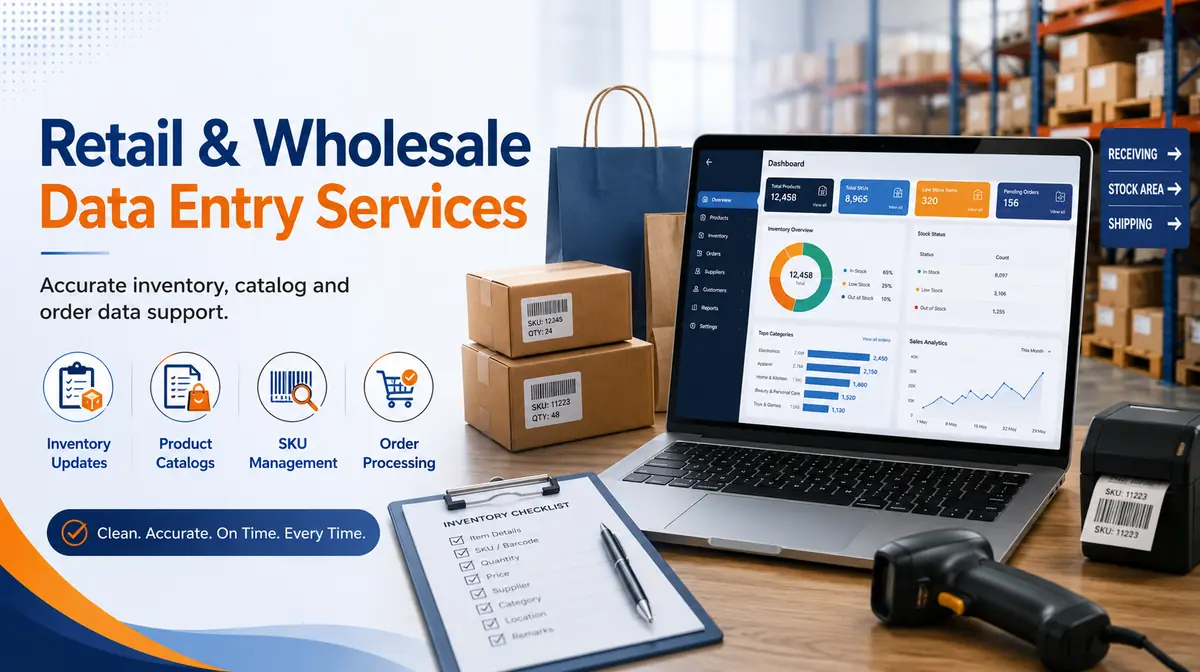
A merchandise record connects purchasing, warehousing, pricing, selling channels and customer service. SDES provides retail and wholesale data entry services for distributors, chains, wholesalers and multi-channel retailers managing high-volume item data.
Our professional operators work from approved item masters, supplier catalogs, price files and inventory reports. Businesses can outsource retail data entry for onboarding, migration or recurring maintenance while buyers and merchandise teams retain assortment and pricing decisions.
Retail problems arise when an item is purchased by case, stocked by unit and sold in several pack configurations without clear relationships.
Project rules define item identifiers, supplier mappings, units of measure, product hierarchy, price types and the source controlling each field. Potential duplicates are compared using approved keys rather than names alone.
The retail data management solution captures supplied product and stock information without selecting assortment, approving vendors or setting prices. Uncertain pack conversions and unexpected stock values remain visible for an expert merchandiser or inventory controller.
Batches can be separated by supplier, category, location or channel so the correct internal team reviews them.
An offshore retail data entry workflow adds capacity for supplier onboarding and recurring maintenance, but it should not make commercial decisions to fill gaps.
Retailers that outsource merchandise entry receive completed records plus an item-level exception file showing the source and affected field.
Approved SKU, name, category, brand, unit and status fields are prepared for system review.
Vendor products, references, pack sizes and costs are mapped to the retailer’s structure.
Dimensions, materials, specifications and supplied features are organised for filtering and comparison.
Cost, selling, promotion, currency and effective-date values are applied from approved sources.
Location, available, reserved, incoming and supplied stock fields are updated by SKU.
Supplier, item, quantity, unit, price and delivery references are captured for authorised review.
Branch, contact, hours, service and status records are maintained from approved operations files.
Potential duplicates and inconsistent brands or units are identified without automatic merging.
SKUs, units, hierarchies and price fields are confirmed.
The pilot includes ordinary items, cases and known conflicts.
Batches match merchandise-team ownership.
Price, assortment and uncertain item matches remain internal.
Send a representative sample with your real source files and field rules. We will return a review-ready output so you can assess the workflow before making a financial commitment.
Retail and wholesale data must remain consistent across the item master, vendor files, price lists and inventory feeds.
SKU, UPC, pack size and supplier references are checked before product records are merged or updated.
Currency, cost, selling price, case quantity and unit-of-measure values follow the approved source.
Negative balances, unknown locations and unexpected SKU changes are separated for review.
Prepare new assortments and exceptions before buyer approval.
Structure item, vendor and inventory records for technical validation.
Apply authorised files through a stable item-matching guide.
Our professional retail data processing follows approved item masters, supplier files and pricing authority. Operators preserve commercial context rather than forcing every value into a record.
The client’s expert buying, inventory and pricing teams retain decisions. SDES provides offshore capacity with source-linked item exceptions.
Problem: Product and pack fields differed across vendor spreadsheets.
Solution: Records were mapped by supplier, SKU and approved unit rules.
Outcome: Item-master files and a pack-conversion exception list were delivered.
Title: Merchandise Operations Manager
Industry: Retail Chain
Country: Australia
Problem: Legacy files mixed currencies, customer groups and effective dates.
Solution: Price records were separated under approved type and date mappings.
Outcome: ERP-ready prices and a commercial-review register were prepared.
Title: Pricing Systems Lead
Industry: Wholesale Distribution
Country: United Kingdom
Problem: Duplicate items and unknown locations affected stock reporting.
Solution: Records were checked using approved SKU and branch identifiers.
Outcome: A standardised inventory file and duplicate-review list were delivered.
Title: Inventory Systems Director
Industry: Multi-Channel Retail
Country: United States
“The item master now gives our buyers one dependable view of SKU, pack size and supplier reference. Potential duplicates were presented with evidence instead of being merged automatically. We were satisfied with the accuracy and the professional handling of the work.”
Georgia K.
Merchandise Operations Manager
Australia
“Price-list updates were handled carefully across currencies and units of measure. Our commercial team could approve exceptions without holding up the rest of the supplier file. The turnaround was impressive and helped us keep the project on schedule.”
Archie P.
Pricing Systems Lead
United Kingdom
“Inventory records from different locations now follow the same structure, and unusual balances are easy to isolate. The output has reduced routine correction work for our store-support team. The pricing was fair, and outsourcing reduced the burden on our internal team.”
Penelope H.
Inventory Systems Director
United States
Yes, under approved item, unit, category and attribute mappings.
No. Approved price files are applied; commercial decisions remain with the client.
Only under confirmed conversion rules; uncertain units are escalated.
Yes, using approved SKU and branch or warehouse identifiers.
Yes, after destination fields and mappings are confirmed.
Provide mixed items, supplier files, units, prices and required output.