
India-Based Data Entry Outsourcing Support Serving USA, Canada, UK, Australia, Europe, New Zealand, Singapore, UAE
Finance & Accounting Data Entry

Finance and Accounting Data Entry That Keeps Source Evidence Attached to Every Number

A transaction is not ready for an accounting system merely because an amount is legible. The date, entity, currency, tax treatment, vendor or customer, supporting document and approved coding rule must agree. Our professional finance and accounting data entry services capture those details without turning unclear evidence into assumed financial decisions.

An expert setup review maps source documents to the client’s chart of accounts, dimensions, accounting periods and permission structure. The offshore production team then records approved fields in spreadsheets or authorised systems while qualified client personnel retain responsibility for accounting policy, posting approval, reconciliation sign-off and statutory interpretation.

Organisations outsource a backlog, period-close workstream or recurring transaction queue when repetitive entry is limiting internal capacity. The solution provides source-linked records, control totals and a visible exception list so finance teams can review what needs judgement rather than rechecking every completed line.

Shri Data Entry Services team working on Finance and Accounting Data Entry Services projects
5000+ Completed Projects
90% Returning Clients
16+ Years Experience
45+ Countries Served
50+ Professionals Team
Services We Offer

Build financial records that remain traceable through coding, review and reconciliation

  • Entity and period confirmed
  • Source reference retained
  • Currency recorded
  • Coding authority defined
  • Control total balanced
  • Unclear items held

Financial source material rarely arrives as one clean export. A monthly workload may combine supplier invoices, customer remittances, employee expense receipts, payment-processor statements, bank files and handwritten approval notes. Treating every document as an isolated typing task loses the relationships that make the resulting ledger useful.

Before production, we document the fields that can be transcribed directly, the codes that may be applied through an approved lookup and the decisions that must return to the client. This distinction matters when a document lacks an entity, includes mixed tax treatment or appears to duplicate a previously received transaction.

Structured delivery support can extend operational capacity while preserving financial accountability. The documented workflow links each entry to its source, separates complete items from exceptions and gives reviewers the evidence needed to approve, correct or reject a record.

Data entry support matched to the controls surrounding each financial document type

Field maps, coding tables and review ownership are confirmed separately for every workstream.

01

Supplier invoice and accounts payable entry

Invoice number, supplier, entity, dates, currency, line values, tax, purchase-order reference and approved coding are captured from bills and supporting documents. Potential duplicates, unmatched purchase orders and calculation differences are held for accounts-payable review rather than posted through an assumption.

02

Customer receipt and receivables entry

Remittance references, customer accounts, invoice allocations, payment dates, amounts, deductions and unapplied balances are recorded from bank evidence and customer notices. Where one receipt could match several open items, the record is routed to the authorised receivables owner.

03

Bookkeeping and general-ledger inputs

Approved journals, expense records, petty-cash transactions, fixed-asset additions and recurring schedules are prepared according to the supplied chart of accounts and dimensions. The service records authorised inputs; it does not create accounting policy or independently approve journals.

04

Bank, card and processor statement capture

Transaction date, description, reference, debit, credit, balance and supplied category information are entered from bank statements, card reports and payment-platform files. Opening, movement and closing totals are reconciled to the source before delivery.

05

Payroll and employee-expense inputs

Approved hours, pay-rate changes, leave, reimbursements, benefit codes and deduction inputs are captured from authorised records using the client’s period and employee identifiers. Sensitive fields receive restricted access, and policy or statutory questions are returned to payroll owners.

06

Financial schedule and reporting support

Trial-balance data, budget comparatives, account schedules and approved period figures are populated into controlled reporting templates. Formula cells, commentary ownership and final statement approval remain protected so data preparation is not confused with financial reporting judgement.

Finance Software Compatibility

Finance And Accounting Data Entry Services: Direct Integration and Software Compatibility

Outputs are prepared around the field structure, controlled values and import requirements of your destination environment. Files can be delivered for review, staging or authorised import without forcing your team to rebuild the completed work.

Supported destinations

Review-ready records for accounting and ERP workflows

Files are mapped to the client’s approved template, naming rules, identifiers and system structure before full production begins.

  • QuickBooksVendor, invoice and account fields
  • XeroBills, contacts and reference data
  • SageAccounting import templates
  • NetSuiteERP records and relationship keys
  • Dynamics 365Finance staging structures
  • Custom SQLControlled finance tables
Source continuity

References stay connected

Source IDs, filenames, record keys and approved relationships remain available for review and downstream traceability.

Import control

Fields are mapped before production

Mandatory fields, formats, controlled values, character limits and relationship keys are checked against the destination specification.

Pilot validation

Test the handoff with a representative batch

Rejected rows, unsupported values and mapping conflicts are returned with exact references so approved corrections can be incorporated before full-volume delivery.

Delivery formatsStructured for review, staging or import
  • CSV
  • XLSX
  • IIF

Column order, encoding, date rules, multi-value handling and destination-specific requirements can follow the receiving system’s approved specification.

Compatibility means SDES prepares outputs to specifications supplied or approved by the client. Product names identify commonly used destination systems and do not imply endorsement, certification or partnership.

Process, Quality and Security

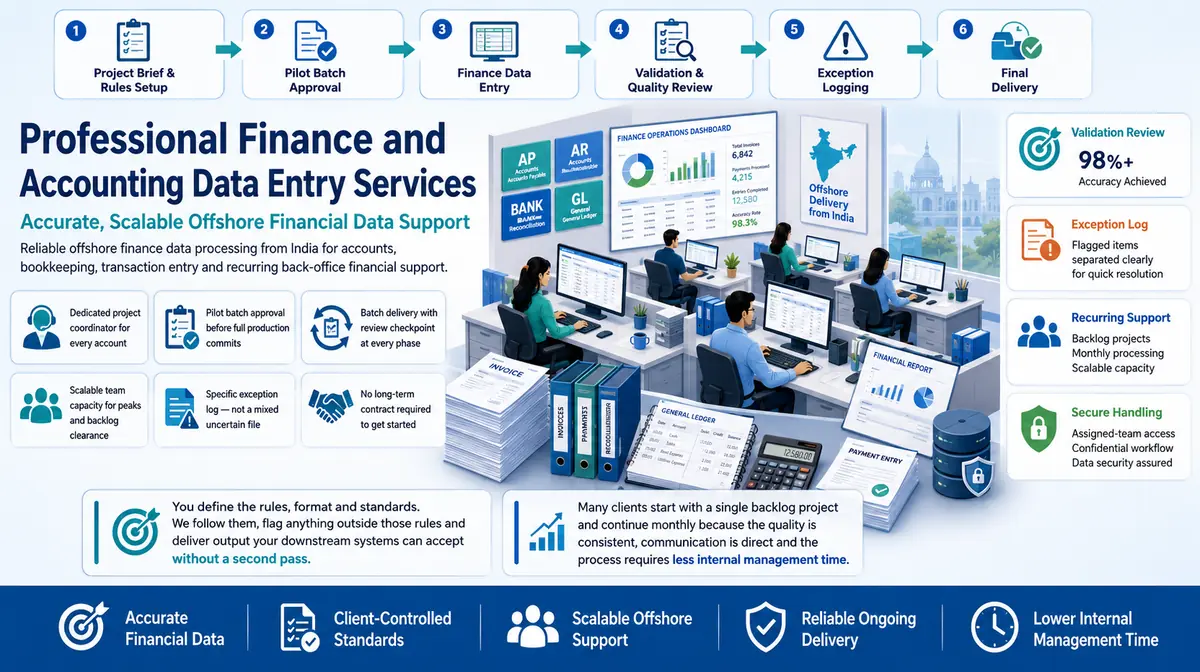
A finance data-entry cycle designed around evidence, control totals and approval

1. Define the Accounting Boundary

The client identifies entities, periods, systems, authorised fields and decisions that require a qualified finance owner.

2. Map Sources to Destinations

The setup review maps document fields, account codes, tax fields, currencies, dimensions and source references to the required output.

3. Test a Complete Control Cycle

A representative pilot includes normal items, credits, duplicates and unclear documents so exception rules are tested before scale.

4. Capture in Controlled Batches

The delivery team records source-supported values and applies only approved lookup rules, with originals retained for traceability.

5. Balance and Review

Counts, document totals, debit-credit movements and other agreed controls are compared with the batch source and output.

6. Release Ledger-Ready Entries and Accounting Holds

Completed records, held items and control evidence are delivered separately for client approval, posting or reconciliation.

We work with the financial documents your business already produces

Financial source documents come in many formats — paper invoices, PDF statements, scanned receipts, digital exports, spreadsheet workings. We process all of them into your required output format.

📂 Source formats we accept
  • Supplier invoices, purchase orders and approvals
  • Customer remittances and billing records
  • Bank, card and payment-processor statements
  • Expense receipts and authorised payroll inputs
  • Approved journals and account schedules
  • Trial balances, budgets and reporting templates
📤 Delivery formats
  • Source-referenced transaction registers
  • Authorised accounting-system entries
  • Reconciliation-ready spreadsheets or CSV files
  • Balanced control-total summaries
  • Duplicate and exception registers
  • Populated financial schedules for client review

Before starting any finance data entry project, we review sample source documents and confirm the field mapping, coding structure and exception handling approach with your team.

Quality checks are tied to the workstream rather than expressed as a generic accuracy promise. Invoice batches may be checked for duplicate references and extension totals; statement capture may be balanced from opening balance through movements to closing balance.

Access is limited to assigned personnel and the minimum system permissions needed for the agreed task. Source files, credentials, working copies, delivery locations and retention periods follow the client-approved handling plan.

A completed field is not evidence that the accounting treatment is correct. The production team records supported values and approved codes; an expert client reviewer remains responsible for reconciliation, posting, tax positions and financial-statement approval.

🔒 NDA Protected Before files are shared
🌐 GDPR Aware EU data handling
Defined Quality Target Confirmed by pilot
🛡️ Secure Transfer Encrypted file access
📋 Exception Log Every delivery
👥 Project Team Only Controlled access
Free accuracy test

Ready to reduce the data entry burden on your finance team?

Share a sample of your financial source documents, your accounting software and your volume estimate. We provide a specific quote within the agreed response window and include a free pilot batch so your team can verify accuracy, field mapping and formatting before committing to full production.

✓ No credit card required✓ No contract required✓ 24–48 hour return
Get a Free Pilot
Source sampleyour_sample_data.csv
Received
Verified deliveryverified_output.xlsx
Reviewed
▣ Encrypted transfer◉ Quality controlled
Why Outsource to SDES?

Why finance teams need capacity without transferring financial authority

Finance and Accounting Data Entry Services workflow and quality review
  • Client-owned accounting policy
  • Source-reference retention
  • Approved coding tables
  • Balanced batch controls
  • Restricted financial access
  • Scalable processing capacity

Accounting firms and finance departments outsource professional financial data entry when qualified employees are spending too much period-close time on repetitive capture and document organisation.

The documented workflow gives the delivery team a precise operating boundary. Source-supported records progress efficiently, while tax treatment, unusual coding, write-offs, provisioning and posting approval remain with authorised client personnel.

Start Your Project →
Industries We Support

Financial data support adapted to different transaction patterns and review needs

Accounting and Advisory Firms

Client bookkeeping inputs, working schedules and period files prepared under firm-specific account maps and reviewer ownership.

Retail and eCommerce

Supplier bills, payment-processor settlements, marketplace fees, refunds and multi-channel transaction files organised for reconciliation.

Manufacturing and Distribution

Purchase-order-linked invoices, freight charges, supplier credits and cost-centre fields captured across operating entities.

Property and Facilities

Property-level invoices, tenant receipts, service charges and recurring schedules maintained with asset or location dimensions.

Transport and Logistics

Carrier bills, fuel and driver expenses, customer charges and route references prepared for high-volume finance operations.

Consulting and Agency Firms

Time-based billing inputs, employee expenses, project codes and management-report schedules organised for client finance teams.

Case Studies

Relevant Project Experience

Multi-Entity Supplier Invoice Register

Project Name
Multi-Entity Supplier Invoice Register
Volume
27,500 invoices across 18 operating entities — completed in 4 weeks
Problem
Invoices arrived through regional inboxes with inconsistent entity references, and central AP staff repeatedly reopened documents to identify routing and coding exceptions. For the Multi-Entity Supplier Invoice Register in United Kingdom workload, channel teams had to compare supplier sources manually, slowing publication and increasing the risk of inconsistent product records.
Solution
A professional field map linked legal entities, supplier masters, purchase-order references and permitted cost-centre lookups. Items without reliable entity evidence were held instead of forced into the register.
Outcome
The client received balanced entity-level batches and a focused exception queue for AP approval before system posting. After completing Multi-Entity Supplier Invoice Register in United Kingdom, product, variant and asset relationships remained consistent across releases, reducing repeated correction work for merchandising teams.
Title
Group Accounts Payable Manager
Industry
Industrial Distribution
Country
United Kingdom

Marketplace Settlement Reconstruction

Project Name
Marketplace Settlement Reconstruction
Volume
14 months and 1.8 million settlement lines — completed in 6 weeks
Problem
Sales, fees, refunds and reserves from several marketplaces had been retained in incompatible exports, leaving the finance team without one traceable reconciliation dataset. During the Marketplace Settlement Reconstruction in Australia review, without dependable product keys, routine updates could attach attributes, prices or assets to the wrong listing.
Solution
The delivery team preserved original settlement identifiers and normalised approved transaction types, currencies and period fields. The solution separated unmapped fee codes for expert controller review.
Outcome
Each reporting period was delivered with source totals, transformed totals and unresolved classifications, allowing reconciliation to proceed without losing transaction lineage. Following delivery for Marketplace Settlement Reconstruction in Australia, channel teams could publish confirmed products from a clean file and resolve supplier exceptions without rechecking the complete catalog.
Title
Financial Operations Director
Industry
eCommerce
Country
Australia

Property Expense Schedule Recovery

Project Name
Property Expense Schedule Recovery
Volume
9,200 documents for 64 properties — completed in 2 weeks
Problem
Receipts, card statements and property invoices were mixed across folders after a system migration, while month-end reviewers needed asset-level schedules. Within Property Expense Schedule Recovery in United States, incorrect references or inconsistent formats could delay matching and move exceptions into later accounting stages.
Solution
Source evidence was indexed first; professional data entry then captured property, supplier, date, amount and approved category into a controlled schedule. Within the Property Expense Schedule Recovery in United States workflow, the team preserved supplier provenance and applied approved mappings only where the source supported the destination value.
Outcome
The property group gained review-ready records and a separate set of unsupported or potentially duplicated expenses rather than a falsely complete ledger. As a result of the Property Expense Schedule Recovery in United States workflow, clean records could move forward as one batch, while incomplete references and conflicting values remained clearly isolated.
Title
Portfolio Finance Controller
Industry
Property Management
Country
United States
FAQs

Questions to resolve before financial records enter production

Do you decide how unclear transactions should be coded?

No. We apply documented client rules and approved lookup tables. Transactions requiring accounting, tax or policy judgement are returned through the exception process.

Can you work directly in our accounting platform?

Yes, when the agreed scope, role-based permissions, access method, approval workflow and rollback arrangements support direct entry. Posting authority can remain with the client.

What should we provide when we outsource recurring finance data entry?

Provide representative source files, field and coding rules, entity and period definitions, control totals, system instructions, exception owners and the required delivery calendar.

Can Finance and Accounting Data Entry Services follow our existing template or platform fields?

Yes, when the destination fields, accepted values, identifiers and permitted actions are confirmed. Delivery can be prepared as Source-referenced transaction registers, Authorised accounting-system entries, with unresolved records excluded from upload-ready output.

📩 Get a Free Pilot
💬