
India-Based Data Entry Outsourcing Support Serving USA, Canada, UK, Australia, Europe, New Zealand, Singapore, UAE
Medical Records Indexing Services

Medical Records Indexing That Makes Documents Findable Without Misstating Their Meaning

A digital document can exist in a repository yet remain effectively lost when its patient, date, type or encounter metadata is wrong. Our professional medical records indexing services organise healthcare documents around the client’s retrieval and record-management rules.

An expert setup review confirms document taxonomy, patient identifiers, date hierarchy, provider and facility fields, encounter relationships, naming standards, retention metadata and escalation authority. The delivery team then indexes supported evidence without diagnosing content or attaching an uncertain document to a likely chart.

Health systems and HIM teams outsource archive conversion, migration indexing and recurring document queues when volume delays retrieval. The solution delivers traceable index records, coverage reporting and a separate queue for mixed packets, absent identifiers, ambiguous dates and clinically dependent classification.

Shri Data Entry Services team working on Medical Records Indexing and Retrieval Services projects
5000+ Completed Projects
90% Returning Clients
16+ Years Experience
45+ Countries Served
50+ Professionals Team
Services We Offer

Index the document being stored—not the condition or procedure merely mentioned within it

  • Document type supported
  • Patient identity confirmed
  • Date rule applied
  • Provider role clear
  • Encounter link supported
  • Ambiguity isolated

A referral letter may mention a lab result, surgery and medication while still remaining a referral document. Indexing by an incidental clinical term can place it in the wrong chart section and mislead later retrieval.

We use the approved document taxonomy and source cues such as form title, issuing organisation, signatures, service date and encounter reference. Where a page lacks enough evidence, it remains an exception rather than receiving the closest available label.

Dedicated offshore capacity supports large archives and incoming queues. The documented workflow keeps document classification transparent while qualified HIM and clinical owners resolve taxonomy gaps, patient ambiguity and substantive record questions.

Healthcare documents indexed around identity, type, chronology and retrieval use

The client’s taxonomy, repository and record-governance rules control each metadata field.

01

Document classification and type indexing

Approved forms, reports, letters, notes and administrative documents are assigned to the applicable document class using taxonomy definitions and source evidence. Unclear or mixed-content records enter review.

02

Patient and chart association

Patient name, date of birth, medical-record number and other approved identifiers support chart association. Conflicting or insufficient identity evidence blocks final attachment or delivery as a confirmed match.

03

Date, encounter and chronology indexing

Document date, service date, received date, scanned date and encounter reference are treated as distinct fields where required. The approved date hierarchy controls which value drives chart chronology.

04

Provider, facility and source metadata

Author, ordering, referring or rendering provider roles and facility or source organisation are captured only when the document supports them. Similar names and unclear signatures remain exceptions.

05

Multi-document packet separation

Combined scans are divided into document units under approved boundary rules, preserving page sequence and patient context. Coversheets, continuations and attachments are retained with the correct record.

06

EHR migration and retrieval validation

Legacy documents are indexed into staging files or approved repository workflows with source IDs retained. Retrieval samples confirm that patient, type and date filters return the intended documents before closure.

Document System Compatibility

Medical Records Indexing Services: Direct Integration and Software Compatibility

Outputs are prepared around the field structure, controlled values and import requirements of your destination environment. Files can be delivered for review, staging or authorised import without forcing your team to rebuild the completed work.

Supported destinations

DMS-compatible files and metadata for searchable repositories

Files are mapped to the client’s approved template, naming rules, identifiers and system structure before full production begins.

  • SharePointLibraries and metadata columns
  • OpenTextEnterprise content repositories
  • iManageLegal matter workspaces
  • NetDocumentsCloud document profiles
  • AlfrescoContent models and properties
  • Custom SQLStaging and relational tables
Source continuity

References stay connected

Source IDs, filenames, record keys and approved relationships remain available for review and downstream traceability.

Import control

Fields are mapped before production

Mandatory fields, formats, controlled values, character limits and relationship keys are checked against the destination specification.

Pilot validation

Test the handoff with a representative batch

Rejected rows, unsupported values and mapping conflicts are returned with exact references so approved corrections can be incorporated before full-volume delivery.

Delivery formatsStructured for review, staging or import
  • CSV
  • XLSX
  • XML

Column order, encoding, date rules, multi-value handling and destination-specific requirements can follow the receiving system’s approved specification.

Compatibility means SDES prepares outputs to specifications supplied or approved by the client. Product names identify commonly used destination systems and do not imply endorsement, certification or partnership.

Process, Quality and Security

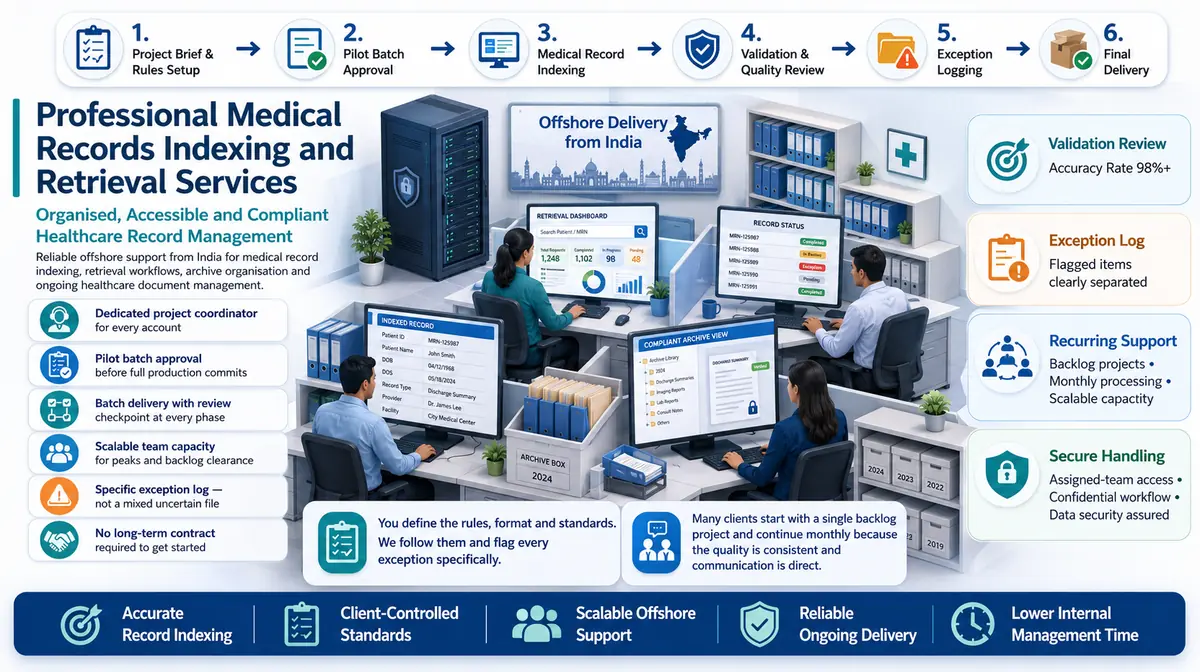
A medical indexing workflow from taxonomy calibration to retrieval-tested delivery

1. Define the Indexing Model

Repository, taxonomy, patients, dates, providers, encounters, source systems and owners are documented.

2. Set Evidence and Boundary Rules

The setup review confirms classification cues, patient matching, date hierarchy and packet separation.

3. Pilot Ambiguous Documents

Mixed packets, undated pages, unclear signatures and overlapping document types test the model.

4. Index Supported Records

The delivery team assigns approved metadata while retaining source, image, patient and page relationships.

5. Audit Metadata and Retrieval

Identifiers, types, dates, provider roles, page counts and sample search results are reviewed.

6. Release Indexes and Exceptions

Approved metadata and items requiring HIM, clinical, privacy or taxonomy decisions are separated.

We index medical documents from scanned images, legacy systems and conversion batches

Medical records arrive as scanned images, PDF documents and legacy system exports. We index all formats into your EHR or document management system with complete metadata.

📂 Source formats we accept
  • Scanned medical documents and legacy exports
  • Patient master and matching criteria
  • Document taxonomy and classification definitions
  • Date, provider and encounter rules
  • File naming and repository requirements
  • Retention metadata and HIM escalation policy
📤 Delivery formats
  • Indexed medical-document dataset
  • Patient-to-document association register
  • Document type and date metadata file
  • Packet-separation and page map
  • Migration-ready index file
  • Identity, taxonomy and chronology exception queue

We sign a BAA and review your indexing schema, classification taxonomy and quality requirements before any patient records are processed.

Quality checks cover patient identifiers, document class, date type and value, provider role, facility, encounter, source file, page range, sequence, duplicate risk, required metadata and agreement between image, index and delivery counts.

Indexing accuracy is evaluated through both field review and retrieval behaviour. A valid metadata value is corrected when it places the document outside the intended patient, chart section or chronological view.

The production team applies approved indexing rules. An expert client owner approves patient association exceptions, clinical interpretation, new document types, taxonomy changes, retention treatment and final attachment to the health record.

🔒 NDA Protected Before files are shared
🌐 GDPR Aware EU data handling
Defined Quality Target Confirmed by pilot
🛡️ Secure Transfer Encrypted file access
📋 Exception Log Every delivery
👥 Project Team Only Controlled access
Free accuracy test

Ready to make your medical records properly indexed and reliably retrievable?

Share a sample batch of your records, your indexing schema and your volume estimate. We sign a BAA and NDA immediately and run a pilot batch to confirm indexing accuracy before full production.

✓ No credit card required✓ No contract required✓ 24–48 hour return
Start With a HIPAA-Conscious Pilot
Source sampleyour_sample_data.csv
Received
Verified deliveryverified_output.xlsx
Reviewed
▣ Encrypted transfer◉ Quality controlled
Why Outsource to SDES?

Why medical indexing quality must be tested through retrieval

Medical Records Indexing and Retrieval Services workflow and quality review
  • Taxonomy definitions
  • Patient-match controls
  • Date hierarchy
  • Packet integrity
  • Source lineage
  • Scalable archive capacity

Healthcare organisations outsource professional medical records indexing when archive conversion and incoming document volume exceed internal HIM capacity.

The documented workflow gives the delivery team controlled metadata work while patient-match exceptions, clinical interpretation, taxonomy governance, retention decisions and final chart attachment remain with qualified client owners.

Start Your Project →
Industries We Support

Medical records indexing adapted to different repositories and document flows

Hospitals and Health Systems

Enterprise document classes, patient and encounter links prepared for large archives and incoming queues.

Medical and Specialty Practices

Referrals, reports, consent forms and historical charts organised within practice-specific taxonomies.

Diagnostic and Imaging Providers

Requisitions, reports and supporting records indexed by patient, service date, source and provider role.

Health Information Management

Chart conversion, legacy migration and exception queues prepared for qualified governance and attachment review.

Insurers and Administrators

Authorised claim and supporting medical documents classified under purpose-limited administrative schemas.

Healthcare Technology Providers

Repository migrations and implementation index files prepared for configured client environments.

Case Studies

Relevant Project Experience

Enterprise Archive Reindexing

Project Name
Enterprise Archive Reindexing
Volume
5.4 million documents for 310,000 patients — completed in 6 weeks
Problem
A legacy repository used hundreds of local document labels, making records difficult to retrieve consistently after health-system consolidation. For the Enterprise Archive Reindexing in United States workload, reviewers spent additional time opening individual files because filenames and folder locations did not answer common retrieval questions.
Solution
A controlled crosswalk mapped supported legacy labels to enterprise taxonomy nodes while patient, date and source IDs remained intact. During production for Enterprise Archive Reindexing in United States, representative searches were tested against the completed index to confirm that users could retrieve the intended source files.
Outcome
The health system received migration-ready indexes and a bounded list of local labels requiring HIM governance decisions. As a result of the Enterprise Archive Reindexing in United States workflow, records personnel received both a searchable index and a smaller exception queue for incomplete or uncertain documents.
Title
Enterprise HIM Director
Industry
Hospital Network
Country
United States

Referral Packet Separation

Project Name
Referral Packet Separation
Volume
620,000 pages from specialty referral queues — completed in 9 weeks
Problem
Single scanned files combined cover sheets, referrals, prior reports and insurance pages, often spanning more than one service date. For the Referral Packet Separation in Australia workload, reviewers spent additional time opening individual files because filenames and folder locations did not answer common retrieval questions.
Solution
The delivery team applied approved boundary and chronology rules. The solution isolated packets with conflicting patient identifiers for expert clinic review.
Outcome
Individual documents became searchable by correct type and date without breaking continuations or attaching uncertain pages. Following delivery for Referral Packet Separation in Australia, users could search the completed register by approved metadata while unresolved files remained visible for targeted review.
Title
Referral Operations Manager
Industry
Specialty Care Network
Country
Australia

Diagnostic Report Metadata Recovery

Project Name
Diagnostic Report Metadata Recovery
Volume
280,000 reports from six acquired centres — completed in 5 weeks
Problem
Provider roles and service dates were stored inconsistently, and imported documents appeared in the wrong chart order. For the Diagnostic Report Metadata Recovery in Canada workload, reviewers spent additional time opening individual files because filenames and folder locations did not answer common retrieval questions.
Solution
Professional indexing distinguished ordering, performing and signing roles and applied the approved date hierarchy from source evidence. For Diagnostic Report Metadata Recovery in Canada, each index row retained its source filename or document reference, and unclear classifications were separated for records-owner review.
Outcome
Clinicians and administrators could retrieve reports more consistently while unclear signatures remained flagged. Following delivery for Diagnostic Report Metadata Recovery in Canada, users could search the completed register by approved metadata while unresolved files remained visible for targeted review.
Title
Clinical Information Services Lead
Industry
Diagnostic Services
Country
Canada
FAQs

Document class, encounter and chart-linking decisions

How do you choose a document type when several clinical topics appear on the page?

We classify the document itself using the approved taxonomy, title, source and purpose. Incidental clinical terms do not automatically determine its type.

Can you attach indexed documents directly to patient charts?

Only within approved access and matching rules. Uncertain patient association remains blocked for qualified client review.

What should we provide when we outsource medical records indexing?

Provide document sources, patient-matching criteria, taxonomy definitions, date and provider rules, repository fields, packet-separation standards, retention metadata and named HIM owners.

What should a Medical Records Indexing and Retrieval Services pilot contain?

Provide Scanned medical documents and legacy exports, Patient master and matching criteria, Document taxonomy and classification definitions. The pilot should include ordinary records and known exceptions so field interpretation, review rules and delivery structure can be confirmed before production.

📩 Get a Free Pilot
💬