
India-Based Data Entry Outsourcing Support Serving USA, Canada, UK, Australia, Europe, New Zealand, Singapore, UAE
Microsoft Dynamics Data Entry

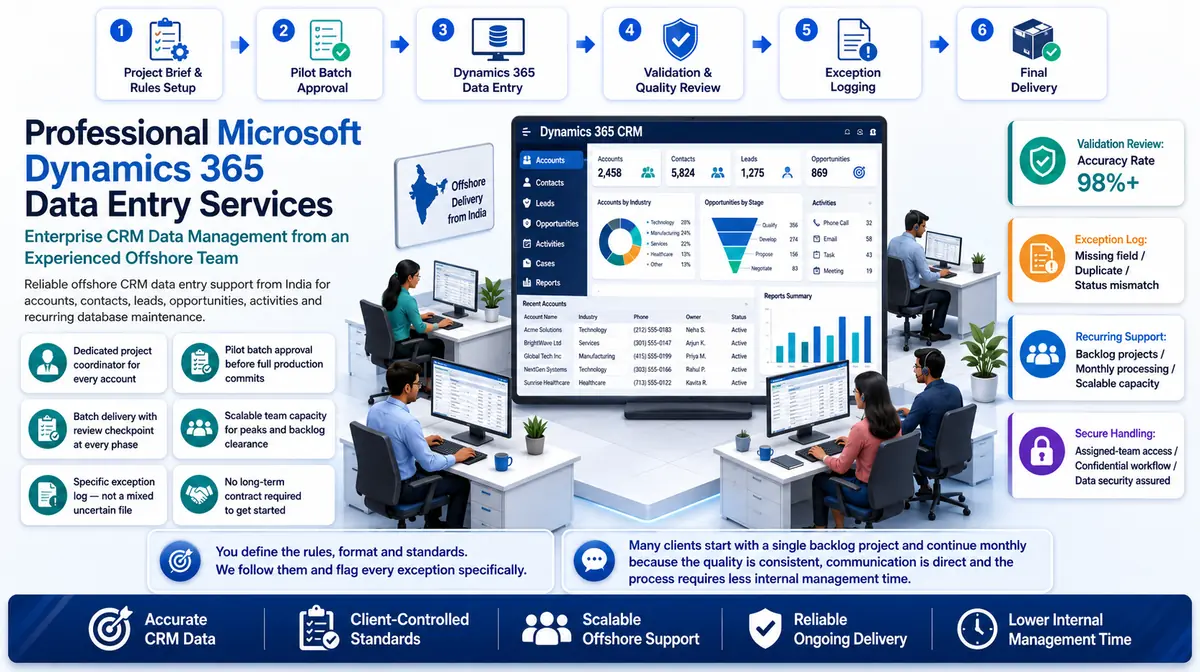
Microsoft Dynamics Data Entry Services for Records That Follow Your Dataverse and Business Process Design

A Dynamics spreadsheet may look straightforward until one column turns out to be a Dataverse lookup, another requires an internal choice value and a third belongs to a custom table used by a business process flow. The client environment—not the column heading—determines what constitutes a valid record.

Our work therefore begins inside the data model. Table relationships, alternate keys, business units, owner teams and process-sensitive fields are translated into a professional entry guide. The offshore team uses that guide for approved account, contact, lead, opportunity, product and custom-table records.

Migration files and recurring queues can be outsourced while configuration remains firmly with the client. Expert administrators resolve uncertain lookups and process questions; SDES provides the production solution for validated imports, cleansing and reconciled record updates.

Shri Data Entry Services team working on Microsoft Dynamics Data Entry Services projects
5000+ Completed Projects
90% Returning Clients
16+ Years Experience
45+ Countries Served
50+ Professionals Team
Services We Offer

Dynamics records must fit the client’s data model before they fit an import file

  • Standard and custom tables identified
  • Primary and alternate keys confirmed
  • Lookup targets mapped
  • Choice values matched to accepted options
  • Owner and business unit retained
  • Process-sensitive fields isolated

A column in a source workbook may map to a Dynamics text field, a lookup, a choice, a date, a currency or a custom relationship. Similar labels do not guarantee the same behaviour. The data map must reflect how the client configured Dataverse.

Lookups are especially important. A contact can reference an account, an opportunity can reference a customer and custom records can rely on several connected tables. Missing or ambiguous keys are returned for review rather than resolved by approximate name alone.

Business process flows and automation may react to field or stage changes. The client identifies process-sensitive fields and whether production users may update them. Routine Dynamics CRM record logging remains separate from qualification, routing and process design.

Data entry across standard tables, custom tables and connected sales records

The environment’s configuration determines valid values, relationships and permitted actions.

01

Contact and account updates

Names, addresses, roles, customer relationships and owner references are maintained using approved keys and source records.

02

Lead and opportunity entry

Approved lead, opportunity, value, date and activity fields are entered without making qualification or forecast decisions.

03

Custom table data entry

Client-defined tables and columns are populated according to Dataverse data types, relationships and business meaning.

04

Dynamics bulk import

Files are prepared with valid keys, choice values, lookups and formats, then test results are reconciled before wider batches.

05

Dynamics data cleansing

Missing links, invalid choices, duplicate candidates and outdated records are reviewed against authorised sources.

06

CRM migration preparation

Source entities, fields, owners and relationships are mapped into Dynamics-ready structures with unresolved dependencies isolated.

CRM Software Compatibility

Microsoft Dynamics Data Entry Services: Direct Integration and Software Compatibility

Outputs are prepared around the field structure, controlled values and import requirements of your destination environment. Files can be delivered for review, staging or authorised import without forcing your team to rebuild the completed work.

Supported destinations

Field-mapped records for customer and sales platforms

Files are mapped to the client’s approved template, naming rules, identifiers and system structure before full production begins.

  • SalesforceObjects, owners and custom fields
  • HubSpotContacts, companies and deals
  • Zoho CRMModules and approved layouts
  • Dynamics 365Entities and relationship keys
  • PipedrivePeople, organisations and pipelines
  • Custom CRM / SQLStaging and import tables
Source continuity

References stay connected

Source IDs, filenames, record keys and approved relationships remain available for review and downstream traceability.

Import control

Fields are mapped before production

Mandatory fields, formats, controlled values, character limits and relationship keys are checked against the destination specification.

Pilot validation

Test the handoff with a representative batch

Rejected rows, unsupported values and mapping conflicts are returned with exact references so approved corrections can be incorporated before full-volume delivery.

Delivery formatsStructured for review, staging or import
  • CSV
  • XLSX
  • JSON

Column order, encoding, date rules, multi-value handling and destination-specific requirements can follow the receiving system’s approved specification.

Compatibility means SDES prepares outputs to specifications supplied or approved by the client. Product names identify commonly used destination systems and do not imply endorsement, certification or partnership.

Process, Quality and Security

How source records become valid Dynamics 365 data

1. Profile the Environment

Standard and custom tables, columns, keys, relationships and security roles are documented.

2. Map Values and Lookups

Source values are connected to accepted choices, currencies, owners and related records.

3. Flag Process Dependencies

Fields linked to flows, routing or automation are identified before production.

4. Run a Controlled Import Test

A sample checks creates, updates, lookups, rejected values and owner assignments.

5. Process by Table and Action

Create, update and held records remain separate across controlled batches.

6. Reconcile Dynamics Results

Accepted, failed and unexpectedly changed records are reviewed with the client.

Dynamics import quality depends on keys and relationships, not only column names

Each row must connect to the intended table, lookup and owner within the configured environment.

📂 Source formats we accept
  • Dynamics table and column export
  • Source CRM or spreadsheets
  • Owner and business-unit lists
  • Choice values
  • Relationship keys
  • Migration rules
📤 Delivery formats
  • Dynamics-ready import files
  • Lookup exception list
  • Choice-value mapping
  • Duplicate candidate queue
  • Import reconciliation
  • Updated approved records

A useful pilot includes alternate keys, inactive owners, custom choices, polymorphic customer lookups and records that interact with business process flows.

Validation covers data type, key, lookup, choice, owner, currency and required relationships. Import success is reconciled with source and held records.

Security roles should expose only required tables and actions. Environment customisation, bulk deletion, export, user administration and process editing remain excluded by default.

Dynamics 365 configuration varies by environment and can change. Final mappings and import behaviour must be confirmed in the client tenant before production.

🔒 NDA Protected Before files are shared
🌐 GDPR Aware EU data handling
Defined Quality Target Confirmed by pilot
🛡️ Secure Transfer Encrypted file access
📋 Exception Log Every delivery
👥 Project Team Only Controlled access
Free accuracy test

Preparing Dynamics 365 records, a migration or a recurring update queue?

Share a redacted table map, source sample, accepted choices and key relationships. We will identify validation and exception requirements.

✓ No credit card required✓ No contract required✓ 24–48 hour return
Discuss Dynamics Data Entry
Source sampleyour_sample_data.csv
Received
Verified deliveryverified_output.xlsx
Reviewed
▣ Encrypted transfer◉ Quality controlled
Why Outsource to SDES?

Why organisations outsource Dynamics production entry while retaining environment governance

Microsoft Dynamics Data Entry Services workflow and quality review
  • Professional Dataverse mapping
  • Expert lookup escalation
  • Offshore capacity for table-based batches
  • Choice and owner validation
  • Process-sensitive fields protected
  • Client owns configuration and sales decisions

A Microsoft Dynamics data entry solution should respect the configured environment rather than assume every Dynamics implementation is alike. SDES follows the client’s tables, relationships and permitted actions.

System owners retain configuration, process, security and commercial authority. Our team applies approved entry and migration rules, allowing businesses to outsource Dynamics 365 CRM data entry without delegating platform governance.

Start Your Project →
Industries We Support

Dynamics records adapted to connected sales and operational models

Manufacturing

Accounts, products, distributors and opportunity records.

Technology

Leads, customers, subscriptions and service relationships.

Business Finance

Approved client and activity records without advice authority.

Property

Accounts, contacts, assets and opportunity-related tables.

Logistics

Customer, route, service and operational CRM data.

Professional Services

Clients, engagements and custom business records.

Case Studies

Relevant Project Experience

Dataverse Account Migration

Project Name
Dataverse Account Migration
Volume
24,751 records — completed in 10 weeks
Problem
Source parent relationships and owner names did not align with Dynamics keys and business units. Within Dataverse Account Migration in Germany, the resulting uncertainty weakened segmentation and made routine follow-up more dependent on manual verification.
Solution
Alternate keys and approved owner maps supported migration, while unresolved lookups stayed outside the import. During production for Dataverse Account Migration in Germany, the clean import file was separated from uncertain matches and records requiring account-owner direction.
Outcome
The proposed offshore workflow preserved account structure without assigning uncertain ownership. As a result of the Dataverse Account Migration in Germany workflow, recurring maintenance became easier to govern because each update followed the same identity and field-authority rules.
Title
CRM Transformation Lead
Industry
Manufacturing
Country
Germany

Custom Table Backlog

Project Name
Custom Table Backlog
Volume
57,051 records — completed in 4 weeks
Problem
Spreadsheet labels resembled Dynamics columns but several values represented lookups and choices. Within Custom Table Backlog in United Kingdom, the inconsistency slowed routine processing and allowed unresolved questions to move into downstream teams.
Solution
Dataverse types and relationships were documented before preparation; invalid options returned for review. During production for Custom Table Backlog in United Kingdom, representative searches were tested against the completed index to confirm that users could retrieve the intended source files.
Outcome
The professional system team received valid table batches and an explicit dependency list. Following delivery for Custom Table Backlog in United Kingdom, the client received a clean operational file, a source-linked exception register and clearer ownership of the remaining decisions.
Title
Business Applications Manager
Industry
Field Services
Country
United Kingdom

Opportunity Activity Updates

Project Name
Opportunity Activity Updates
Volume
17,446 records per month
Problem
Notes contained approved facts alongside subjective stage and probability language. During the Opportunity Activity Updates in Australia review, without a controlled structure, the client could not separate records ready for use from those requiring an authorised decision.
Solution
Routine activity and date fields were separated from commercial decisions reserved for expert sales owners. Within the Opportunity Activity Updates in Australia workflow, confirmed records moved through controlled batches, while missing, unreadable and conflicting items remained in a source-linked exception file.
Outcome
The resulting workflow kept activity records current without allowing the offshore team to forecast opportunities. As a result of the Opportunity Activity Updates in Australia workflow, the resulting workflow made recurring delivery more predictable while preserving client authority over unsupported decisions.
Title
Sales Operations Director
Industry
Technology
Country
Australia
FAQs

Questions about Microsoft Dynamics data entry

Can custom Dynamics tables be supported?

Yes, when the table, columns, types, relationships and accepted values are documented from the client environment.

How are lookup fields handled?

Approved record IDs, alternate keys or client mappings are used. Ambiguous name-only matches are held rather than attached to an uncertain record.

Can business process stages be changed?

Only under explicit evidence and authority. Process design, qualification and commercial decisions remain with client owners.

Which items are held for client review during Microsoft Dynamics Data Entry Services?

Unreadable values, conflicting identifiers, unsupported classifications and decisions outside the approved guide are held apart from clean CRM records and platform relationships on Microsoft Dynamics Data Entry Services projects. Each held item keeps the record and source reference the authorised reviewer needs.

📩 Review a Dynamics Sample
💬