
Matter and client record entry
Client names, matter references, responsible lawyers, practice groups, opening dates and approved status fields are prepared for spreadsheets, databases or case-management imports.
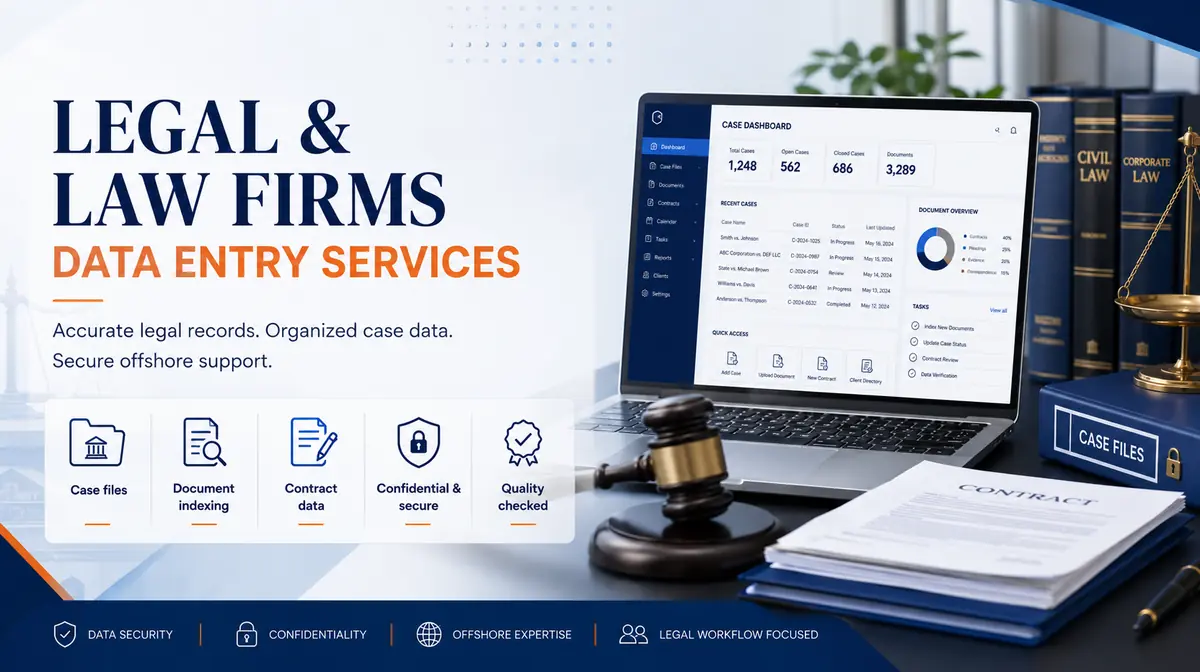
A legal record loses practical value when it is separated from the client, matter, instrument, jurisdiction or source document that gives it context. Contracts, pleadings, deeds, correspondence and discovery files therefore need more than accurate transcription; they need a traceable place within the matter.
Legal data entry services from SDES address that administrative requirement for law firms, legal departments, conveyancing practices and litigation-support teams. The professional legal data entry services capture approved facts while privilege, relevance and filing validity remain with authorised legal personnel. A firm may outsource legal data entry for an archive, migration or recurring queue, with the offshore legal data entry solution following its taxonomy and access rules.
A single matter may contain emails, court documents, witness material, agreements, invoices, exhibits and handwritten notes. Entering fields without preserving those relationships can create records that appear complete but cannot be trusted during retrieval or review.
SDES begins by examining how the firm identifies its work. Depending on the practice, the controlling reference may be a matter number, case number, client code, property parcel, application number, contract ID or court reference. That identifier remains attached to every record produced from the source material.
Our expert legal data entry team can preserve document-level details such as author, recipient, execution date, filing date, document class, jurisdiction, confidentiality status and supplied privilege designation. When documents disagree, we do not choose the version that looks most likely. The conflict is recorded with its file and page reference for authorised review.
This source-linked approach creates a practical legal document data entry solution for teams that need searchable information without losing the evidential trail behind it.
Administrative support should remove repetitive work without transferring professional authority. SDES captures supplied facts and applies approved classifications; it does not decide legal meaning.
These boundaries are part of our professional legal data processing model. Lawyers, paralegals, title specialists and compliance personnel remain the expert reviewers for decisions requiring legal knowledge.
The offshore legal data entry services provided by SDES do not include responsiveness, relevance or privilege determinations. Uncertain records stay linked to their sources and move into a separate authorised-review queue.
Each workstream follows its own source hierarchy, field guide and exception boundary rather than forcing unrelated legal documents through one generic entry method.
Client names, matter references, responsible lawyers, practice groups, opening dates and approved status fields are prepared for spreadsheets, databases or case-management imports.
Pleadings, motions, orders, notices and affidavits are indexed using the court, case number, party, filing date and document type shown in the authorised source.
Parties, agreement titles, execution dates, renewal dates and approved clause fields are captured without inferring obligations or legal effect.
Grantor, grantee, parcel, instrument, recording and jurisdictional fields are prepared from deeds and related property records.
Documents are indexed by custodian, date, sender, recipient, source and client-approved category while legal review remains with counsel.
Application, registration, jurisdiction, owner, inventor, filing-date and supplied status fields are updated from authorised IP records.
Matter numbers, time references, expense details and invoice fields are captured; missing rates or classifications are held for billing review.
Dates, participants, document descriptions and matter references are arranged objectively without characterising an event’s legal importance.
The client-approved matter map identifies permitted folders, document classes, required metadata, prohibited decisions and the people authorised to answer exceptions.
A sample includes ordinary files and difficult records such as missing attachments, multiple dates, similar party names, poor handwriting or documents outside the current taxonomy.
Files remain grouped by the approved client or matter boundary. Operators work from the original document to the required record without combining unverified values from unrelated sources.
Each exception identifies the matter, document, page, affected field and reason for escalation, allowing the reviewer to resolve it without searching the entire archive.
Send a representative sample with your real source files and field rules. We will return a review-ready output so you can assess the workflow before making a financial commitment.
Legal information may include personal details, commercially sensitive agreements, financial evidence and privileged correspondence. Access therefore needs to match the project’s matter and document boundaries.
An offshore legal data entry team can be restricted to designated folders, matters or document classes.
Work can remain divided by client, jurisdiction or confidentiality level, with only assigned personnel receiving the approved records.
The expert quality reviewer checks each record inside the same authorised boundary and does not move documents into unrelated collections.
A litigation practice may need daily indexing of incoming filings. A conveyancing provider may need structured capture from historical instruments. A corporate department may require contract metadata before a repository migration.
Define a historical collection, its matter boundaries and the records required for retrieval or retention review.
Firms can outsource legal document indexing on an agreed schedule while internal personnel handle legal exceptions.
The operating guide develops around verified instructions, creating a controlled legal data framework for migration.
A defined external production function helps legal personnel spend less time rebuilding indexes and more time reviewing matters that require professional judgement.
A client can outsource legal records processing in controlled batches, beginning with representative documents and expanding only after the format and exception handling have been approved.
This creates a measurable legal data management approach without requiring the firm to surrender its taxonomy or decision-making authority. Our professional team follows the matter structure and access boundaries approved by your expert legal reviewers.
Problem: Historical files used inconsistent document names, and several folders contained material belonging to similarly named matters.
Solution: Matter-controlled work queues preserved objective metadata and linked every uncertain association to the originating file.
Outcome: Searchable matter indexes, chronology-ready dates and a separate legal-classification register were prepared.
Title: Litigation Support Manager
Industry: Commercial Litigation
Country: Australia
Problem: Older scans used several layouts, while party names and recording references varied between documents.
Solution: Jurisdiction-specific fields were captured from nominated sources; illegible descriptions were referenced by document and page.
Outcome: Repository-ready property records were produced without completing uncertain legal descriptions from context.
Title: Property Records Lead
Industry: Conveyancing
Country: United Kingdom
Problem: Agreements could not be reliably filtered by party, agreement type or execution date before migration.
Solution: Approved objective fields were entered while documents requiring clause interpretation were separated.
Outcome: The migration team received a structured import file, source references and a defined legal-review queue.
Title: Legal Operations Director
Industry: Corporate Legal Services
Country: United States
“The matter index reflects how our lawyers actually search: client, matter, document type and date. Privileged files remained within the agreed access group throughout the assignment. We genuinely appreciated the high quality and attention to detail.”
Lucy K.
Litigation Support Manager
Australia
“Discovery records arrived with dependable document and family references, and questionable dates were clearly marked. Our review team could move straight to legal analysis instead of repairing metadata. Thank you for the prompt delivery and quick handling of our questions.”
Henry B.
Property Records Lead
United Kingdom
“Historical contracts became searchable without altering clause language or inferring missing parties. The source-page links have made subsequent verification considerably faster. Very good value for money—we would confidently outsource this work to SDES again.”
Lauren V.
Legal Operations Director
United States
No. SDES provides administrative data entry, indexing, conversion and record-preparation support. Legal interpretation remains with authorised legal professionals.
Yes. Access can be organised by client, matter, folder, document class or another client-approved boundary.
No. Operators can enter a supplied privilege value, but privilege decisions remain with the client’s legal team.
Yes. Fields can be mapped to an approved case-management, document-management or repository import structure.
The sources and conflict are recorded in the exception register. SDES does not silently select one value without an approved precedence rule.
Provide representative document classes, required metadata, naming instructions and several known exceptions.