India-Based Data Entry Outsourcing Support Serving USA, Canada, UK, Australia, Europe, New Zealand, Singapore, UAE
Bookkeeping Data Entry

Bookkeeping Data Entry That Leaves a Clear Trail From Source Document to Ledger Review

Books become difficult to trust when receipts are detached from entries, bank descriptions are treated as sufficient coding evidence or one month’s backlog is carried into the next. Our professional bookkeeping data entry services organise routine financial activity into source-referenced records ready for review by the client’s bookkeeper or accountant.

The expert setup identifies business entities, accounting periods, account and tax code tables, tracking dimensions and supporting-document rules. An offshore production team then records approved sales, purchases, expenses, receipts and journal inputs without deciding matters that require accounting policy or statutory judgement.

Businesses outsource weekly capture, historic cleanup or a recurring month-end preparation queue when transaction administration is delaying reconciliations. The solution separates ledger-ready items from missing evidence, possible duplicates and coding questions, giving reviewers a smaller and more useful decision list.

Shri Data Entry Services team working on Bookkeeping Data Entry Services projects
5000+ Completed Projects
90% Returning Clients
16+ Years Experience
45+ Countries Served
50+ Professionals Team
Services We Offer

Turn everyday financial evidence into an orderly review queue before month-end pressure builds

  • Period status recorded
  • Source attached or referenced
  • Entity and currency verified
  • Approved code applied
  • Duplicate risk checked
  • Review status visible

Bookkeeping data arrives continuously: a supplier bill today, card receipt tomorrow, customer payment later in the week and a recurring debit with little description at month end. Without a controlled intake, records are often entered late, twice or without enough evidence to support the selected account.

We structure the routine work around document registers, approved masters and period-specific controls. Direct transcription is separated from rule-based coding, and both are separated from decisions that belong to the client’s qualified bookkeeper, accountant or tax adviser.

Additional delivery capacity keeps the transaction queue moving while the documented workflow preserves accountability. Completed records carry their source reference, and uncertain items remain visible instead of being hidden behind a populated field.
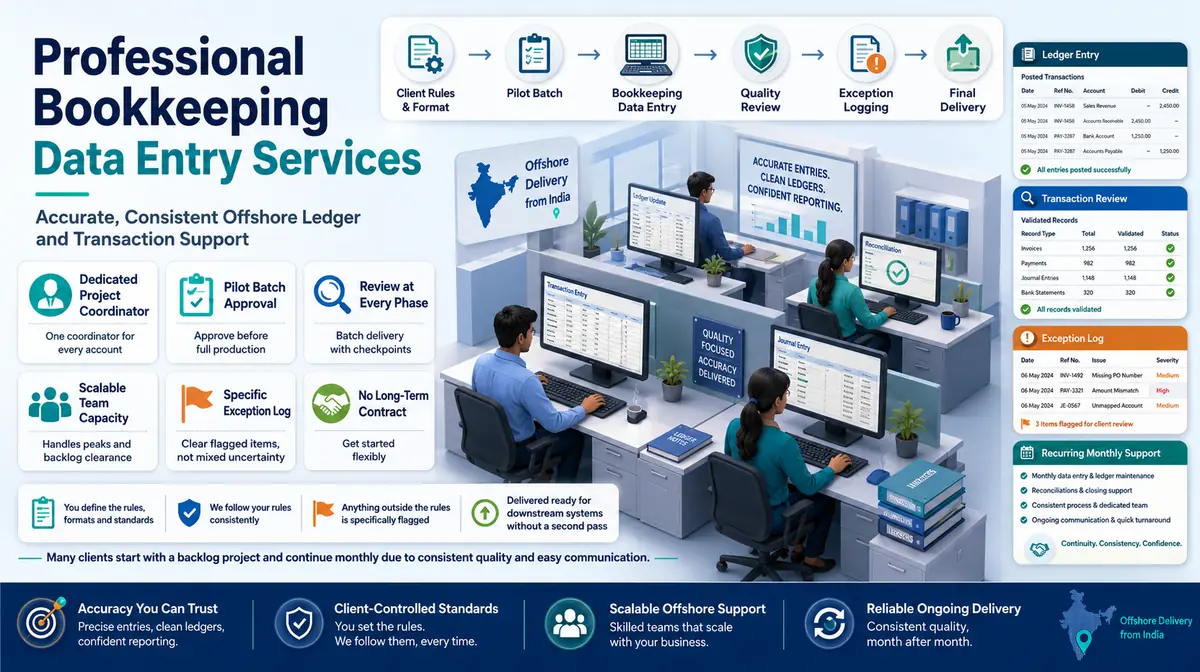

Transaction capture organised for consistent ledger review and reconciliation

Each workstream uses its own source checks, coding authority and batch controls.

01

Sales and income record entry

Approved sales invoices, cash summaries, platform exports and income records are captured with customer or channel, document date, period, currency, net, tax, gross and supplied revenue codes. Missing invoice sequences, credits and totals that do not agree with the source are identified for review.

02

Purchase and expense entry

Supplier bills, employee receipts, petty-cash vouchers and approved expense claims are recorded using the supplied vendor, account, tax and tracking rules. Personal, unsupported or policy-sensitive items are not silently classified as business expenses.

03

Bank and credit-card transaction capture

Dates, descriptions, references, debits, credits and balances are entered from statements or authorised feeds. Rules may be applied to recognised recurring items, while unfamiliar descriptions and split transactions return to the client for coding.

04

Approved journal and adjustment inputs

Authorised accruals, prepayments, depreciation inputs, corrections and reclassification journals are prepared or entered from client-approved schedules. The service does not originate adjustments or decide the accounting basis behind them.

05

Recurring ledger schedule maintenance

Fixed-asset additions, prepaid expense schedules, loan movement tables, subscription registers and other recurring working files are updated from approved source evidence while formulas and prior-period structures remain protected.

06

Bookkeeping backlog organisation

Historic documents are inventoried by entity, period and source before entry begins. Gaps, duplicates and unsupported transactions are logged so a backlog is not presented as complete merely because available files have been processed.

Document System Compatibility

Bookkeeping Data Entry Services: Direct Integration and Software Compatibility

Outputs are prepared around the field structure, controlled values and import requirements of your destination environment. Files can be delivered for review, staging or authorised import without forcing your team to rebuild the completed work.

Supported destinations

DMS-compatible files and metadata for searchable repositories

Files are mapped to the client’s approved template, naming rules, identifiers and system structure before full production begins.

  • SharePointLibraries and metadata columns
  • OpenTextEnterprise content repositories
  • iManageLegal matter workspaces
  • NetDocumentsCloud document profiles
  • AlfrescoContent models and properties
  • Custom SQLStaging and relational tables
Source continuity

References stay connected

Source IDs, filenames, record keys and approved relationships remain available for review and downstream traceability.

Import control

Fields are mapped before production

Mandatory fields, formats, controlled values, character limits and relationship keys are checked against the destination specification.

Pilot validation

Test the handoff with a representative batch

Rejected rows, unsupported values and mapping conflicts are returned with exact references so approved corrections can be incorporated before full-volume delivery.

Delivery formatsStructured for review, staging or import
  • CSV
  • XLSX
  • XML

Column order, encoding, date rules, multi-value handling and destination-specific requirements can follow the receiving system’s approved specification.

Compatibility means SDES prepares outputs to specifications supplied or approved by the client. Product names identify commonly used destination systems and do not imply endorsement, certification or partnership.

Process, Quality and Security

A bookkeeping workflow that closes the distance between daily evidence and monthly review

1. Confirm the Books in Scope

Entities, periods, currencies, systems, closed dates and responsible reviewers are documented before files are handled.

2. Build the Entry Rules

The setup review maps document types, approved accounts, tax codes, dimensions, recurring rules and source-reference requirements.

3. Pilot One Real Transaction Mix

Sales, purchases, expenses, bank activity, credits and unclear items test the process more reliably than a set of easy documents.

4. Enter and Reference

The delivery team captures supported values, applies authorised rules and retains the link between each record and its evidence.

5. Run Period Controls

Document counts, invoice totals, statement movements, opening and closing positions and expected schedules are compared.

6. Hand Off for Bookkeeper Review

Completed records, held items, missing documents and questions are packaged separately for approval and reconciliation.

We work with the financial documents your business already produces every month

Bank statements, receipts, invoices, payroll summaries — bookkeeping source documents come in many formats. We process all of them into accurate ledger entries in your accounting software.

📂 Source formats we accept
  • Sales invoices and income summaries
  • Supplier bills and credit notes
  • Receipts, expense claims and petty-cash vouchers
  • Bank and credit-card statements
  • Approved journals and recurring schedules
  • Existing ledger exports and account-code tables
📤 Delivery formats
  • Source-linked bookkeeping register
  • Ledger-ready spreadsheet or CSV
  • Authorised system entries
  • Updated recurring schedules
  • Batch control and period summary
  • Missing-document, duplicate and coding exception log

We confirm your chart of accounts, coding conventions and period allocation rules before starting any bookkeeping project — ensuring entries are posted correctly from the first batch.

A bookkeeping batch is checked for more than typing accuracy. Review can include document counts, duplicate supplier references, invoice arithmetic, statement movement, currency consistency and agreement between source totals and captured totals.

Closed periods and approved ledger structures are protected. Direct system access uses the minimum agreed permissions, and the client controls posting rights, period locks, bank-feed rules and final reconciliation.

The production team does not make a weak source look certain. An expert client reviewer receives separate lists for missing documents, unknown payees, mixed-purpose expenses, tax questions and transactions requiring an adjustment decision.

🔒 NDA Protected Before files are shared
🌐 GDPR Aware EU data handling
Defined Quality Target Confirmed by pilot
🛡️ Secure Transfer Encrypted file access
📋 Exception Log Every delivery
👥 Project Team Only Controlled access
Free accuracy test

Need consistent, accurate bookkeeping data entry without the overhead?

Share a sample month of source documents, your accounting software and your monthly transaction volume. We provide a specific quote within the agreed response window and include a free pilot to confirm coding accuracy and formatting before the first paid production month begins.

✓ No credit card required✓ No contract required✓ 24–48 hour return
Start With a Free Pilot
Source sampleyour_sample_data.csv
Received
Verified deliveryverified_output.xlsx
Reviewed
▣ Encrypted transfer◉ Quality controlled
Why Outsource to SDES?

Why bookkeeping support should reduce clerical work without disguising unresolved records

Bookkeeping Data Entry Services workflow and quality review
  • Source-linked transactions
  • Client-approved coding
  • Protected closed periods
  • Period control totals
  • Exception-led review
  • Scalable recurring capacity

Companies and accounting practices outsource professional bookkeeping data entry when document capture and ledger preparation are absorbing time needed for reconciliation, client discussion and financial review.

The documented workflow gives the delivery team repeatable rules but not unrestricted judgement. Unusual transactions, tax questions, unsupported expenses and adjustments remain with the authorised bookkeeper or accountant.

Start Your Project →
Industries We Support

Bookkeeping data shaped around the transaction cycle of each business

eCommerce and Marketplace Sellers

Sales settlements, refunds, fees, advertising charges, supplier bills and payment-channel records organised across stores.

Property and Rental Operations

Property expenses, tenant receipts, maintenance invoices and asset-level schedules captured with location references.

Consulting and Creative Firms

Project expenses, contractor bills, reimbursable costs and client billing inputs prepared by job or department.

Healthcare Practices

Operating expenses, supplier records, payroll inputs and non-clinical financial documents organised under restricted access.

Transport Businesses

Fuel, tolls, repairs, driver expenses, freight income and vehicle-level references structured for review.

Accounting Practices

Client source documents and working schedules prepared to firm-specific coding tables and reviewer queues.

Case Studies

Relevant Project Experience

Weekly Multi-Channel Books Preparation

Project Name
Weekly Multi-Channel Books Preparation
Volume
46,000 transactions per month
Problem
A homeware retailer downloaded separate store, marketplace, payment and bank files, but descriptions and settlement timing prevented straightforward matching. During the Weekly Multi-Channel Books Preparation in Canada review, without dependable product keys, routine updates could attach attributes, prices or assets to the wrong listing.
Solution
The controlled workflow preserved order and settlement identifiers, mapped approved fee types and prepared weekly source-balanced registers. Unrecognised deductions remained outside the ledger-ready batch.
Outcome
The internal bookkeeper began each reconciliation with organised transaction groups and a specific deduction queue instead of four unrelated exports. Following delivery for Weekly Multi-Channel Books Preparation in Canada, channel teams could publish confirmed products from a clean file and resolve supplier exceptions without rechecking the complete catalog.
Title
Finance Systems Manager
Industry
Omnichannel Retail
Country
Canada

Consultancy Receipt Backlog Recovery

Project Name
Consultancy Receipt Backlog Recovery
Volume
11,800 receipts covering 22 months — completed in 9 weeks
Problem
Employee receipts were mixed by date and project, with missing approvals and several copies submitted through both email and expense folders. For the Consultancy Receipt Backlog Recovery in United Kingdom workload, internal reviewers had to compare multiple sources manually before they could trust the record for its intended business use.
Solution
Documents were indexed before entry; the delivery team used image and amount references to identify likely duplicates, then captured only supported fields. Within the Consultancy Receipt Backlog Recovery in United Kingdom workflow, the approved metadata dictionary controlled field meaning, permitted values and multi-value handling throughout production.
Outcome
The solution produced period and project schedules while keeping unapproved, personal and duplicate-risk items available for expert partner review. After completing Consultancy Receipt Backlog Recovery in United Kingdom, internal reviewers could focus on genuine exceptions instead of rechecking every completed record.
Title
Operations Partner
Industry
Management Consulting
Country
United Kingdom

Fleet Expense Ledger Preparation

Project Name
Fleet Expense Ledger Preparation
Volume
8,600 records per month
Problem
Vehicle costs arrived from card statements, workshop invoices and driver submissions, making unit-level cost review slow and inconsistent. For the Fleet Expense Ledger Preparation in Australia workload, finance reviewers had to revisit source documents before reconciliation, approval or posting could continue.
Solution
A vehicle master and approved expense map linked registration references to each source type. Professional controls compared card movement and document totals before handoff.
Outcome
The transport company received vehicle-level bookkeeping inputs plus a short list of transactions with missing vehicle or supporting evidence. As a result of the Fleet Expense Ledger Preparation in Australia workflow, clean records could move forward as one batch, while incomplete references and conflicting values remained clearly isolated.
Title
Commercial Finance Manager
Industry
Road Transport
Country
Australia
FAQs

Questions to settle before bookkeeping data entry begins

Is bookkeeping data entry the same as engaging an accountant?

No. We capture and organise transactions under approved rules. Accounting policy, reconciliations, tax advice, adjustments and final approval remain with qualified client personnel.

Can you update records directly in QuickBooks, Xero or another platform?

Direct entry is possible when access, permissions, coding rules, posting authority, closed periods and review steps are agreed during setup.

What happens when we outsource a backlog with missing documents?

Available records are inventoried by period and source. Missing evidence, duplicates and unresolved transactions are reported separately rather than hidden inside an apparently complete delivery.

Which items are held for client review during Bookkeeping Data Entry Services?

For Bookkeeping Data Entry Services, anything that cannot be read confidently — conflicting identifiers, unsupported classifications, decisions outside the approved guide — is held apart from clean finance and accounting records rather than guessed. Held items keep their source reference for the authorised reviewer.

📩 Get a Free Pilot
💬