
DACH markets
German-language product, supplier and technical records can retain legal entity, language, decimal and source references for teams in Germany, Austria and Switzerland.
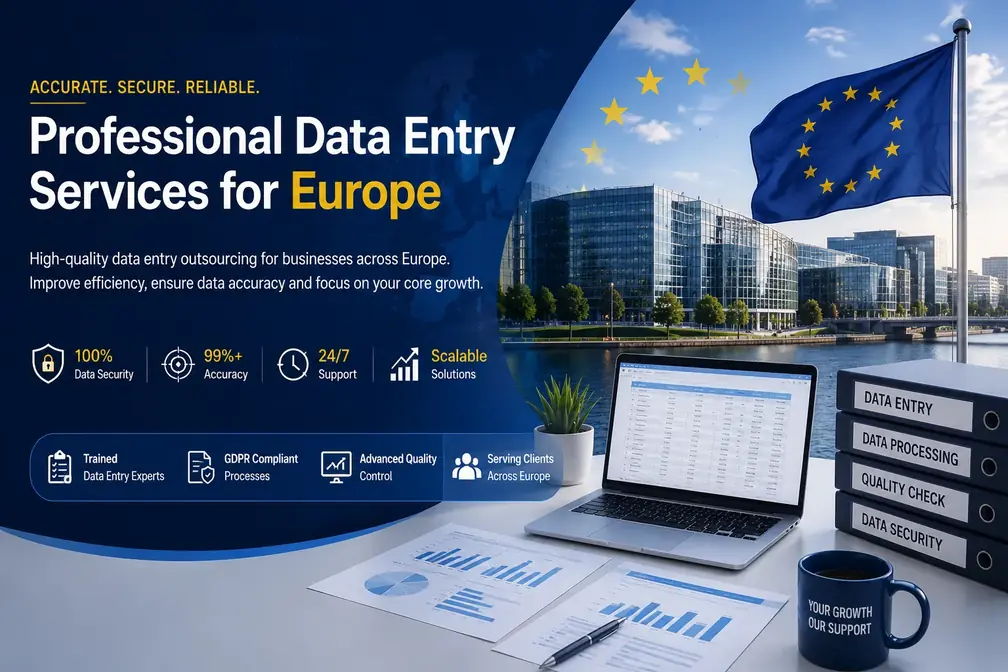
European operations frequently need one reporting structure to accommodate several languages, currencies, legal entities, address conventions and sales channels. SDES provides data entry services Europe for organisations that want cross-border information prepared consistently without stripping away the market-level context needed by local teams.
Our India-based delivery team works as a processor under the client’s documented scope. Professional operators capture authorised fields, while an expert review stage checks identity, language, format and required values. Businesses can outsource data entry Europe for multilingual catalogs, document archives, finance support, logistics records or database migration while retaining legal, tax, translation and commercial authority.
A regional database may need common customer, product or supplier fields, yet the source records can use different decimal separators, address orders, VAT references, languages and local classifications. Treating those differences as errors can damage the dataset just as easily as leaving every market in an incompatible format.
We begin by separating regional standards from local values. The client defines the common destination schema and identifies fields that must remain country-specific. Language codes, source market, legal entity, currency, tax identifier, original description and translated description can therefore remain distinct.
This is the practical purpose of European data entry services: preparing information for regional use while keeping enough provenance for a local reviewer to understand where it came from. The offshore team follows the approved model but does not decide VAT treatment, create translations, interpret contracts or determine whether two legal entities are the same.
German-language product, supplier and technical records can retain legal entity, language, decimal and source references for teams in Germany, Austria and Switzerland.
Belgium, the Netherlands and Luxembourg often require multilingual customer, logistics and commerce data to remain aligned across compact but distinct markets.
Denmark, Sweden, Norway, Finland and Iceland may use central systems while preserving national product, customer and document fields.
French, Spanish, Italian, Portuguese, Greek, Cypriot and Maltese source data can be mapped into approved regional structures without unapproved translation.
Polish, Czech, Romanian, Hungarian, Slovak, Slovenian, Croatian and Bulgarian records can retain market and language provenance through migration.
Irish, Estonian, Latvian and Lithuanian teams can use the same offshore capacity for catalogs, CRM, finance and document workflows while maintaining local review ownership.
Approved titles, attributes, variants, prices and language fields are mapped by SKU and market.
Company, contact, country, consent-related and ownership fields are prepared under client rules.
Legal entity, supplier, document, currency, supplied VAT and line information are structured.
Shipment, carrier, route, consignment and delivery references are linked across source documents.
Regional archives receive document class, country, language, date and business-reference metadata.
Format issues and possible duplicates are isolated without merging separate entities from similar names.
Survey and market datasets are coded under an approved questionnaire and country structure.
Country files are reorganised into import-ready spreadsheets, CSV files or target-system templates.
Country, language, legal entity, currency and responsible reviewer are established.
The regional schema is aligned without overwriting market-specific information.
Samples include several languages, formats, entities and exception types.
Clean data and country-specific review queues are delivered to the right owners.
A commerce team can use multilingual data entry services Europe to align approved local descriptions with one product master. A manufacturer can prepare supplier and technical-document metadata for a regional ERP. A logistics company can bring consignment records from several branches into one reporting structure.
The value is not produced by repeating a primary keyword for every country. It comes from separating routine preparation from decisions that belong to market specialists. Local teams retain translation approval, regulatory interpretation and commercial judgement. SDES supplies offshore capacity, documented instructions and a consistent exception process.
A dedicated coordinator helps manage additions to the field guide as new countries or source formats enter scope. This professional operating layer reduces the risk that an instruction agreed for one market is incorrectly applied to all others.
Share a sample file, your volume estimate, output format and any compliance or security requirements relevant to your Europe operations. We provide a specific, transparent quote within the agreed response window and include a free pilot batch so you can verify accuracy and output quality before committing to any volume.
The client defines why each personal-data field is needed and which records may be processed.
Assigned operators receive only the files, fields and system permissions required by the approved task.
Storage, return and deletion periods follow the documented engagement rather than an assumed default.
For GDPR-compliant data entry services Europe, the European client must establish the lawful basis, controller responsibilities, transfer mechanism and instructions appropriate to its circumstances. SDES can operate within those documented requirements but should not claim to certify the client’s entire compliance position.
Quality controls remain separate from privacy controls. Product records are checked by SKU and market; invoices by entity, supplier and currency; CRM data by identity and authorised matching evidence. When an expert decision is required, the record stays in an exception queue with its source and market context.
Draft project narratives require factual confirmation before publication.
Volume: 29,400 SKUs across six language feeds — completed in 12 weeks
Problem: Titles, attributes and variant structures did not align across local storefront files.
Solution: Approved language fields were mapped by SKU, market and channel; unsupported translations were returned to local owners.
Outcome: Regional upload files were delivered with a separate market-level content queue.
Title: European Catalog Director
Industry: eCommerce
Country: Netherlands
Volume: 17,800 supplier and establishment records — completed in 5 weeks
Problem: Similar trading names and inconsistent legal-entity references created duplicate risk.
Solution: Records were compared using approved tax, registration, address and ERP identifiers.
Outcome: A migration-ready supplier file and legal-entity review register were prepared.
Title: Master Data Lead
Industry: Industrial Manufacturing
Country: Germany
Volume: 48,600 freight and delivery documents — completed in 8 weeks
Problem: Regional branches used different file naming, route and status conventions.
Solution: Documents were indexed by consignment, branch, country, carrier and authorised event status.
Outcome: A searchable logistics archive and unresolved-reference queue were delivered.
Title: Regional Operations Manager
Industry: Logistics
Country: Belgium
Draft quotations require verification and publication permission.
“The team handled country-specific address and tax fields without flattening them into a generic European format. Our regional owners could review their exceptions independently. Excellent work—the consistency across the batch made review much easier.”
Sanne V.
European Catalog Director
eCommerce · Netherlands
“Multilingual product records remained aligned to the same SKU throughout the migration. Unclear translations came back with enough source context for quick approval. Wonderful job—the early delivery removed real pressure from our deadline.”
Jonas K.
Master Data Lead
Industrial Manufacturing · Germany
“Our customer database is more consistent, yet legitimate local differences were preserved. We especially valued the evidence-based approach to possible duplicate companies. Very good value for money—we would confidently outsource this work to SDES again.”
Amélie D.
Regional Operations Manager
Logistics · Belgium
Approved multilingual values can be entered and aligned. Unauthorised translation or interpretation remains with qualified client reviewers.
Yes. The workflow separates shared regional fields from market-specific language, entity, currency and review requirements.
No provider should make a blanket claim. The client defines its legal basis and transfer requirements; SDES follows the documented processing scope and controls.
Supplied VAT identifiers and amounts can be captured, but tax treatment and validation decisions remain with the client.
Only approved identifiers and evidence are used. Similar names alone do not justify a merge.
Include multiple markets, languages, entities, source formats and known exceptions to test the regional model properly.
Share representative country files, language fields, entity rules, destination requirements and privacy instructions. We will outline a professional data processing solution that shows where SDES can help and where local authority must remain.
Online retailers and marketplace sellers that need accurate product data, catalog management, marketplace listing support and order management data entry handled consistently at scale without burdening their internal team.
Medical practices, billing companies and healthcare providers that handle patient records, clinical data, insurance information and billing documentation requiring precise entry and confidential handling.
Property firms, real estate agencies and title companies managing listing details, transaction records, deed data and client databases across large and growing portfolios.
Accounting firms, finance departments and financial services companies processing invoices, statements, claims, reconciliation records and financial document data at recurring volume.
Law firms and legal departments digitising and managing case files, contracts, compliance records, court documents and legal correspondence with appropriate confidentiality controls.
Freight companies, 3PLs and supply chain teams maintaining accurate shipment records, supplier data, inventory counts and delivery documentation across high-volume operations.
Manufacturers needing product specifications, supplier records, quality inspection data and inventory management data entry for production and procurement systems.
Marketing agencies, digital agencies and business services firms outsourcing data entry, list building, research and campaign data management to a reliable offshore partner.
 eCommerce
 Healthcare
 Real Estate
 Finance
 Legal
Legal
 Logistics
 Manufacturing
 Agencies