
India-Based Data Entry Outsourcing Support Serving USA, Canada, UK, Australia, Europe, New Zealand, Singapore, UAE
Court Filing Data Entry

Court Filing Data Entry That Keeps Every Procedural Record Tied to Its Official Source

A court record can include a document date, submission date, accepted date, entered date, service date and hearing date. Treating them as interchangeable can damage the reliability of a matter system. Our professional court filing data entry services capture each approved field with its source and procedural label intact.

An expert setup review defines courts, jurisdictions, matter identifiers, filing types, party roles, status terms, receipt evidence and escalation rules. The delivery team updates authorised registers or case systems while deadline calculation, procedural interpretation, filing submission and legal action remain with client lawyers and filing personnel.

Firms outsource historic docket cleanup or recurring filing-record administration when case teams need more time for substantive work. The solution provides source-linked updates, receipt reconciliation and a clear exception list for rejected, incomplete, conflicting or judgement-dependent records.

Shri Data Entry Services team working on Court Filing Data Entry Services projects
5000+ Completed Projects
90% Returning Clients
16+ Years Experience
45+ Countries Served
50+ Professionals Team
Services We Offer

Record what the court, filing system and service evidence state without inferring the next legal step

  • Court and case confirmed
  • Source authority identified
  • Date purpose labelled
  • Party role controlled
  • Receipt status retained
  • Legal action escalated

A filing may move through preparation, submission, rejection, resubmission, acceptance and docket entry. Separate notices can later change a hearing date or procedural status. A useful case record must preserve that sequence instead of overwriting every earlier event with the latest status.

We define fields and controlled values from the client’s court-filing protocol. Submission receipts, notices, stamped copies, service evidence and docket records are linked to the relevant filing event, and conflicting identifiers or dates are held for legal-team review.

Structured delivery support can maintain the administrative record while the documented workflow protects procedural authority. Reviewers see what was received, what was entered and which items still require a lawyer or authorised filing specialist to act.
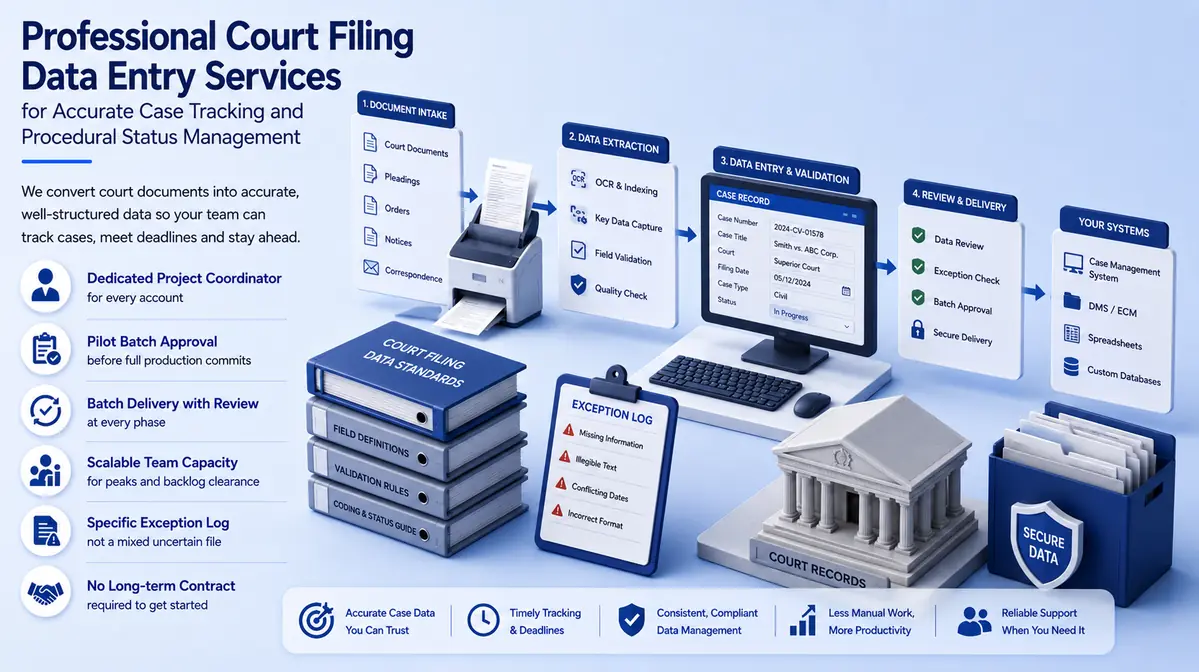

Procedural data organised for case tracking, retrieval and authorised follow-up

Every update retains the court, matter, source document and status history behind it.

01

Court and case metadata entry

Court, jurisdiction, division, case or claim number, matter ID, parties, counsel, assigned judicial officer and supplied case status are captured from approved sources under the client’s naming protocol.

02

Filing and docket event records

Document title, filing type, submitted date, accepted or entered date, docket reference, filing party, source link and approved status are entered as separate procedural fields. Rejections and replacements retain their event history.

03

Hearing, conference and order updates

Hearing date, time, location or connection details, event type, notice date, order reference and supplied attendance owner are recorded from authorised notices. Scheduling conflicts and legal-response requirements are escalated.

04

Service and proof-of-service records

Served party, method, address or channel, service date, server, proof reference and supplied status are captured from approved evidence. Whether service is legally effective remains a client legal decision.

05

Submission receipt and rejection tracking

Portal confirmation, transaction reference, fee, timestamp, rejection reason, resubmission link and final status are maintained so the case team can distinguish a prepared document from an accepted filing.

06

Historical docket and case-system migration

Legacy spreadsheets, court notices, scanned registers and exported dockets are converted into standard records while original sequence, event descriptions, identifiers and source references remain available.

Business System Compatibility

Court Filing Data Entry Services: Direct Integration and Software Compatibility

Outputs are prepared around the field structure, controlled values and import requirements of your destination environment. Files can be delivered for review, staging or authorised import without forcing your team to rebuild the completed work.

Supported destinations

Structured output for the platforms your team already uses

Files are mapped to the client’s approved template, naming rules, identifiers and system structure before full production begins.

  • Microsoft ExcelControlled worksheets and import tables
  • Google SheetsShared review and operational files
  • SharePointLists, libraries and metadata columns
  • SalesforceCRM objects and approved fields
  • ERP / CRM SystemsClient-defined import templates
  • Custom SQLStaging and relational tables
Source continuity

References stay connected

Source IDs, filenames, record keys and approved relationships remain available for review and downstream traceability.

Import control

Fields are mapped before production

Mandatory fields, formats, controlled values, character limits and relationship keys are checked against the destination specification.

Pilot validation

Test the handoff with a representative batch

Rejected rows, unsupported values and mapping conflicts are returned with exact references so approved corrections can be incorporated before full-volume delivery.

Delivery formatsStructured for review, staging or import
  • CSV
  • XLSX
  • XML

Column order, encoding, date rules, multi-value handling and destination-specific requirements can follow the receiving system’s approved specification.

Compatibility means SDES prepares outputs to specifications supplied or approved by the client. Product names identify commonly used destination systems and do not imply endorsement, certification or partnership.

Process, Quality and Security

A filing-record workflow from official source review to legal-team handoff

1. Define Courts and Matter Scope

Jurisdictions, systems, matters, authorised sources, access groups and client filing owners are documented.

2. Approve Procedural Field Rules

The setup review defines event types, date meanings, statuses, source hierarchy and questions requiring legal review.

3. Pilot Complete Event Sequences

Accepted, rejected, resubmitted, served, rescheduled and conflicting records test the workflow.

4. Capture and Link Filing Events

The delivery team records source-supported data and connects receipts, notices and stamped documents to the correct matter event.

5. Reconcile Event Integrity

Case identifiers, dates, statuses, sequence, parties, document references and source links are reviewed.

6. Return Action Items to Counsel

Completed updates and issues involving deadlines, validity, response or procedural interpretation are separated.

We process court filing data from all standard legal document sources

Court filing data arrives as PDF notices, electronic filings, paper documents and attorney notes. We process all formats into accurate entries in your case management system.

📂 Source formats we accept
  • Court notices, orders and stamped copies
  • Electronic filing receipts and rejection notices
  • Docket sheets and case exports
  • Hearing and conference notices
  • Service and proof-of-service documents
  • Legacy matter and filing registers
📤 Delivery formats
  • Source-linked filing register
  • Case-management import file
  • Docket event history
  • Hearing and service schedule
  • Receipt and rejection tracker
  • Missing, conflicting and procedural-review exception log

We confirm your case management system's field structure, matter numbering conventions and jurisdiction-specific identifier formats before starting any court filing data entry project.

Quality checks cover court, jurisdiction, matter and case identifiers, document or event type, distinctly labelled dates, parties, docket references, receipt status and agreement between the entry and official source.

Matter-level access and source controls apply throughout production. Rejected filings, replacement documents and changed hearing notices retain version and event history rather than being silently overwritten.

The production team records procedural evidence under the protocol. An expert client lawyer or filing specialist determines deadlines, validity, service effectiveness, legal response, filing action and compliance with applicable court rules.

🔒 NDA Protected Before files are shared
🌐 GDPR Aware EU data handling
Defined Quality Target Confirmed by pilot
🛡️ Secure Transfer Encrypted file access
📋 Exception Log Every delivery
👥 Project Team Only Controlled access
Free accuracy test

Ready to keep your case management data current without consuming attorney or paralegal time?

Share a sample of your court filing documents, your case management platform and your weekly filing volume. We execute an NDA immediately, provide a specific quote within the agreed response window and run a pilot batch to confirm accuracy before production begins.

✓ No credit card required✓ No contract required✓ 24–48 hour return
Start With a Confidential Pilot
Source sampleyour_sample_data.csv
Received
Verified deliveryverified_output.xlsx
Reviewed
▣ Encrypted transfer◉ Quality controlled
Why Outsource to SDES?

Why court record support must never be mistaken for procedural control

Court Filing Data Entry Services workflow and quality review
  • Official-source references
  • Distinct procedural dates
  • Event-history retention
  • Receipt reconciliation
  • Named legal owners
  • Scalable record capacity

Litigation teams outsource professional court filing data entry when docket administration and record migration are consuming time needed for drafting, advocacy and matter management.

The documented workflow lets the delivery team maintain supported records while deadline calculation, court-rule interpretation, submission, service decisions and legal response remain with authorised client personnel.

Start Your Project →
Industries We Support

Court and tribunal records supported across different matter portfolios

Litigation Law Firms

Pleadings, docket events, notices, hearings, service records and receipts maintained across active matters.

Corporate Legal Departments

External-counsel filing updates and dispute records organised within internal matter-management systems.

Insurance Legal Teams

Claims litigation, hearing, order and service records linked to approved claim and matter identifiers.

Property and Construction Disputes

Court, tribunal and adjudication records organised by project, property, party and procedural event.

Financial Services Disputes

Restricted litigation and regulatory proceeding records maintained under matter-specific access rules.

Healthcare Legal Operations

Court and tribunal records organised without extending access to unrelated patient or clinical information.

Case Studies

Relevant Project Experience

National Litigation Docket Migration

Project Name
National Litigation Docket Migration
Volume
5,400 matters and 286,000 docket events — completed in 5 weeks
Problem
Legacy databases used inconsistent court names and combined submitted, accepted and entered dates in one field. During the National Litigation Docket Migration in United States review, time-sensitive review could not proceed efficiently while key references remained fragmented across documents and spreadsheets.
Solution
A professional migration map standardised approved court and event values while preserving each original description and source reference. During production for National Litigation Docket Migration in United States, confirmed records and exception items were delivered separately to protect matter relationships during import or archive preparation.
Outcome
The new matter system received sequenced docket histories plus a focused queue for unresolved case identifiers and ambiguous dates. As a result of the National Litigation Docket Migration in United States workflow, counsel and legal operations personnel received organised records that supported review, migration or archive retrieval.
Title
Litigation Technology Director
Industry
National Law Firm
Country
United States

Electronic Filing Receipt Desk

Project Name
Electronic Filing Receipt Desk
Volume
18,500 filing events per month
Problem
Portal receipts, rejection emails and stamped copies were stored separately, so case teams could not quickly confirm final acceptance status. During the Electronic Filing Receipt Desk in Australia review, time-sensitive review could not proceed efficiently while key references remained fragmented across documents and spreadsheets.
Solution
The delivery team linked submission, rejection, resubmission and acceptance evidence under one event model. The solution escalated conflicting receipts for expert filing review.
Outcome
Matter teams gained traceable status records without relying on filenames or assuming submission meant acceptance. After completing Electronic Filing Receipt Desk in Australia, the archive became easier to migrate, audit and retrieve without losing the link to the original source files.
Title
Court Services Manager
Industry
Legal Services
Country
Australia

Tribunal Hearing Notice Register

Project Name
Tribunal Hearing Notice Register
Volume
12,800 notices across 2,100 matters — completed in 12 weeks
Problem
Rescheduled events and amended directions repeatedly replaced earlier calendar entries without retaining the source history. For the Tribunal Hearing Notice Register in United Kingdom workload, legal personnel had to reopen source files to confirm matter, party, date and document relationships before substantive review.
Solution
Professional data entry created distinct notice events with matter, event type, date, location, issuing body and supersession references. For Tribunal Hearing Notice Register in United Kingdom, matter references and the client’s controlled legal taxonomy governed entry, while interpretation and ambiguous classifications remained with counsel.
Outcome
Counsel received current review schedules while earlier notices remained available for procedural context. Following delivery for Tribunal Hearing Notice Register in United Kingdom, legal reviewers could retrieve confirmed matter records quickly while ambiguous classifications remained in a focused review queue.
Title
Head of Dispute Operations
Industry
Employment Law
Country
United Kingdom
FAQs

Questions to resolve before court filing records enter production

Does your team calculate filing deadlines or submit documents to court?

Not as part of data entry. Deadline calculation, procedural interpretation, filing submission and legal response remain with authorised client lawyers or filing specialists.

How are rejected and resubmitted filings recorded?

Each event retains its own timestamp, receipt, status and relationship. The later accepted record does not erase the earlier rejection history.

What should we provide when we outsource court filing data entry?

Provide court and matter masters, authorised sources, event and status definitions, date rules, source-link requirements, access controls and named legal reviewers.

Which items are held for client review during Court Filing Data Entry Services?

On Court Filing Data Entry Services engagements, unreadable values, conflicting identifiers and decisions outside the approved guide are kept separate from clean legal and property records. Every held item retains its source reference for the authorised reviewer.

📩 Get a Free Pilot
💬