
India-Based Data Entry Outsourcing Support Serving USA, Canada, UK, Australia, Europe, New Zealand, Singapore, UAE
Back-Office Support Services

Back-Office Support Services That Keep Routine Operations Moving Without Taking Control Away From Your Team

Orders waiting to be recorded, supplier files awaiting checks and calendars missing updates are not isolated clerical problems. They are broken handoffs between teams. Our professional back-office support begins by locating those handoffs and defining what evidence closes each task.

A single offshore operating queue can cover compatible non-voice work, but every activity keeps its own source, deadline, permission and escalation owner. Procurement still approves spend; managers still interpret policy; system owners still control access.

You may outsource a temporary backlog or an ongoing mix of scheduled tasks. The expert solution is a measured operating rhythm with visible exceptions—not a general inbox in which unrelated requests lose their context.

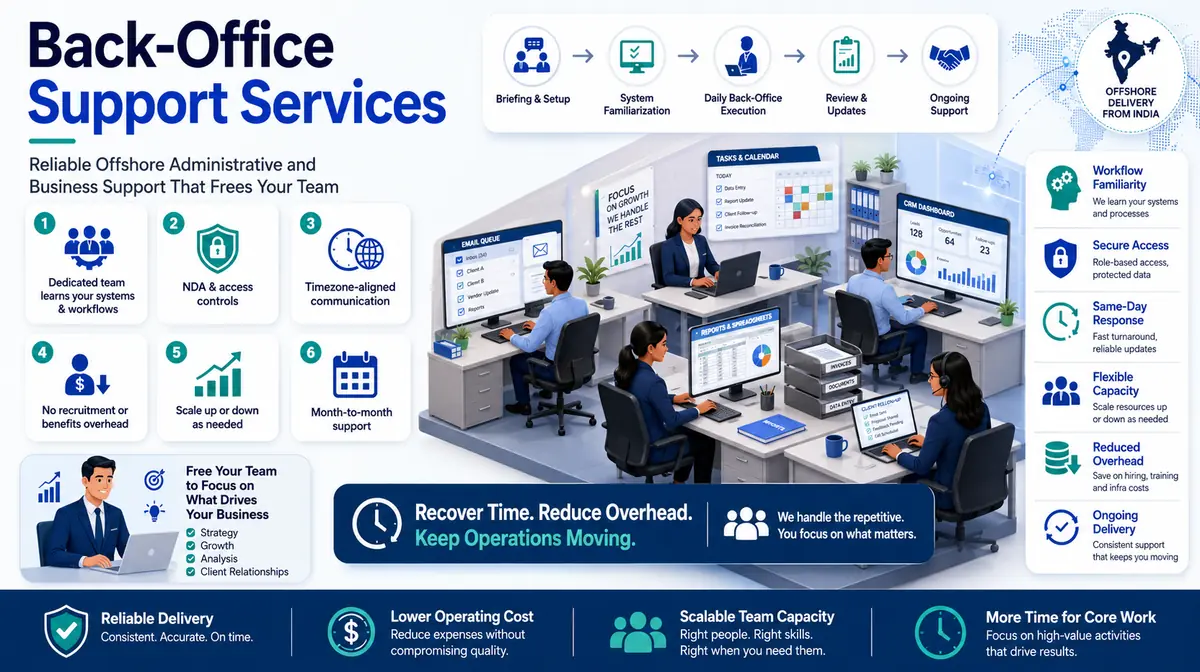
Shri Data Entry Services team working on Back-Office Support Services projects
5000+ Completed Projects
90% Returning Clients
16+ Years Experience
45+ Countries Served
50+ Professionals Team
Services We Offer

A useful back-office model connects routine tasks without blurring responsibility

  • Task inventory by owner and frequency
  • Sources and destination systems mapped
  • Authorised actions documented
  • Decision points retained by the client
  • Handoffs timed to operating needs
  • Exceptions assigned to named owners

Back-office work is rarely difficult because of typing alone. A vendor update may affect purchasing, finance and compliance. An appointment change may require calendar, CRM and follow-up updates. An order record may depend on an approved customer reference and product code. Treating each click as an isolated task creates gaps between departments.

We begin with the handoffs. The client identifies what starts a task, which information is authoritative, what a completed item looks like and who decides when the normal rule does not apply. The resulting workflow can cover back-office data processing, document processing, CRM data updates, order processing support and virtual back-office assistance without transferring management authority.

This approach suits recurring work that has a stable business purpose but variable volume. Daily queues, weekly reconciliations, monthly updates and temporary backlogs can use different delivery rhythms. Capacity changes are planned against measured demand rather than solved by silently reducing review.

Back-office capabilities organised around the record, the action and the handoff

Each workstream has its own instructions and completion evidence, even when several services share one coordinator.

01

Administrative records and office data

Forms, trackers, registers, correspondence details and approved database fields are entered or updated using your naming, formatting and status rules. Unsupported values are held outside the clean queue.

02

Purchase and order administration

Purchase requests, purchase orders, acknowledgements and tracking facts are recorded for procurement review. Commercial approval, supplier selection and payment authority remain with the client.

03

Vendor and supplier information

Supplier profiles, contacts, identifiers, classifications and document-status fields are maintained from authorised sources, with possible duplicates and ownership conflicts routed for review.

04

Virtual administrative assistance

Defined email, research, calendar, document and coordination tasks are completed through an agreed queue. Communication requiring judgement follows approved scripts or returns to an internal owner.

05

Restricted client-system entry

Approved records can be entered through a remote desktop, virtual desktop or controlled portal when file exchange is unsuitable. Permissions and permitted actions are confirmed before production.

06

Appointment and calendar coordination

Booking requests, confirmations, rescheduling facts and CRM appointment updates are managed within availability, priority and escalation rules supplied by the client.

Business System Compatibility

Back-office Support Services: Direct Integration and Software Compatibility

Outputs are prepared around the field structure, controlled values and import requirements of your destination environment. Files can be delivered for review, staging or authorised import without forcing your team to rebuild the completed work.

Supported destinations

Structured output for the platforms your team already uses

Files are mapped to the client’s approved template, naming rules, identifiers and system structure before full production begins.

  • Microsoft ExcelControlled worksheets and import tables
  • Google SheetsShared review and operational files
  • SharePointLists, libraries and metadata columns
  • SalesforceCRM objects and approved fields
  • ERP / CRM SystemsClient-defined import templates
  • Custom SQLStaging and relational tables
Source continuity

References stay connected

Source IDs, filenames, record keys and approved relationships remain available for review and downstream traceability.

Import control

Fields are mapped before production

Mandatory fields, formats, controlled values, character limits and relationship keys are checked against the destination specification.

Pilot validation

Test the handoff with a representative batch

Rejected rows, unsupported values and mapping conflicts are returned with exact references so approved corrections can be incorporated before full-volume delivery.

Delivery formatsStructured for review, staging or import
  • CSV
  • XLSX
  • XML

Column order, encoding, date rules, multi-value handling and destination-specific requirements can follow the receiving system’s approved specification.

Compatibility means SDES prepares outputs to specifications supplied or approved by the client. Product names identify commonly used destination systems and do not imply endorsement, certification or partnership.

Process, Quality and Security

From scattered support requests to a measurable back-office operating queue

1. Inventory the Work

Tasks are grouped by source, owner, frequency, system and business consequence. One-off requests are separated from recurring production.

2. Draw the Authority Line

Permitted updates, prohibited actions, approvals and escalation owners are documented for each workstream.

3. Build Completion Evidence

Status values, required notes, source references and handoff expectations are defined so completed work can be checked.

4. Test Connected Tasks

A pilot follows real handoffs across sample records and systems, including exceptions rather than only straightforward items.

5. Operate by Queue and Cut-Off

Work is processed against agreed priorities, service windows and batch schedules with unresolved items kept visible.

6. Review Demand and Exceptions

Volume, ageing, rework and exception themes are reviewed to refine instructions or return decisions to the right owner.

Inputs become operational work only after authority and completion criteria are clear

A task queue should show what can be completed, what needs approval and what evidence confirms completion.

📂 Source formats we accept
  • Email and task queues
  • Approved forms and documents
  • CRM or ERP update lists
  • Purchase and supplier records
  • Calendar requests
  • Department trackers
📤 Delivery formats
  • Completed task register
  • Updated approved systems
  • Structured operational files
  • Exception and decision queue
  • Handoff summary
  • Volume and status report

Representative work should include ordinary tasks, cross-department dependencies and known exceptions. A clean demonstration alone cannot reveal the management effort needed for live production.

Quality is measured against the purpose of each queue. Required identifiers, ownership links, dates, controlled statuses and completion notes may receive different checks from lower-risk descriptive fields.

Security begins with minimised access. Only the files, folders, portals and functions required for the agreed task are used. Credential ownership, session rules, downloads, retention and access removal are confirmed with the client.

No certification, guaranteed saving or universal accuracy rate is implied by this page. The proposal records the controls, review level, delivery schedule and evidence applicable to the actual engagement.

🔒 NDA Protected Before files are shared
🌐 GDPR Aware EU data handling
Defined Quality Target Confirmed by pilot
🛡️ Secure Transfer Encrypted file access
📋 Exception Log Every delivery
👥 Project Team Only Controlled access
Free accuracy test

Which routine activities are absorbing specialist time?

Share a task list, approximate frequency, systems involved and examples of normal and difficult cases. We will separate suitable production work from approvals and management decisions.

✓ No credit card required✓ No contract required✓ 24–48 hour return
Request a Workflow Review
Source sampleyour_sample_data.csv
Received
Verified deliveryverified_output.xlsx
Reviewed
▣ Encrypted transfer◉ Quality controlled
Why Outsource to SDES?

Why companies use SDES to add capacity without creating a shadow operations department

Back-Office Support Services workflow and quality review
  • One coordinator across related queues
  • Professional instructions at task level
  • Expert escalation before uncertain action
  • Offshore capacity matched to measured demand
  • Client ownership of approvals and policy
  • Documented status and exception reporting

A back-office support solution should make work easier to supervise. SDES maintains separate instructions for each queue, records completion using agreed evidence and keeps exceptions visible. Your managers can see what moved, what is waiting and why.

The ability to outsource routine execution is most valuable when internal specialists remain focused on judgement. Procurement owns commercial choices, finance owns payment decisions, clinicians own care decisions and sales leaders own customer strategy. The support team records and coordinates within the boundary set by those owners.

Start Your Project →
Industries We Support

Different operating environments require different back-office boundaries

eCommerce and Retail

Product, order, supplier and inventory administration linked to platform rules.

Healthcare Administration

Approved scheduling and record tasks under privacy and clinical escalation boundaries.

Finance Operations

Transaction-support and document queues without approval or payment authority.

Property Businesses

Listing, tenant, supplier and portfolio administration tied to asset references.

Logistics

Shipment, carrier, proof and vendor records maintained for operational teams.

Professional Services

Client, project, calendar and correspondence administration by engagement.

Case Studies

Relevant Project Experience

Regional Order Administration Desk

Project Name
Regional Order Administration Desk
Volume
35,876 records per month
Problem
Order details arrived through email, spreadsheets and CRM notes, leaving operations staff to reconstruct each request. For the Regional Order Administration Desk in Australia workload, sales and service users could not rely on ownership, relationship or activity fields without checking the original sources.
Solution
A single intake register linked customer references, approved product codes and missing-information holds before ERP preparation. During production for Regional Order Administration Desk in Australia, priority identifiers, variants and asset links received focused review before channel-ready records were released.
Outcome
The model gave sales and operations one visible queue while preserving internal approval of pricing and fulfilment. As a result of the Regional Order Administration Desk in Australia workflow, recurring maintenance became easier to govern because each update followed the same identity and field-authority rules.
Title
Operations Enablement Lead
Industry
Wholesale Distribution
Country
Australia

Multi-Team Administrative Queue

Project Name
Multi-Team Administrative Queue
Volume
40,543 records per month
Problem
Requests were assigned informally, making age, ownership and completion difficult to measure. For the Multi-Team Administrative Queue in United Kingdom workload, internal reviewers had to compare multiple sources manually before they could trust the record for its intended business use.
Solution
Task types received separate completion rules, cut-off times and escalation owners under one coordinated queue. For Multi-Team Administrative Queue in United Kingdom, a source-to-destination guide defined field authority, permitted standardisation and the exact conditions requiring client review.
Outcome
The proposed offshore model made routine work traceable without allowing the support team to decide policy exceptions. After completing Multi-Team Administrative Queue in United Kingdom, internal reviewers could focus on genuine exceptions instead of rechecking every completed record.
Title
Shared Services Manager
Industry
Professional Services
Country
United Kingdom

Supplier and Calendar Support Cycle

Project Name
Supplier and Calendar Support Cycle
Volume
15,975 records per month
Problem
Two connected workloads competed for the same internal administrator during peak periods. For the Supplier and Calendar Support Cycle in United States workload, channel teams had to compare supplier sources manually, slowing publication and increasing the risk of inconsistent product records.
Solution
Supplier batches and calendar requests used different priority windows, instructions and review paths while sharing reporting. Within the Supplier and Calendar Support Cycle in United States workflow, the team preserved supplier provenance and applied approved mappings only where the source supported the destination value.
Outcome
The expert owners could review only commercial and scheduling exceptions instead of processing every routine item. Following delivery for Supplier and Calendar Support Cycle in United States, channel teams could publish confirmed products from a clean file and resolve supplier exceptions without rechecking the complete catalog.
Title
Business Services Director
Industry
Facilities Management
Country
United States
FAQs

Questions about managed back-office support

Which tasks are suitable for back-office support?

Repeatable, non-voice tasks with defined sources, actions and completion rules are the strongest fit. Approvals, policy decisions and work requiring unsupported judgement should remain with authorised owners.

Can several departments use the same support team?

Yes, but each queue should retain separate instructions, priorities and escalation owners. Shared coordination should not erase functional responsibility.

Can SDES work inside our business systems?

Potentially. Access is assessed by system, role and task. Restricted permissions, session controls, recovery and audit requirements must be agreed before live work begins.

Can Back-Office Support Services follow our existing template or platform fields?

Yes, when the destination fields, accepted values, identifiers and permitted actions are confirmed. Delivery can be prepared as Completed task register, Updated approved systems, with unresolved records excluded from upload-ready output.

📩 Map a Back-Office Workflow
💬