
Employee master updates
Approved identity, role, location and organisational fields are maintained using HRIS references.
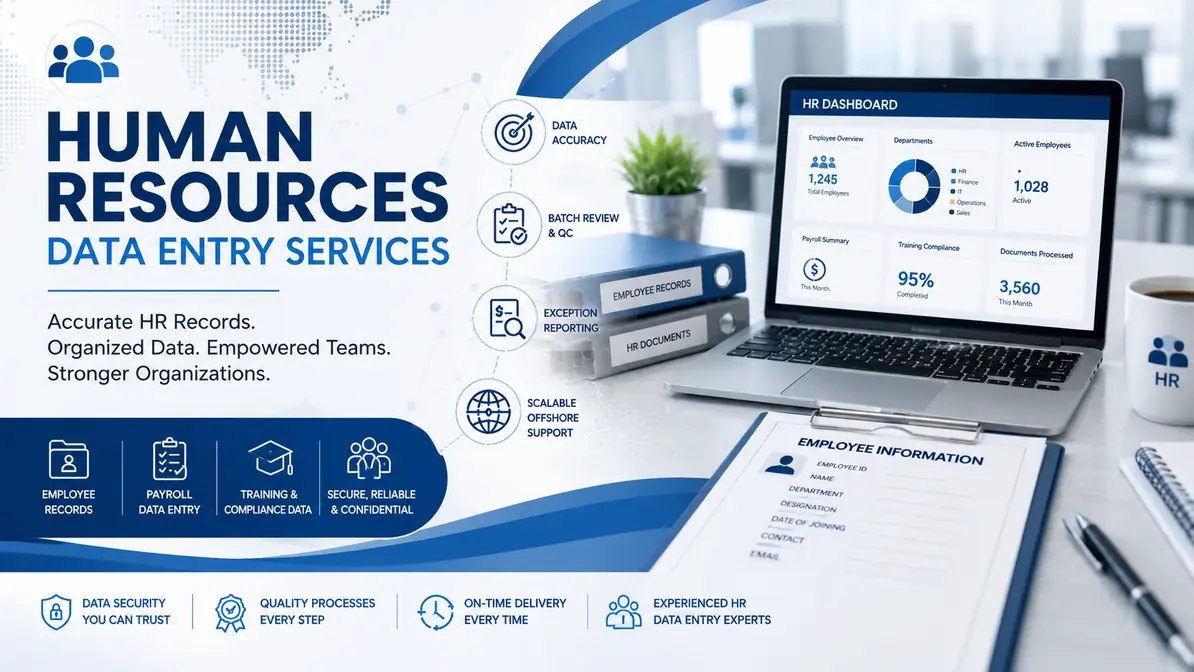
Employee information changes from recruitment and onboarding through transfer, training, leave and exit. SDES provides human resources data entry services that help authorised HR teams organise documents and update approved fields without transferring employment decisions.
Our professional operators work within defined HRIS roles and file permissions. Organisations can outsource HR data entry for migrations, personnel-file backlogs or recurring administration while HR specialists retain control of compensation, performance and employment actions.
A status change entered against the wrong profile can affect payroll, access or reporting. HR processing therefore begins with approved identifiers and effective-date rules.
We confirm permitted fields, source priority and the actions operators may perform. Employee IDs, HRIS references and authorised documents are used to prevent similar names from being confused.
The HR data management solution captures supplied facts without evaluating a candidate, changing compensation or interpreting policy. Sensitive fields can be excluded entirely when they are not required for the assignment.
Missing signatures, contradictory dates and uncertain employee matches remain in an exception queue for an HR expert.
An offshore HR data entry arrangement should use least-privilege access. Work can be divided by document type or field set so operators see only what production requires.
Businesses that outsource HR administration retain decisions involving hiring, termination, performance, pay and policy. SDES applies confirmed instructions and documents anything requiring authority.
Approved identity, role, location and organisational fields are maintained using HRIS references.
Required forms, start dates and checklist status are indexed for HR review.
Authorised dates, categories and balances are captured without deciding eligibility.
Courses, completions, expiries and certificates are linked to the correct employee.
Enrolment and supporting documents are classified under restricted access.
Legacy files are named and indexed under the organisation’s retention taxonomy.
Application status and supplied candidate facts are updated without suitability judgement.
Approved exit dates, asset-return status and document references are organised for authorised teams.
Access excludes data that is not needed for production.
The pilot tests names, IDs and difficult profile conflicts.
Onboarding, training, leave and exits remain distinct.
Unclear authority, dates and matches are sent to HR.
Send a representative sample with your real source files and field rules. We will return a review-ready output so you can assess the workflow before making a financial commitment.
HR workflows balance field accuracy with strict separation of employee, payroll and recruitment information.
Employee IDs and approved identifiers prevent documents from being attached to the wrong profile.
Compensation, banking, identity and medical fields are restricted according to the project scope.
Joiner, transfer, leave and exit updates are checked against the effective date and authorised source.
Prepare employee fields and document indexes for technical validation.
Classify legacy files and identify missing or duplicate documents.
Process authorised lifecycle updates on an agreed schedule.
Our professional HR data processing follows approved documents, field permissions and retention instructions. The client’s expert HR team retains employment and policy decisions.
SDES supplies offshore capacity for repeatable administration, with exceptions tied to the employee, source and affected field.
Problem: Legacy documents lacked consistent employee and document metadata.
Solution: Files were indexed by approved employee ID and document class.
Outcome: An HRIS-ready index and missing-document register were delivered.
Title: People Systems Manager
Industry: Professional Services
Country: Australia
Problem: Department trackers used inconsistent course and employee identifiers.
Solution: Records were matched to approved rosters and uncertain profiles isolated.
Outcome: A consolidated compliance-training file was prepared.
Title: Learning Compliance Lead
Industry: Facilities Management
Country: United Kingdom
Problem: Multiple business units used different status labels.
Solution: Statuses were mapped under HR-approved rules with authorisation gaps flagged.
Outcome: Migration files and a lifecycle-status exception list were delivered.
Title: HR Technology Director
Industry: Logistics
Country: United States
“Employee files from multiple offices were organised without combining people simply because their names matched. HR received a clean migration file and a small identity-review queue. Amazing quality—the finished work exceeded our expectations.”
Ruby A.
People Systems Manager
Australia
“The onboarding tracker now shows exactly which document is present, missing or unreadable for each employee. It has removed a great deal of manual checking from our weekly process. The work arrived within the agreed timeframe and helped our schedule.”
Oscar L.
Learning Compliance Lead
United Kingdom
“I was pleased with how access was limited throughout the assignment. Routine data entry moved forward without exposing compensation or sensitive employee documents to teams that did not need them. The service has been well worth outsourcing to SDES and offers strong value for the cost.”
Mia P.
HR Technology Director
United States
No. HR authority remains entirely with the client.
Yes. Access can be limited by field, record class, folder and system role.
Using client-approved identifiers; uncertain profiles are not combined.
Yes, under the client’s taxonomy, retention and access rules.
Yes, when sources, authority and effective-date rules are stable.
Provide representative, preferably de-identified records and the required HRIS fields.