
Book Metadata Entry
Titles, subtitles, contributors, ISBNs, formats, publication dates, page counts, language, subjects and supplied descriptions are prepared from authorised title sheets, catalogues or publisher systems.
A book, journal, magazine, newspaper archive or digital publication can exist in several editions, languages and formats. If its metadata loses the connection between title, contributor, identifier, publication date and rights status, readers may struggle to find it and internal teams may struggle to manage it.
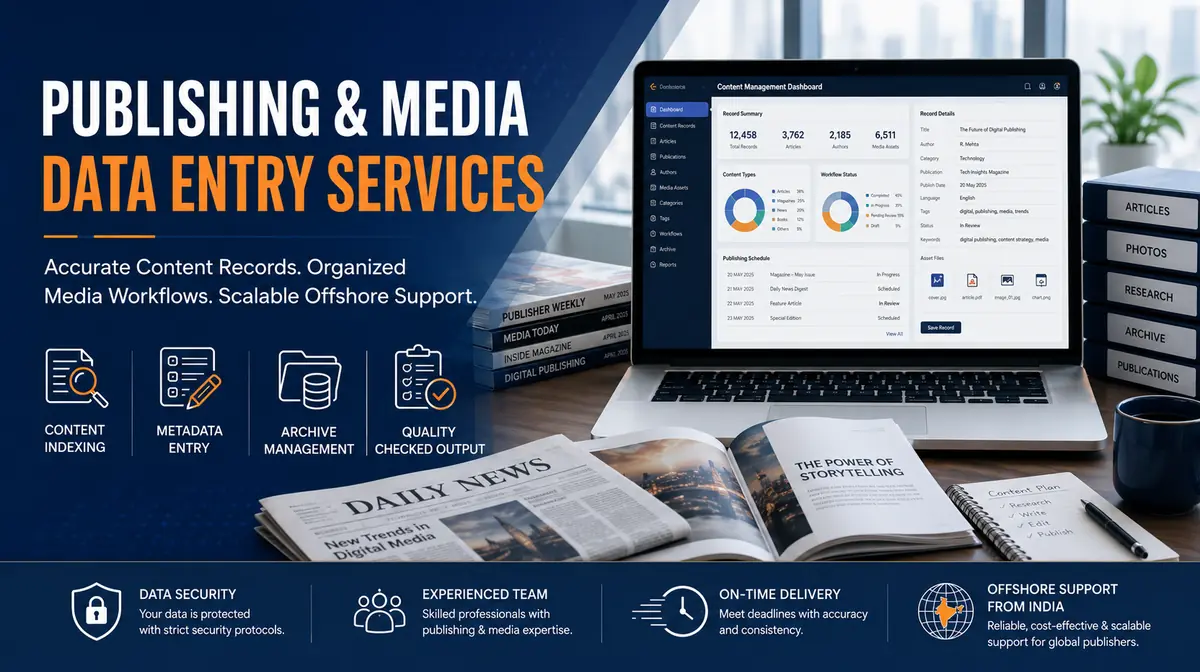
SDES delivers publishing data entry services for publishers, media houses, journals, educational-content providers, libraries, aggregators and digital archives. The work focuses on preserving the identity of each publication and the relationships that distinguish one edition or media asset from another.
An offshore publishing data entry solution can support catalogue preparation, archive conversion, content migration or recurring metadata updates. Editorial judgement, rights clearance, content approval and publication decisions remain with the publisher.
CTA: Share a Publication and Its Metadata
The same work may be available as a hardcover, paperback, eBook, audiobook, revised edition, translated version or regional release. Treating every format as one record can erase differences; treating each appearance as unrelated can fragment the publication history.
Before production, SDES identifies the hierarchy used by the publisher:
Our expert publishing data entry team applies the publisher’s approved identifiers and relationship rules. Similar titles are not merged merely because their names match, and separate formats are not combined when they carry different identifiers or rights.
This structured title history supports catalogue search, distribution, licensing, archive retrieval and platform migration.
Titles, subtitles, contributors, ISBNs, formats, publication dates, page counts, language, subjects and supplied descriptions are prepared from authorised title sheets, catalogues or publisher systems.
Journal, volume, issue, article title, author, affiliation, page range, DOI, abstract and keyword fields are captured according to the publication’s indexing rules.
Publication date, edition, section, headline, byline, page and topic fields can be organised for searchable historical archives.
Digital-edition identifiers, formats, file references, accessibility fields, territories and platform-specific metadata are structured for publisher or distributor review.
Narrator, duration, language, audio format, track, contributor and release information can be linked to the correct title and edition.
Author, editor, translator, illustrator, photographer and narrator records are updated using confirmed identifiers. Similar names remain separate unless the publisher’s matching rules establish the relationship.
Covers, illustrations, photographs, audio files and supporting assets are named and indexed by title, edition, chapter, article or supplied asset reference.
Historical catalogues, spreadsheets, PDFs and printed title lists are converted into structured metadata for archive, distribution or system migration.
An ISBN usually identifies a specific book edition and format. An ISSN identifies a serial publication. A DOI may identify an article or another digital object. Replacing one identifier with a similar title match can attach prices, rights, contributors or assets to the wrong publication.
Our professional publishing data processing maintains the identifier supplied for each title or edition. Formatting may be standardised where the publisher has approved the rule, but the underlying identity is not changed.
A publisher may outsource book metadata entry when preparing a seasonal catalogue, digitising a backlist or migrating to a new title-management platform. Production continues for confirmed editions, while identifier conflicts and uncertain relationships remain outside the upload file.
This creates a dependable publishing metadata management solution without asking operators to decide whether two editions should be consolidated.
Contributor information affects search, royalties, contracts, attribution and reader trust. A contributor may publish under initials, a pen name, a changed surname or different name forms across markets.
SDES follows the publisher’s contributor authority file or approved matching criteria. A matching name alone does not prove that two records represent the same person.
The workflow can preserve:
The expert editorial or rights team retains authority over credit wording, pen-name relationships, contributor disputes and contractual interpretation.
A publication record may include territories, languages, formats, licence periods, restrictions and rights holders. Entering these fields does not establish that the publisher is legally entitled to use or distribute the content.
An offshore media data entry team can capture supplied rights information from authorised contracts, rights sheets and systems. Operators do not interpret unclear clauses, extend an expired licence or infer rights from previous publication.
A record requires rights-team direction when:
Each exception identifies the title, edition, asset and source involved. This allows the publisher’s rights personnel to make a focused decision without searching the entire catalogue.
Initial title, contributor, imprint and planned-format records can be prepared from approved acquisition or title-information documents.
ISBNs, dates, descriptions, subjects, classifications, dimensions, prices and distribution fields are entered as the publisher confirms them.
Approved changes to dates, prices, availability, descriptions and assets can be applied to publisher or distributor files.
Older titles, changed contributors, rights updates, revised descriptions and new digital formats can be added without rebuilding the complete catalogue.
Historical catalogues and asset collections can be indexed for a new platform, digital archive or discovery system.
Publishers can outsource publishing data entry for one stage or maintain a recurring queue that follows the title lifecycle.
A metadata record can pass a spelling check and still be wrong. A valid ISBN may belong to another format; a contributor may be attached to the wrong edition; a cover image may belong to a regional release.
The professional review process checks:
SDES does not rewrite marketing descriptions, select subject categories through editorial judgement or approve publication data. Those decisions remain with the publisher’s expert metadata and editorial teams.
Send a representative sample with your real source files and field rules. We will return a review-ready output so you can assess the workflow before making a financial commitment.
Publishing files may include unreleased titles, manuscripts, contributor details, contract references, pricing plans, images and licensed media. Access should reflect the assigned catalogue or production role.
An offshore publishing support project can be divided by imprint, publication type, territory, client, title list or asset class. Someone indexing historical newspaper pages does not need access to unreleased manuscripts or contributor contracts.
Assigned operators receive the authorised files required for their task. Rights documents and sensitive contributor information can remain outside routine metadata entry when only confirmed fields are needed.
SDES can prepare:
Field names, identifier formats, controlled vocabularies, date structures and destination requirements are confirmed before production. The resulting publishing data framework is designed for the receiving catalogue, archive or distribution process.
Historical title data can be converted from catalogues, PDFs and spreadsheets into structured records linked to editions and formats.
Publishers may outsource catalogue data entry while editors continue managing descriptions, classification and publication decisions.
Cover images, illustrations, audio files and supporting assets can be indexed by title, format and regional release.
Volumes, issues, articles, contributors, page ranges and identifiers can be prepared for archive or indexing-system review.
Uncertain edition matches, missing identifiers and unsupported rights information remain outside the destination-ready file.
A controlled offshore media support arrangement increases production capacity without transferring editorial or rights authority.
Project Name: Multi-Volume Article Discovery Database
Volume: 42,600 articles across 310 journal issues — completed in 11 weeks
Problem: Older issues were available as scanned PDFs but lacked article-level titles, authors, page ranges and subject metadata.
Solution: Issue and article relationships were captured from the source pages. Unclear author names and incomplete page sequences remained linked to the affected issue.
Outcome: The publisher received a searchable article index and a smaller editorial-review file for uncertain credits and pagination.
Title: Journal Production Manager
Industry: Academic Publishing
Country: Australia
Project Name: Multi-Format Book Catalogue Reconstruction
Volume: 18,400 titles with 29,700 edition and format records — completed in 3 weeks
Problem: Historical spreadsheets combined print and digital formats, causing ISBN, price and cover-image relationships to overlap.
Solution: Edition records were rebuilt around confirmed ISBNs, formats and publisher references. Unsupported title matches remained separate.
Outcome: The migration team received edition-specific catalogue files and a review register for unidentified or conflicting formats.
Title: Metadata Operations Lead
Industry: Trade Publishing
Country: United Kingdom
Project Name: Searchable Historical Media Archive
Volume: 86,000 scanned pages covering 14 years — completed in 4 weeks
Problem: Pages were stored by scan sequence and could not be retrieved by publication date, edition, section or article heading.
Solution: Publication and page metadata were indexed from mastheads, section markers and supplied archive references.
Outcome: Researchers could locate pages by date and section, while damaged or incomplete issues remained clearly identified.
Title: Digital Archive Director
Industry: News Media
Country: United States
> “Article records remained connected to the correct journal issue. Unclear author names were returned with exact page references for editorial review.”
Charlotte D.
Journal Production Manager
Australia
> “The migration files finally separated print and eBook editions. ISBN and cover relationships were no longer mixed inside one title record.”
George P.
Metadata Operations Lead
United Kingdom
> “Our historical pages became searchable by date and section without changing the wording or structure of the original publication.”
Madison L.
Digital Archive Director
United States
No. SDES enters identifiers supplied through authorised publisher sources. Identifier assignment remains with the publisher and relevant registration authority.
Yes. Print, digital, audio, revised, translated and regional editions can remain connected to the work while retaining their distinct identifiers and metadata.
No. Supplied rights fields can be entered, but rights interpretation and clearance remain with authorised personnel.
Yes. Article, author, page, issue and supplied subject information can be captured from readable source pages.
Yes. Output can follow confirmed destination fields and controlled values, with unresolved records separated before import.
Provide related title, edition and asset records, the required metadata structure, identifier rules and examples of known catalogue problems.
Share one title with its print, digital or audio editions, contributor information and related assets. Our professional publishing services team will prepare the authorised metadata while your expert editorial and rights personnel retain publication authority.
CTA: Request a Publishing Data Entry Pilot