
Donor records
Constituent IDs, contacts, supplied preferences and relationships follow authorised sources.
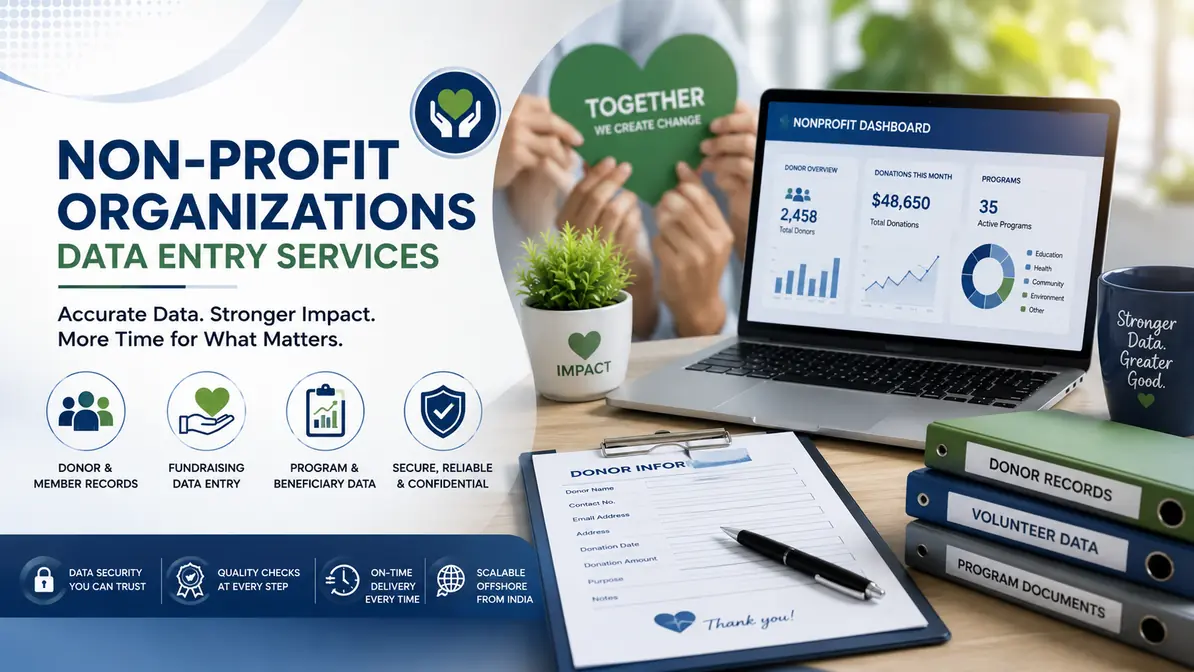
One person may appear as a donor, volunteer, member, event participant or beneficiary. Treating those entries as automatic duplicates can erase important relationships; leaving every variation untouched can fragment the organisation’s history.
SDES organises non-profit data entry services around the roles, consent, campaigns, funds and programmes defined by the organisation. The offshore non-profit data entry solution makes authorised records usable without deciding how a constituent should be approached or how a gift should be allocated.
Records arrive through donation forms, events, volunteer applications, spreadsheets, membership systems, grant files and programme intake documents.
Our expert non-profit data entry team applies approved identity and relationship rules. Operators do not merge records because names look similar or assign a constituent category without evidence.
Individual, household and organisation relationships remain distinct, as do donor, volunteer, member and beneficiary roles. Consent source, communication preference, campaign, fund and programme context travel with the record.
A charity can outsource donor data entry while retaining decisions about stewardship, identity, consent and communication.
Donor intent cannot be reconstructed from whichever record is easiest to process.
When a payment receipt, appeal code and accompanying instruction point in different directions, the gift pauses before acknowledgement or fund allocation. SDES records the available evidence and routes the decision to the organisation’s fundraising or finance representative.
This protects the supporter relationship as well as restricted-fund reporting. Professional donation data entry services capture confirmed campaign, appeal, fund and transaction references without creating an unsupported allocation.
During campaign peaks, non-profits can outsource donation data entry; clear gifts continue while identity, allocation and duplicate-payment questions enter a fundraising-review queue.
Constituent IDs, contacts, supplied preferences and relationships follow authorised sources.
Amount, date, appeal, campaign, fund, payment reference and acknowledgement status remain connected.
Pledge schedules, instalments, balances and supplied statuses use confirmed donor and transaction references.
Availability, interests, assignments and training information are organised without suitability decisions.
Member IDs, categories, chapters, renewals, fees and preferences are prepared for platform review.
Participant, ticket, table, dietary, accessibility and payment fields support fundraising and community events.
Funder, project, milestone and supplied reporting fields are captured without assessing eligibility or effectiveness.
Approved intake and service fields are digitised while sensitive narratives remain within scope.
A beneficiary may also donate or volunteer, but those roles can carry different privacy and communication requirements.
Gift, consent and acknowledgement information stays within authorised stewardship work.
Applications and assignments remain under coordinator and safeguarding authority.
Sensitive beneficiary information is confined to approved fields and personnel.
An offshore charity data entry team can operate in separated environments. Relationship links are added only when the organisation supplies evidence and authorises the connection.
Send a representative sample with your real source files and field rules. We will return a review-ready output so you can assess the workflow before making a financial commitment.
Non-profit data may reveal financial support, beliefs, health circumstances, family information or participation in sensitive programmes.
A controlled offshore non-profit support project can be divided by programme, region, funder or constituent type.
PII can be masked or excluded when it is unnecessary for the approved output.
Professional reviewers check transaction and constituent links; expert client personnel retain safeguarding and allocation decisions.
Gifts and pledges move in scheduled batches while allocation exceptions remain with fundraising and finance.
Registrations, attendance, sponsorship and follow-up preferences are reconciled against event sources.
Grant and programme records are organised by funder, activity and period without interpreting outcomes.
Organisations may outsource charity data entry during genuine peaks rather than forcing every record type through a permanent generic workflow.
Fields, naming standards, dates, mandatory values and import requirements are confirmed before production, creating a non-profit data solution aligned with authorised review.
A professional non-profit services team prepares the authorised records while your expert personnel retain fundraising, safeguarding, allocation and programme decisions.
A charity should outsource database maintenance only after the pilot confirms constituent identity, role separation and donor-intent handling.
Project Name: Emergency Appeal Gift Processing
Problem: Several channels produced gifts without confirmed campaign or donor references.
Solution: Approved payment keys controlled matching; uncertain allocations stayed outside acknowledgement.
Outcome: Scheduled gift batches and a focused allocation queue supported the appeal.
Title: Fundraising Operations Manager
Industry: Humanitarian Charity
Country: Australia
Project Name: Volunteer Records Prepared for CRM
Problem: Historical spreadsheets used inconsistent IDs and contacts.
Solution: Approved volunteer IDs controlled consolidation; possible matches remained separate.
Outcome: Migration-ready profiles, histories and a coordinator review list were delivered.
Title: Volunteer Services Lead
Industry: Community Services
Country: United Kingdom
Project Name: Grant Programme Evidence Index
Problem: Evidence was stored by upload date instead of grant, activity or period.
Solution: Confirmed grant and programme references controlled indexing; incomplete evidence remained source-linked.
Outcome: Reporting teams could retrieve support by funder without exposing unrelated beneficiary files.
Title: Programme Data Director
Industry: International Development
Country: United States
“Confirmed donations moved to acknowledgement while uncertain campaign allocations stayed visible for our fundraising team. That balance was particularly valuable during a time-sensitive appeal. We were satisfied with the accuracy and the professional handling of the work.”
Mia H.
Fundraising Operations Manager
Australia
“Volunteer histories were consolidated without merging people on name alone. Our coordinators could review possible matches with the relevant contact and participation details already together. Fast, dependable service that saved our reviewers valuable time.”
Thomas W.
Volunteer Services Lead
United Kingdom
“Programme evidence is now easy to retrieve by grant and reporting period, while beneficiary information remains restricted. The structure has made funder reporting far less stressful. Outstanding value for money with excellent quality and dependable delivery.”
Natalie P.
Programme Data Director
United States
No. Unclear allocation stays with authorised fundraising or finance personnel.
Potential matches can be identified; final merging follows approved rules.
Yes, by programme, folder, field and operator role.
Yes, when confirmed registration, transaction or constituent references support the link.
Yes. Uncertain identities and roles remain outside import.
Provide one workstream, its required fields, identity rules and known exceptions.