
India-Based Data Entry Outsourcing Support Serving USA, Canada, UK, Australia, Europe, New Zealand, Singapore, UAE
Healthcare Data Entry Services

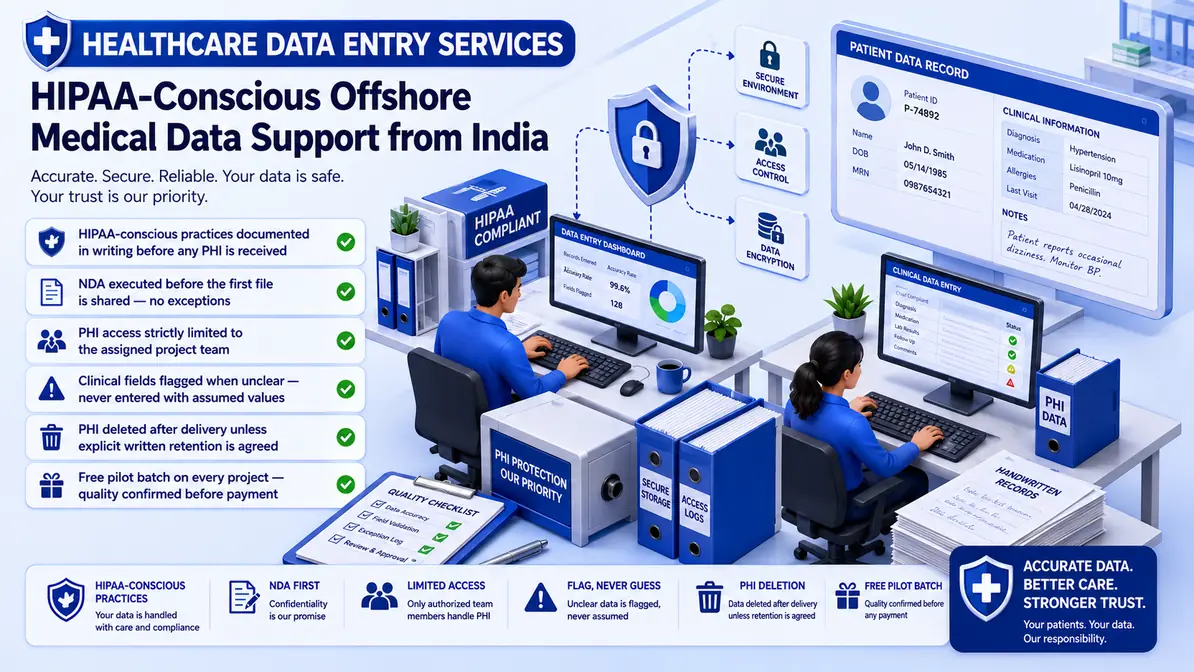
Healthcare Data Entry Built Around Source Fidelity, Limited Access and Clear Clinical Boundaries

Healthcare records support care, payment, operations and research, but not every data-entry task requires access to an entire chart. Our professional healthcare data entry services are scoped around the specific source documents, approved fields and intended administrative purpose.

Before production, an specialist reviews contractual requirements, permitted use, minimum-necessary access where applicable, system roles, patient-matching rules, field definitions and escalation paths. The delivery team then enters supported information without diagnosing, interpreting clinical meaning or choosing codes that require licensed judgement.

Providers, billing organisations and healthcare technology teams outsource structured back-office work when record volume exceeds internal capacity. The solution delivers source-referenced entries, batch-level quality controls and a separate queue for illegible, conflicting, missing or clinically sensitive information.

Shri Data Entry Services team working on Healthcare Data Entry Services projects
5000+ Completed Projects
90% Returning Clients
16+ Years Experience
45+ Countries Served
50+ Professionals Team
Services We Offer

Confirm the patient, document, purpose and authorised destination before entering healthcare data

  • Purpose documented
  • Access role approved
  • Patient identifiers checked
  • Source retained
  • Clinical decisions excluded
  • Exception owner named

A correctly typed value can still be unsafe if it reaches the wrong patient, encounter, document class or system field. Identity, context and destination therefore receive the same attention as transcription accuracy.

We follow client-approved patient identifiers, source hierarchies, field formats and record-placement rules. Unclear handwriting, conflicting dates, missing signatures and uncertain chart matches remain visible rather than being converted into plausible entries.

Additional delivery capacity supports repetitive administrative workloads. The documented workflow keeps operators within defined roles while clinicians, health-information teams, coders, compliance owners and billing authorities retain decisions that require their judgement.

Administrative healthcare records prepared for approved systems and accountable review

Each engagement is limited to the authorised purpose, fields, records and access route.

01

Patient registration and demographic entry

Approved name, date of birth, contact, guarantor, insurance reference, provider and administrative fields are entered from intake or registration sources. Potential duplicate patients and conflicting identifiers are escalated before chart creation or update.

02

EHR and EMR administrative updates

Authorised demographics, document metadata, referral information and designated structured fields are updated under the client’s workflow. Operators do not create diagnoses, alter clinical notes or make treatment decisions.

03

Medical billing source-data entry

Approved encounter, charge, payer and provider information is captured from supplied billing sources into designated staging files or systems. Missing documentation and code questions are routed to qualified billing or coding owners.

04

Healthcare form digitisation

Patient forms, consent and authorisation documents, questionnaires and administrative records are scanned, named or transcribed under agreed rules. Illegible fields and absent signatures remain exceptions.

05

Medical record indexing and attachment

Documents are classified by patient, date, record type, encounter, provider and other approved metadata before upload or delivery. Uncertain chart association is blocked rather than attached to a likely patient.

06

Data quality review and exception control

Required fields, formats, patient keys, dates, document placement and source-to-output counts are reviewed. Corrections are limited to evidence-backed administrative changes, with clinical ambiguity returned to authorised staff.

Healthcare System Compatibility

Healthcare Data Entry Services: Direct Integration and Software Compatibility

Outputs are prepared around the field structure, controlled values and import requirements of your destination environment. Files can be delivered for review, staging or authorised import without forcing your team to rebuild the completed work.

Supported destinations

Administrative data prepared for approved healthcare environments

Files are mapped to the client’s approved template, naming rules, identifiers and system structure before full production begins.

  • EpicClient-approved import structures
  • Oracle Health / CernerPatient and document fields
  • athenahealthAdministrative record templates
  • eClinicalWorksApproved demographic fields
  • NextGenMigration and staging files
  • Secure SQL DatabaseControlled staging tables
Source continuity

References stay connected

Source IDs, filenames, record keys and approved relationships remain available for review and downstream traceability.

Import control

Fields are mapped before production

Mandatory fields, formats, controlled values, character limits and relationship keys are checked against the destination specification.

Pilot validation

Test the handoff with a representative batch

Rejected rows, unsupported values and mapping conflicts are returned with exact references so approved corrections can be incorporated before full-volume delivery.

Delivery formatsStructured for review, staging or import
  • CSV
  • XLSX
  • HL7

Column order, encoding, date rules, multi-value handling and destination-specific requirements can follow the receiving system’s approved specification.

Compatibility means SDES prepares outputs to specifications supplied or approved by the client. Product names identify commonly used destination systems and do not imply endorsement, certification or partnership.

Process, Quality and Security

A healthcare data-entry workflow from contractual scope to accountable batch closure

1. Confirm Purpose and Authority

Contract, permitted use, applicable privacy obligations, records, fields, retention and owners are documented.

2. Limit Access and Define Rules

The setup review establishes roles, transfer route, patient matching, field formats and prohibited decisions.

3. Pilot Representative Records

Legible, incomplete, conflicting, multi-document and sensitive examples test the workflow and exceptions.

4. Enter Source-Supported Data

The delivery team processes approved fields while preserving patient, document and source context.

5. Review Identity and Completeness

Patient keys, dates, record placement, required fields, counts and sampled values are checked.

6. Return Administrative Records With Clinical Holds

Approved outputs and items requiring clinical, HIM, billing or compliance review are separated.

📂 Source formats we accept
  • Approved patient and administrative source files
  • EHR, billing or document-management field rules
  • Patient identifier and matching policy
  • Document taxonomy and naming standards
  • Access, transfer and retention requirements
  • Clinical, billing and compliance escalation matrix
📤 Delivery formats
  • Structured healthcare data-entry file
  • Approved system update batch
  • Patient and document index
  • Source-to-record reference register
  • Batch quality and coverage report
  • Identity, legibility and clinical-review exception log

Quality checks cover patient and record identifiers, source document, field placement, date format, required-field coverage, duplicate risk, document class, attachment destination, exception status and agreement between received and completed counts.

Where HIPAA applies, the covered entity or responsible client determines the permitted purpose, minimum-necessary approach and required contractual assurances. Appropriate administrative, physical and technical safeguards must be established before protected information is shared.

The production team enters supported administrative data. An expert client owner approves patient matching exceptions, clinical interpretation, diagnoses, code selection, treatment content, formal amendments, disclosures and final posting authority.

🔒 NDA Protected Before files are shared
🌐 GDPR Aware EU data handling
Defined Quality Target Confirmed by pilot
🛡️ Secure Transfer Encrypted file access
📋 Exception Log Every delivery
👥 Project Team Only Controlled access
Free accuracy test

Healthcare data project? Start with a free pilot batch.

Share a sample of your source forms, records or encounter documentation. We process a free pilot batch under NDA and return the output so you can evaluate accuracy and PHI handling before committing to production.

✓ No credit card required✓ No contract required✓ 24–48 hour return
Request a Free Healthcare Data Pilot
Source sampleyour_sample_data.csv
Received
Verified deliveryverified_output.xlsx
Reviewed
▣ Encrypted transfer◉ Quality controlled
Why Outsource to SDES?

Why healthcare data support needs strict limits as well as accuracy

Healthcare Data Entry Services workflow and quality review
  • Purpose-limited scope
  • Role-based access
  • Patient-match safeguards
  • Source traceability
  • Clinical boundaries
  • Scalable administrative capacity

Healthcare organisations outsource professional medical data entry when repetitive administrative records delay billing, migration, indexing and authorised operational workflows.

The documented workflow gives the delivery team precise production boundaries while privacy determinations, patient care, clinical interpretation, code selection, record amendment and final system authority remain with qualified client owners.

Start Your Project →
Industries We Support

Healthcare data support adapted to different administrative environments

Hospitals and Health Systems

High-volume patient administration, document indexing and migration support under approved system roles.

Medical and Specialty Practices

Registration, referral, billing-source and chart-document workflows aligned with clinic procedures.

Billing and Revenue-Cycle Organisations

Approved claim and billing fields entered with source references and qualified coding exceptions.

Healthcare Technology Providers

Structured migration, implementation and quality-review batches prepared for client-controlled platforms.

Healthcare Research Teams

Authorised survey and study-form fields entered under protocol, consent and de-identification requirements supplied by the client.

Insurers and Administrators

Claim-document and member-administration data processed under defined purpose, access and review rules.

Case Studies

Relevant Project Experience

Multi-Clinic Registration Backlog

Project Name
Multi-Clinic Registration Backlog
Volume
86,000 registration packets across 24 locations — completed in 12 weeks
Problem
Forms arrived with inconsistent identifiers and demographic updates that sometimes conflicted with the existing patient master. For the Multi-Clinic Registration Backlog in United States workload, administrative reviewers needed dependable patient, provider and document references before the records could enter the next workflow stage.
Solution
A controlled workflow used approved identity fields and separated new registrations, supported updates and possible duplicates before system entry. For Multi-Clinic Registration Backlog in United States, approved administrative fields were captured under restricted access, while clinical interpretation and unsupported record matching remained with authorised personnel.
Outcome
Clinic staff received completed administrative batches plus a focused patient-identity queue without silent chart merging. Following delivery for Multi-Clinic Registration Backlog in United States, administrative teams received structured records and a focused exception queue without transferring clinical judgement to the production team.
Title
Director of Patient Access
Industry
Ambulatory Healthcare
Country
United States

Legacy Chart Migration Preparation

Project Name
Legacy Chart Migration Preparation
Volume
1.7 million scanned pages for 42,000 patients — completed in 8 weeks
Problem
Historical charts contained mixed document types, incomplete dates and pages whose patient association could not be confirmed from the image alone. During the Legacy Chart Migration Preparation in Australia review, staff could not confirm archive coverage without repeatedly comparing index rows with the original source collection.
Solution
The delivery team indexed supported documents by approved patient and metadata rules. The solution isolated uncertain chart links and clinically sensitive classification questions for expert HIM review.
Outcome
The health system gained migration-ready document batches while unresolved pages remained outside patient charts. As a result of the Legacy Chart Migration Preparation in Australia workflow, records personnel received both a searchable index and a smaller exception queue for incomplete or uncertain documents.
Title
Health Information Programme Manager
Industry
Hospital Network
Country
Australia

Billing Source-Data Quality Desk

Project Name
Billing Source-Data Quality Desk
Volume
210,000 encounter packets annually — completed in 10 weeks
Problem
Required administrative and payer fields were scattered across encounter forms, registration records and referral documents. During the Billing Source-Data Quality Desk in Canada review, staff could not confirm archive coverage without repeatedly comparing index rows with the original source collection.
Solution
Professional data entry followed a source hierarchy and returned missing documentation or code questions to authorised billing staff. During production for Billing Source-Data Quality Desk in Canada, representative searches were tested against the completed index to confirm that users could retrieve the intended source files.
Outcome
The billing organisation received more complete staging records without operators selecting unsupported diagnoses or procedure codes. Following delivery for Billing Source-Data Quality Desk in Canada, cRM administrators received a clean import file plus a focused queue for duplicates, ownership questions and unsupported relationships.
Title
Revenue Cycle Operations Lead
Industry
Medical Billing Services
Country
Canada
FAQs

Questions to resolve before healthcare data entry begins

Do you interpret diagnoses or choose medical codes?

No. We enter approved source information within documented rules. Clinical interpretation and coding decisions remain with qualified client personnel.

How is access to patient information determined?

The client defines the permitted purpose, applicable contract, approved systems, role permissions, required records and retention rules before protected information is shared.

What should we provide when we outsource healthcare data entry?

Provide authorised scope, source files, field rules, patient-matching policy, system workflow, privacy and security requirements, prohibited actions and named clinical, HIM, billing and compliance owners.

Which items are held for client review during Healthcare Data Entry Services?

On Healthcare Data Entry Services engagements, unreadable values, conflicting identifiers and decisions outside the approved guide are kept separate from clean healthcare administrative records. Every held item retains its source reference for the authorised reviewer.

📩 Get a Free Pilot Batch
💬