
India-Based Data Entry Outsourcing Support Serving USA, Canada, UK, Australia, Europe, New Zealand, Singapore, UAE
EHR and EMR Data Entry Services

EHR and EMR Data Entry That Protects Patient Identity and Record Context

An electronic record is useful only when information is associated with the correct patient and placed in the intended field, encounter or document section. Our professional EHR and EMR data entry services begin with identity and destination controls rather than treating a chart as a general data repository.

An expert setup review confirms the platform workflow, approved roles, patient-matching criteria, source hierarchy, structured fields, document taxonomy, amendment limits and escalation owners. The delivery team then completes authorised administrative work without creating clinical notes, interpreting results or altering treatment information.

Healthcare providers and implementation teams outsource backlog entry, migration preparation and document association when record volume exceeds internal capacity. The solution delivers source-referenced updates, coverage reports and a separate queue for duplicate patients, conflicting records, uncertain chart links and clinical questions.

Shri Data Entry Services team working on EHR and EMR Data Entry Services projects
5000+ Completed Projects
90% Returning Clients
16+ Years Experience
45+ Countries Served
50+ Professionals Team
Services We Offer

Verify patient, encounter, field and source before any EHR or EMR update

  • Patient criteria approved
  • Encounter context known
  • Field destination fixed
  • Source retained
  • Role permissions limited
  • Amendment owner named

Names and dates of birth may not uniquely identify a patient, particularly across acquired practices or legacy systems. Reliable matching uses the organisation’s approved combination of identifiers and stops when evidence conflicts.

We preserve the relationship between each entered value and its source document or legacy record. Structured administrative fields, document metadata and permitted historical data follow defined placement rules rather than being added to whichever section appears convenient.

Dedicated offshore capacity supports repetitive record work. The documented workflow keeps operators inside assigned access and change boundaries while clinicians, HIM specialists and system administrators retain chart-merging, interpretation and formal amendment authority.
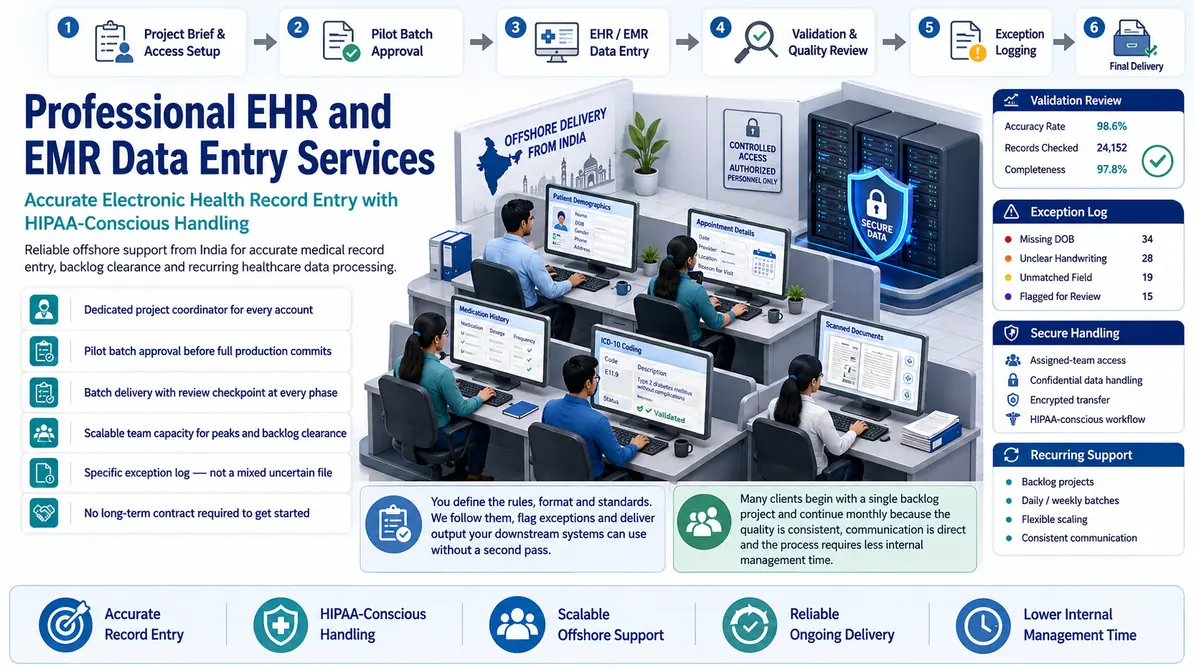

EHR and EMR support organised around patient identity, record structure and authorised changes

The client’s platform configuration, access model and approved workflow control every batch.

01

Patient registration and administrative fields

Approved demographics, contact, guarantor, insurance reference, provider assignment and other designated fields are entered from authorised sources. Potential duplicate or conflicting patient identities are held before record creation or update.

02

Structured historical record entry

Permitted history fields are transferred from supplied paper, scanned or legacy sources into client-designated locations. Operators preserve source wording and do not infer diagnoses, medication status or clinical significance.

03

Document classification and chart attachment

Referral letters, reports, consent forms and other authorised documents are named and indexed by patient, date, type, provider or encounter. Uncertain patient association blocks attachment until qualified review.

04

Legacy EHR and EMR migration preparation

Patient, record and document data are mapped into staging files or approved destination workflows with source IDs retained. Active, historical and unresolved records remain distinguishable throughout migration.

05

Administrative cleanup and duplicate review

Incomplete demographics, inconsistent provider names, missing document labels and duplicate candidates are reviewed under client-approved rules. Patient merges and substantive chart corrections remain restricted decisions.

06

Record coverage and exception reconciliation

Received files, expected patients, completed fields, attached documents and unresolved records are reconciled. Identity conflicts, missing dates, prohibited fields and clinical questions are routed to named owners.

Healthcare System Compatibility

EHR Data Entry Services: Direct Integration and Software Compatibility

Outputs are prepared around the field structure, controlled values and import requirements of your destination environment. Files can be delivered for review, staging or authorised import without forcing your team to rebuild the completed work.

Supported destinations

Administrative data prepared for approved healthcare environments

Files are mapped to the client’s approved template, naming rules, identifiers and system structure before full production begins.

  • EpicClient-approved import structures
  • Oracle Health / CernerPatient and document fields
  • athenahealthAdministrative record templates
  • eClinicalWorksApproved demographic fields
  • NextGenMigration and staging files
  • Secure SQL DatabaseControlled staging tables
Source continuity

References stay connected

Source IDs, filenames, record keys and approved relationships remain available for review and downstream traceability.

Import control

Fields are mapped before production

Mandatory fields, formats, controlled values, character limits and relationship keys are checked against the destination specification.

Pilot validation

Test the handoff with a representative batch

Rejected rows, unsupported values and mapping conflicts are returned with exact references so approved corrections can be incorporated before full-volume delivery.

Delivery formatsStructured for review, staging or import
  • CSV
  • XLSX
  • HL7

Column order, encoding, date rules, multi-value handling and destination-specific requirements can follow the receiving system’s approved specification.

Compatibility means SDES prepares outputs to specifications supplied or approved by the client. Product names identify commonly used destination systems and do not imply endorsement, certification or partnership.

Process, Quality and Security

An EHR workflow from patient-identity validation to accountable record handoff

1. Map the Record Environment

Platform, roles, patients, fields, documents, source systems, migration scope and owners are documented.

2. Define Identity and Access Rules

The setup review establishes matching criteria, permissions, placement rules and prohibited changes.

3. Pilot Safety-Critical Cases

Duplicate candidates, conflicting identifiers, undated documents and sensitive fields test the workflow.

4. Enter Authorised Information

The delivery team updates approved fields while preserving patient, encounter, document and source context.

5. Audit Record Placement

Patient keys, destinations, dates, document classes, counts and sampled values are reviewed.

6. Release Approved EHR Updates and Clinical Exceptions

Completed records and items requiring clinical, HIM, privacy or administrator review are separated.

We work with the patient data sources your practice already uses

Patient data arrives in registration forms, paper charts, scanned documents and system exports. We process all formats into accurate entries in your EHR or EMR system.

📂 Source formats we accept
  • Approved EHR or EMR workflow documentation
  • Patient master and matching criteria
  • Paper, scanned and legacy record sources
  • Field dictionary and document taxonomy
  • User-role and amendment restrictions
  • Migration priorities and clinical/HIM escalation matrix
📤 Delivery formats
  • Completed EHR or EMR update batch
  • Structured migration staging file
  • Patient and source record crosswalk
  • Indexed document attachment register
  • Coverage and quality report
  • Identity, placement and clinical-review exception queue

We sign a BAA and review your EHR system's field structure and clinical documentation standards before any patient data is processed.

Quality checks cover patient identifiers, source record, encounter or date context, field destination, document class, provider reference, duplicate risk, required values, attachment location, exception status and agreement between received and completed counts.

Current ONC SAFER guidance identifies reliable patient identification as central to ensuring information displayed and entered in an EHR is associated with the correct person. Client-defined matching and escalation rules are therefore established before production.

The production team completes authorised record tasks. An expert client owner approves chart merges, clinical interpretation, diagnoses, medication or allergy status, orders, formal amendments, disclosures and final system access.

🔒 NDA Protected Before files are shared
🌐 GDPR Aware EU data handling
Defined Quality Target Confirmed by pilot
🛡️ Secure Transfer Encrypted file access
📋 Exception Log Every delivery
👥 Project Team Only Controlled access
Free accuracy test

Ready to reduce the EHR data entry burden on your clinical and administrative staff?

Share a sample of your patient data sources, your EHR platform details and your monthly data entry volume. We execute a BAA and NDA immediately, provide a quote within the agreed response window and run a pilot batch to confirm accuracy before production begins.

✓ No credit card required✓ No contract required✓ 24–48 hour return
Start With a HIPAA-Conscious Pilot
Source sampleyour_sample_data.csv
Received
Verified deliveryverified_output.xlsx
Reviewed
▣ Encrypted transfer◉ Quality controlled
Why Outsource to SDES?

Why electronic record support must treat patient identification as a safety control

EHR and EMR Data Entry Services workflow and quality review
  • Approved matching criteria
  • Role-limited access
  • Source-to-field lineage
  • Attachment safeguards
  • Migration coverage
  • Scalable record capacity

Health systems outsource professional EHR and EMR data entry when migration, backlog and document workloads delay authorised administrative record maintenance.

The documented workflow gives the delivery team controlled tasks while patient merges, diagnoses, clinical interpretation, orders, treatment content, formal amendments and final chart authority remain with qualified client owners.

Start Your Project →
Industries We Support

Electronic record support adapted to different care and implementation settings

Hospitals and Health Systems

Large patient, document and migration batches processed under health-system identity and access controls.

Medical and Specialty Practices

Administrative fields, referrals and chart documents maintained within practice-specific record workflows.

Behavioural and Allied Health

Authorised administrative records handled without entering or interpreting restricted clinical narrative.

EHR Vendors and Implementers

Client-controlled migration staging, mapping and quality-review batches prepared for configured environments.

Health Information Management Teams

Document metadata, chart conversion and exception queues organised for qualified HIM review.

Healthcare Networks and Acquisitions

Legacy patient and record sources cross-referenced while duplicate and comingled-record risks remain visible.

Case Studies

Relevant Project Experience

Active-Patient EHR Migration

Project Name
Active-Patient EHR Migration
Volume
64,000 patients and 2.8 million structured values — completed in 11 weeks
Problem
Legacy exports used different patient identifiers across locations, and acquired clinics contained possible duplicate records. For the Active-Patient EHR Migration in United States workload, administrative reviewers needed dependable patient, provider and document references before the records could enter the next workflow stage.
Solution
A controlled patient crosswalk used approved identifier combinations and separated exact, possible and conflicting matches before any destination entry. For Active-Patient EHR Migration in United States, approved administrative fields were captured under restricted access, while clinical interpretation and unsupported record matching remained with authorised personnel.
Outcome
The implementation team received priority migration batches without silently merging patients whose identity evidence was incomplete. Following delivery for Active-Patient EHR Migration in United States, administrative teams received structured records and a focused exception queue without transferring clinical judgement to the production team.
Title
EHR Transformation Director
Industry
Regional Health Network
Country
United States

Chart Document Association Backlog

Project Name
Chart Document Association Backlog
Volume
740,000 scanned clinical and administrative documents — completed in 9 weeks
Problem
Multi-page files contained mixed document types, and some cover sheets lacked a dependable encounter or patient number. Within Chart Document Association Backlog in Australia, the missing structure made audit, migration and day-to-day retrieval slower than the client’s operational timetable allowed.
Solution
The delivery team split and indexed supported documents under the approved taxonomy. The solution isolated uncertain chart associations for expert HIM review.
Outcome
Verified documents became available in the intended chart sections while unresolved pages remained outside patient records. After completing Chart Document Association Backlog in Australia, the archive became easier to migrate, audit and retrieve without losing the link to the original source files.
Title
Health Information Services Manager
Industry
Hospital System
Country
Australia

Practice EHR Administrative Cleanup

Project Name
Practice EHR Administrative Cleanup
Volume
118,000 patient records across 37 clinics — completed in 12 weeks
Problem
Provider names, document labels and demographic formats had diverged after years of local maintenance. During the Practice EHR Administrative Cleanup in Canada review, staff could not confirm archive coverage without repeatedly comparing index rows with the original source collection.
Solution
Professional cleanup applied approved administrative dictionaries and retained an audit note for changed values and duplicate candidates. For Practice EHR Administrative Cleanup in Canada, confirmed identifiers controlled updates, while duplicate, ownership and relationship decisions remained with authorised CRM administrators.
Outcome
The practice group gained more consistent search and reporting fields without permitting production operators to merge charts or alter clinical content. After completing Practice EHR Administrative Cleanup in Canada, product, variant and asset relationships remained consistent across releases, reducing repeated correction work for merchandising teams.
Title
Clinical Systems Operations Lead
Industry
Primary Care Network
Country
Canada
FAQs

Questions to resolve before EHR or EMR data entry begins

Can your team merge duplicate patient charts?

Only qualified client personnel should approve chart merges. We can identify and document candidates under approved rules, but uncertain records remain separate.

Do you create or edit clinical notes?

No. We handle authorised administrative and source-transfer tasks. Clinical documentation, interpretation, orders and substantive amendments remain with qualified users.

What should we provide when we outsource EHR or EMR data entry?

Provide platform workflow, approved roles, patient-matching criteria, source records, field and document rules, amendment restrictions, migration priorities and named clinical, HIM, privacy and system owners.

Can EHR and EMR Data Entry Services follow our existing template or platform fields?

Yes, when the destination fields, accepted values, identifiers and permitted actions are confirmed. Delivery can be prepared as Completed EHR or EMR update batch, Structured migration staging file, with unresolved records excluded from upload-ready output.

📩 Get a Free Pilot
💬