
India-Based Data Entry Outsourcing Support Serving USA, Canada, UK, Australia, Europe, New Zealand, Singapore, UAE
Legal Document Data Entry

Legal Document Data Entry That Preserves the Matter, the Source and the Review Boundary

A legal document can contain several dates, names and references, but only some belong in a particular matter field. Our professional legal document data entry services capture approved metadata and source text without turning ambiguous wording into a legal conclusion.

An expert setup review defines matter identifiers, document classes, parties, custodians, dates, privilege-handling instructions and prohibited fields. The offshore production team then builds review-ready records while legal interpretation, privilege decisions, responsiveness, deadlines and advice remain with authorised lawyers or client personnel.

Law firms and corporate legal teams outsource document backlogs or recurring intake when skilled staff need more time for analysis and case work. The solution links each record to its source, applies controlled vocabularies and separates uncertainty for legal review instead of embedding assumptions in the database.

Shri Data Entry Services team working on Legal Data Entry Services projects
5000+ Completed Projects
90% Returning Clients
16+ Years Experience
45+ Countries Served
50+ Professionals Team
Services We Offer

Structure documents for retrieval without deciding what they mean in law

  • Matter ID confirmed
  • Source location retained
  • Document type controlled
  • Names transcribed consistently
  • Dates labelled by purpose
  • Legal decisions escalated

Pleadings, correspondence, interview notes, exhibits, reports and internal records can describe the same event in different language. A useful legal database must make those sources retrievable while preserving distinctions between document date, received date, event date and any date alleged within the text.

We map fields to the client’s matter protocol and define how aliases, organisations, document families, confidentiality markers and incomplete values are recorded. Text is transcribed or normalised only within approved rules; uncertain relationships are not inferred from proximity or wording alone.

Structured delivery support can reduce document administration while maintaining legal accountability. The documented workflow gives reviewers a reliable index and a visible queue for questions involving relevance, privilege, legal characterisation or conflicting source evidence.
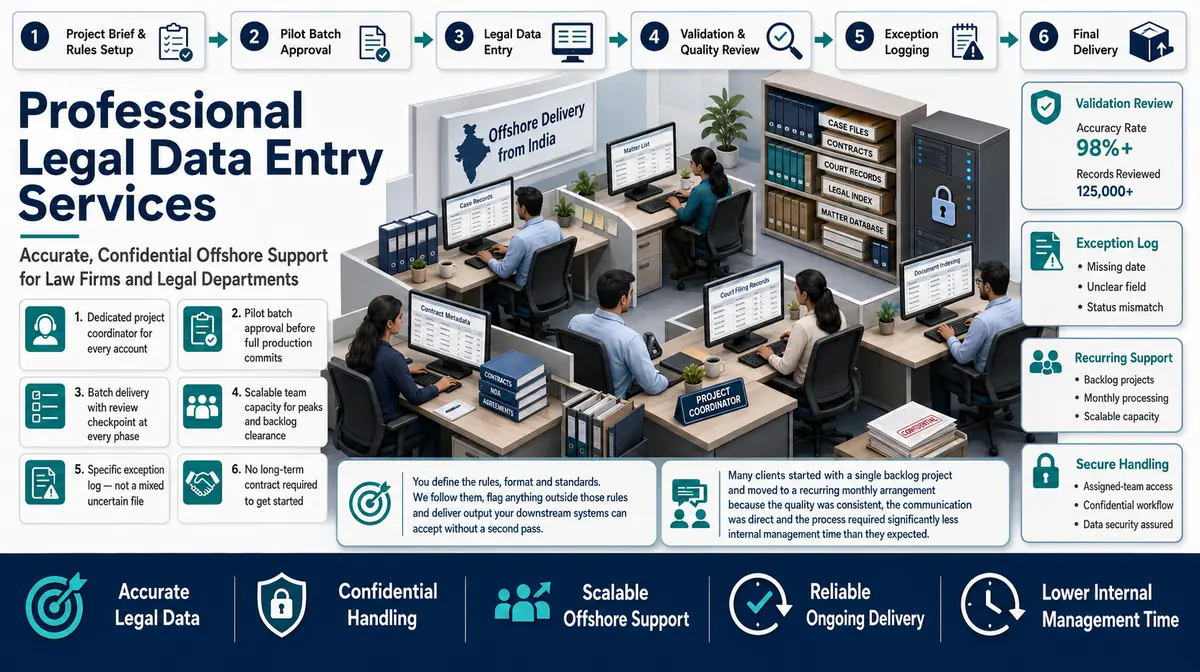

Document data prepared for matter management, search and authorised review

Every record retains its matter context, source reference and review status.

01

Matter and document metadata entry

Matter number, client, document identifier, title, type, date, author, recipient, organisation, source path and supplied confidentiality status are captured under the client’s data dictionary. Unknown or conflicting values remain marked for review.

02

Legal correspondence indexing

Letters, emails, notices and memoranda are indexed by participants, dates, subject, matter and document family. Thread relationships or copied recipients are recorded only where the source and protocol support them.

03

Pleading, exhibit and bundle registers

Document titles, case references, parties, filing labels, exhibit identifiers, page ranges and supplied sequence information are entered for internal registers and review bundles. Procedural status and filing validity remain legal-team decisions.

04

Evidence and discovery database entry

Approved custodians, collection sources, document identifiers, dates, file types and review fields are populated into discovery or evidence registers. Responsiveness, privilege and issue coding are handled only under explicit reviewer instructions.

05

Chronology source-field capture

Dates, actors, events and source citations are extracted into chronology templates using client-defined rules. Conflicting accounts and implied dates are flagged rather than reconciled by the production operator.

06

Legal archive and legacy-file conversion

Paper files, scanned documents and historic matter spreadsheets are indexed into consistent, searchable records while original folder, box, page and document references are retained for retrieval.

Document System Compatibility

Legal Document Data Entry Services: Direct Integration and Software Compatibility

Outputs are prepared around the field structure, controlled values and import requirements of your destination environment. Files can be delivered for review, staging or authorised import without forcing your team to rebuild the completed work.

Supported destinations

DMS-compatible files and metadata for searchable repositories

Files are mapped to the client’s approved template, naming rules, identifiers and system structure before full production begins.

  • SharePointLibraries and metadata columns
  • OpenTextEnterprise content repositories
  • iManageLegal matter workspaces
  • NetDocumentsCloud document profiles
  • AlfrescoContent models and properties
  • Custom SQLStaging and relational tables
Source continuity

References stay connected

Source IDs, filenames, record keys and approved relationships remain available for review and downstream traceability.

Import control

Fields are mapped before production

Mandatory fields, formats, controlled values, character limits and relationship keys are checked against the destination specification.

Pilot validation

Test the handoff with a representative batch

Rejected rows, unsupported values and mapping conflicts are returned with exact references so approved corrections can be incorporated before full-volume delivery.

Delivery formatsStructured for review, staging or import
  • CSV
  • XLSX
  • XML

Column order, encoding, date rules, multi-value handling and destination-specific requirements can follow the receiving system’s approved specification.

Compatibility means SDES prepares outputs to specifications supplied or approved by the client. Product names identify commonly used destination systems and do not imply endorsement, certification or partnership.

Process, Quality and Security

A legal data-entry workflow that protects matter context from intake to reviewer handoff

1. Confirm Matter Segregation

Matter boundaries, authorised users, document sources, access rules and client legal owners are identified.

2. Define the Review Protocol

The setup review maps document classes, fields, vocabularies, date meanings and questions that require legal judgement.

3. Pilot Difficult Documents

A representative sample includes poor scans, aliases, attachments, duplicate copies and potentially sensitive material.

4. Capture Under the Protocol

The delivery team records supported values, maintains source references and avoids unapproved legal characterisation.

5. Check Record and Family Integrity

Matter IDs, required fields, names, dates, document families, counts and source links are reviewed.

6. Return Exceptions to Legal Owners

Completed records and questions involving privilege, relevance, status or interpretation are delivered separately.

We process legal documents from all standard source formats

Legal documents come as PDFs, scanned images, paper originals and digital files. We process all formats into structured data entries in your legal management system.

📂 Source formats we accept
  • Pleadings, notices and exhibits
  • Letters, emails and memoranda
  • Evidence and discovery source files
  • Interview notes and investigation records
  • Scanned matter files and legacy indexes
  • Client field dictionaries and review protocols
📤 Delivery formats
  • Source-linked legal document index
  • Matter-management import file
  • Correspondence or evidence register
  • Chronology source table
  • Bundle and exhibit schedule
  • Ambiguity, privilege-routing and missing-field log

Every legal data entry project begins with NDA execution and a confidentiality briefing for the assigned team before any documents are shared.

Quality checks cover matter identifiers, required metadata, document type, named parties, labelled dates, page or file references and agreement between the record and its source. Document-family relationships are checked where the protocol requires them.

Matter segregation and minimum access are established before production. Potentially privileged or specially restricted material follows client-defined routing; the service does not determine privilege independently.

The production team captures facts and text supported by the document. An expert legal reviewer decides relevance, responsiveness, privilege, procedural effect, legal characterisation and any action arising from the record.

🔒 NDA Protected Before files are shared
🌐 GDPR Aware EU data handling
Defined Quality Target Confirmed by pilot
🛡️ Secure Transfer Encrypted file access
📋 Exception Log Every delivery
👥 Project Team Only Controlled access
Free accuracy test

Ready to reduce the administrative burden on your legal team?

Share a sample of your legal documents, your case management system and your volume estimate. We sign an NDA immediately, provide a specific quote within the agreed response window and include a free pilot batch to confirm field accuracy and confidentiality protocols before full production begins.

✓ No credit card required✓ No contract required✓ 24–48 hour return
Start With a Free Pilot
Source sampleyour_sample_data.csv
Received
Verified deliveryverified_output.xlsx
Reviewed
▣ Encrypted transfer◉ Quality controlled
Why Outsource to SDES?

Why legal data capacity must remain subordinate to legal judgement

Legal Data Entry Services workflow and quality review
  • Matter-level segregation
  • Client-defined taxonomy
  • Source-document traceability
  • Privilege-routing rules
  • Named legal reviewers
  • Scalable document capacity

Legal departments outsource professional document data entry when indexing, migration and intake queues are reducing the time available for substantive matter work.

The documented workflow gives the delivery team clear capture rules while privilege, responsiveness, legal status, deadlines, advice and strategic decisions remain with authorised client lawyers.

Start Your Project →
Industries We Support

Legal document support matched to different matter portfolios and source records

Law Firms and Legal Practices

Litigation, advisory and transaction matter records indexed under firm-specific protocols and reviewer ownership.

Corporate Legal Departments

Disputes, investigations, correspondence and legacy matter files organised across business units and jurisdictions.

Insurance and Claims Teams

Coverage correspondence, reports, evidence and dispute records linked to claim or legal matter identifiers.

Property and Construction

Notices, specialist reports, project correspondence and dispute documents arranged by property, contract or matter.

Financial Services

Investigation, complaint and legal-response documents maintained under restricted access and controlled taxonomies.

Healthcare Organisations

Legal and regulatory matter records organised without expanding production access to unrelated clinical information.

Case Studies

Relevant Project Experience

Cross-Border Dispute Document Register

Project Name
Cross-Border Dispute Document Register
Volume
184,000 documents from 23 custodians — completed in 12 weeks
Problem
Emails, attachments and reports used aliases and several date formats, while matter reviewers needed consistent source and family relationships. For the Cross-Border Dispute Document Register in Singapore workload, reviewers spent additional time opening individual files because filenames and folder locations did not answer common retrieval questions.
Solution
A professional protocol defined custodian, alias, document-family and date fields. Ambiguous participants and detached attachments were routed separately.
Outcome
Counsel received a searchable source-linked register without production operators making responsiveness or privilege decisions. As a result of the Cross-Border Dispute Document Register in Singapore workflow, the client gained a repeatable catalog workflow in which ready records and supplier questions were clearly separated.
Title
Litigation Support Director
Industry
International Law Firm
Country
Singapore

Corporate Legal Archive Migration

Project Name
Corporate Legal Archive Migration
Volume
7,600 matters and 410,000 file references — completed in 2 weeks
Problem
Legacy indexes used department abbreviations, former entity names and free-text matter types that did not fit the new system. For the Corporate Legal Archive Migration in Germany workload, reviewers spent additional time opening individual files because filenames and folder locations did not answer common retrieval questions.
Solution
The delivery team preserved original values, applied approved master mappings and returned unmapped classifications to legal operations. During production for Corporate Legal Archive Migration in Germany, representative searches were tested against the completed index to confirm that users could retrieve the intended source files.
Outcome
The solution created import-ready matter and document records with an expert-reviewed exception trail for retired entities and unclear ownership. Following delivery for Corporate Legal Archive Migration in Germany, users could search the completed register by approved metadata while unresolved files remained visible for targeted review.
Title
Head of Legal Operations
Industry
Manufacturing Group
Country
Germany

Construction Evidence Chronology Dataset

Project Name
Construction Evidence Chronology Dataset
Volume
38,500 correspondence and site records — completed in 6 weeks
Problem
The dispute team needed event sources ordered by date, but many documents mentioned several dates and conflicting project milestones. For the Construction Evidence Chronology Dataset in United Kingdom workload, reviewers spent additional time opening individual files because filenames and folder locations did not answer common retrieval questions.
Solution
Professional data entry captured labelled dates, actors, document references and verbatim event summaries under counsel’s chronology rules. For Construction Evidence Chronology Dataset in United Kingdom, each index row retained its source filename or document reference, and unclear classifications were separated for records-owner review.
Outcome
Lawyers received a traceable research dataset while implied dates and conflicting accounts remained clearly marked for review. Following delivery for Construction Evidence Chronology Dataset in United Kingdom, cRM administrators received a clean import file plus a focused queue for duplicates, ownership questions and unsupported relationships.
Title
Senior Disputes Counsel
Industry
Construction
Country
United Kingdom
FAQs

Questions to clarify before legal documents enter production

Does your team decide whether a document is privileged or legally relevant?

No. We follow client-approved fields and routing instructions. Privilege, relevance, responsiveness and legal effect remain decisions for authorised legal reviewers.

How are documents from different matters kept separate?

Matter identifiers, access groups, source locations and delivery paths are defined before intake. Cross-matter exceptions are held rather than reassigned through assumption.

What should we provide when we outsource legal document data entry?

Provide representative files, matter IDs, a field dictionary, controlled vocabularies, privilege-routing rules, source-reference requirements, access instructions and named legal reviewers.

Can Legal Data Entry Services follow our existing template or platform fields?

Yes, when the destination fields, accepted values, identifiers and permitted actions are confirmed. Delivery can be prepared as Source-linked legal document index, Matter-management import file, with unresolved records excluded from upload-ready output.

📩 Get a Free Pilot
💬