Let's talk about a problem we see all the time. You know that the answers to your biggest business questions are out there, scattered across the internet. They're in competitor price lists, customer reviews, and market trends. But actually gathering that information? It feels like trying to drink from a firehose. Your team is stretched to the limit, your developers have more critical projects, and the data you finally manage to pull together is often a messy, outdated spreadsheet that creates more questions than answers. You end up making crucial decisions based on a mixture of guesswork and yesterday's news.
You know, we've sat across the table from a lot of frustrated founders and managers who've all hit the same wall. They're staring at a mountain of data they need but can't seem to reach. And this is precisely the moment we see a lightbulb go off—the moment they decide to stop fighting the battle themselves and start outsourcing their data scraping.
We want to be really clear about this, because we think people sometimes get the wrong idea. Choosing to outsource isn't a concession. It's not about giving up. Honestly, it's one of the smartest strategic power moves we see companies make. It’s about choosing to supercharge your own team's capabilities instead of stretching them to the breaking point.
When you partner with a dedicated data scraping team, especially one with the deep expertise you find in India, you're doing so much more than just hiring a vendor. You're not just getting a service; you're plugging into a brain trust. You're gaining a partner filled with people who are genuinely passionate about the nitty-gritty of data extraction—the kind of folks who geek out on solving the puzzles that make most people's heads spin.
We'll walk you through, exactly how this whole process works from start to finish. We'll talk about real numbers and why the finances make it so easy to see. And most importantly, we'll show you the real, measurable results that happen when you finally switch from having trouble getting data to using it with confidence for real growth.
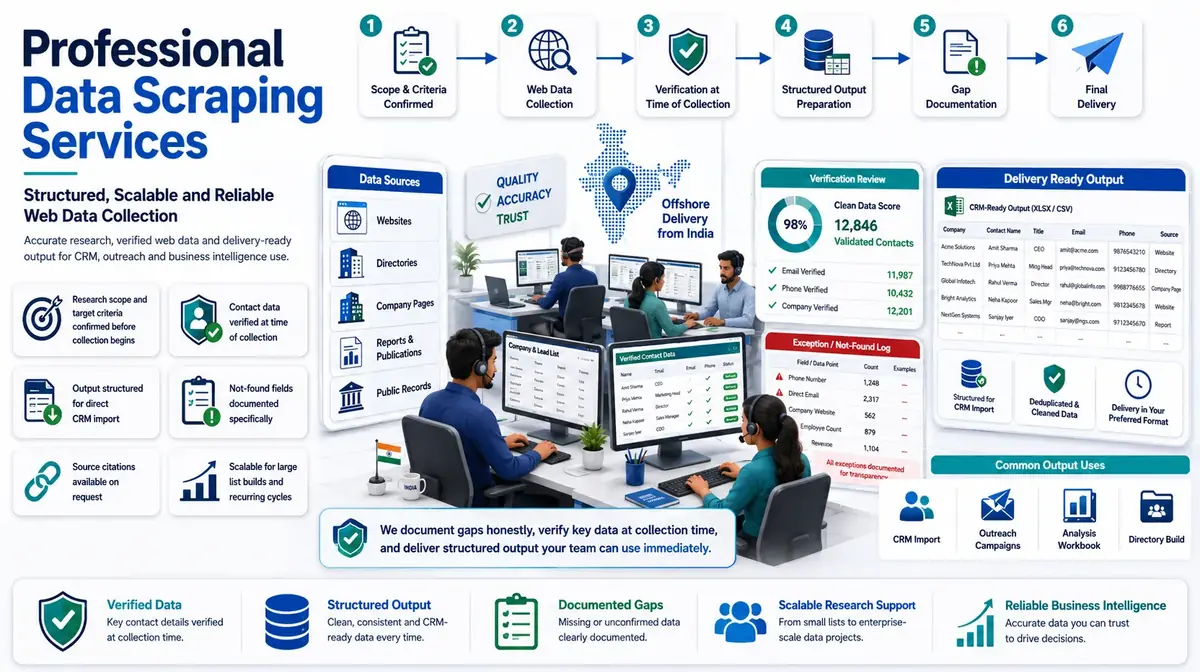
If you think of a simple bot that just copies and pastes, let me change that picture. Professional data scraping is actually a very careful job when done right. There is a complicated dance between technology and the people in charge that makes sure you always get the right data. Let me tell you about the trip in order.
It all starts with a conversation, not a line of code. We need to get inside your head and understand your business. This initial chat is probably the most important part. We'll ask questions that go beyond a simple list of URLs. What's the real problem you're trying to solve? What decision is waiting on this information? How will your team use this data on a Tuesday morning? Getting this context is the secret sauce that turns a folder of numbers into genuine business intelligence.
Once we see the full picture, our tech team gets to work on the blueprint. Here is a little secret: there is no single "best" scraping tool. It all depends on the target. For some simple, straightforward sites, we might use lean, efficient methods. For the really tricky, modern websites that load content dynamically, we need to break out the heavy artillery—tools that can actually open a browser, click buttons, and scroll, just like a real person would. We always pick the right tool for the job.
Now, let's talk about a huge hurdle: staying under the radar. Websites are built to spot and block bots. Our solution? A sophisticated, global network of proxy servers. In short, this makes it look like our requests are coming from thousands of regular computers all over the world. It's the difference between knocking on a door repeatedly with the same face and having a quiet, steady stream of different visitors. It's just good manners, and it's absolutely essential.
Then the actual picking begins. Our custom scripts go to your target pages, find the exact bits of information you need, and pull them out. But a lot of people forget this: web data that isn't cleaned up is messy. It's full of code, weird formatting, and duplicates. Our next job is the unglamorous work of cleaning it up—transforming that digital hairball into a crisp, organized spreadsheet or database your team can actually use.
We're completely obsessive about quality. Let me be direct: we never, ever trust the first pull. Every dataset goes through a brutal quality check. We have automated validations, but we also have real people doing old-fashioned spot checks. If a price looks wrong or a field is blank, we go back and fix the script. It's a pain, but it's what separates a professional service from a amateur attempt.
Delivery is all about your comfort. The final product needs to fit into your workflow like a glove. Do you want a CSV file waiting in your Dropbox every Monday? Does your dashboard need a live API feed? You tell us what works, and we'll make it happen seamlessly.
And finally, our job is never really finished. The internet is a living thing. Websites change constantly. A minor update can break a scraper overnight. That's why a huge part of our service is constant vigilance. We keep a close eye on your data sources and change our scripts as soon as anything changes. This way, your stream of information never runs out.
We understand. It feels safe to keep things in-house. You have control, you think it might be cheaper, and you want to use your own team. But after years in this field, I've seen the hidden costs and the sheer drag of the DIY approach. Let's take a clear-eyed look at the reality.
First, consider the true cost of your team's time. Your developers and analysts are your stars. Their real job is to find insights and drive strategy. Forcing them to spend weeks fighting with code, proxy errors, and CAPTCHAs is a terrible waste of their talent and your money. It's like telling your head chef to wash dishes all day. When you hire someone else to do data scraping, you free up your best employees to do what they do best. They can get back to doing the work that is most important.
Now, let's talk hard numbers. Hiring a full-time developer with scraping skills is expensive. When you add up salary, benefits, software, and servers, you're easily looking at $150,000 or more per year in the US or Europe. And that's for one person. When you outsource data scraping services, especially to a region with deep expertise like India, you turn that giant fixed cost into a predictable, manageable expense. The savings are often dramatic, and you get a whole team of experts for the price of one junior employee.
You're also buying experience you can't quickly build. A dedicated data scraping solutions provider has seen it all. They've solved every kind of CAPTCHA, navigated every IP block, and scaled projects to insane sizes. This isn't a side project for them; it's their entire world. You're essentially fast-forwarding through years of trial and error.
Think about scalability. Your data needs will change. Next month, you might need to scrape a million pages for a special report. A professional partner can scale up instantly, then scale back down. An internal team can't pivot that fast without causing chaos.
Then there's reliability. Professional services run on serious infrastructure. This means your data arrives on time, every time. You can make decisions with confidence, not with your fingers crossed.
And don't forget the legal stuff. The rules around web scraping can be fuzzy. Good providers operate with a clear ethical code—respecting website terms, being polite to servers, and handling data responsibly. This takes a huge weight off your shoulders and reduces your company's risk.
The range of what you can achieve is honestly breathtaking. When you work with a professional web scraping services firm, you're opening up a world of specific solutions. Here’s a detailed look at what's on the menu.
Every company always needs good data, but each field uses it in its own way. Let's go on a tour and see how different areas are dealing with real issues.
It's very hard to compete with big companies that can change prices in no time. But, scraping makes it possible. Online stores can compete by automatically keeping track of prices, stock, and reviews. They also can change their prices on the fly, avoid running out of stock, and focus on the products which are popular amongst customers. The bottom line is? You don't just stay alive; you grow, which leads to more sales and loyal customers.
Everyone in finance has the same basic information. "Alternative data" gives you the edge. Funds scrape news and social media for sentiment, keep an eye on corporate hiring, and even look at satellite images to guess how well a company will do before the quarterly reports come out. This can lead to big profits.
In real estate, property listings are scattered everywhere—making it feel like they're nowhere you can truly trust. That's why savvy agents and investors use data scraping to pull everything into a single, reliable source. There are listings for properties everywhere and nowhere. Scraping is used by agents and investors to make one source of truth. They look at information about the neighborhood, price trends, and how long a home has been on the market to find good deals, set fair prices, and give clients good advice.
For a hotel manager, setting the right rate is a daily puzzle. Scraping competitor rates and occupancy data allows for smart pricing that fills rooms and maximizes revenue. Travel agencies use it to build unbeatable packages.
Agencies need to prove their worth. They look at social media and reviews to see how well a campaign is doing, how people feel about a brand, and who the influencers are. This makes people more creative, helps them spend less on ads, and makes clients happy.
A problem in another country can stop work at home. Manufacturers use scraping to keep track of shipping costs, prices of goods, and new suppliers. This makes supply chains that are strong and cheap.
Imagine the pressure of developing a new drug: it's a multi-billion dollar race where every single day you save can literally change patients' lives. In this high-stakes world, drug companies are using data scraping as a secret weapon. It works like a compass, guiding through number of clinical trials and scientific papers from around the world. They can make their own breakthroughs faster, find possible safety issues much earlier, and look for their competitors are doing by connecting these research dots faster than anyone else. In a race this close, you can't fall behind, and this is how they stay ahead.
There is a lot of competition for talent. HR departments look at job boards to see what other companies are paying, what skills are in demand, and how much they are offering. This helps them get and keep the best workers.
To really get it, you need to hear from people who've been there. Here are some of our clients' stories about the problems they had and how using data to make decisions helped them.
Sarah J., who runs a fashion brand in Los Angeles, was constantly being undercut by bigger players. "We were always a step behind. My team was wasting hours every week on manual price checks, and we were still reacting instead of leading." She decided to try a custom scraping solution that kept a constant eye on her competitors. "The change was night and day. We got live data that fed directly into our pricing system. Suddenly, we could anticipate moves instead of just responding to them. Our profit margins jumped by 22%, which was incredible. But just as important, it freed up my team to focus on designing and connecting with customers. We got our mojo back."
David L., a Sales Director at a tech firm in Dublin, saw his team's productivity plummet. "Our salespeople were becoming professional researchers. They lived on LinkedIn, hunting for leads instead of talking to clients. Our pipeline was drying up." They implemented a targeted scraping system that delivered a steady stream of qualified leads. "It was like turning on a tap. The quality of the leads was so much higher because the search was precise. Our sales team could finally do what they do best—build relationships and close deals. We saw a 200% growth in our pipeline in one quarter. It completely transformed our energy and our results."
Maria P. wanted to create a central marketplace for a niche food product in Portland. "The problem was that all the producers were small and scattered. There was no central hub of information." She used a service to gather data from dozens of artisan websites daily. "We launched with the most complete selection anyone had ever seen. Within a year, we had over 50,000 passionate visitors. We didn't just sell products; we became the trusted source for everyone who loved this niche. The data built our brand."
Thomas R., an analyst in Boston, believed customer reviews could predict stock performance. "The theory was solid, but the data was impossible to collect at the scale we needed." He started using a service that provided clean, analyzed review data. "This alternative data became a key part of our models. It gave us an insight that wasn't available anywhere else. My reports became incredibly valuable to our clients because we were seeing things others missed."
Chloe B., who manages luxury chalets in Geneva, was pricing based on instinct. "It was frustrating. I knew we were probably leaving money on the table, but I had no way to see the whole market clearly." She got a dashboard with weekly data on competitor pricing and availability. "The difference was night and day. Suddenly, I had a clear picture of exactly where we stood compared to everyone else. We started letting the data guide our pricing strategy, and honestly, the results surprised us—a 15% boost in our average daily rate and noticeably better occupancy. But the real win? It took the weight off my shoulders. Finally, I could make decisions with confidence instead of just crossing my fingers."
"Bringing this team on board was the best operational decision we made. The data is reliable and just slots into our workflow. It's like having an expert data engineer on the team, but without the overhead and management hassle." – Mark T., San Francisco, CA
"Outsourcing overseas made me nervous, but the team's communication blew me away. They went beyond just doing the job—they became true thought partners, proactively suggesting better ways to achieve our goals. It was a game-changer." – Eleanor W., London, UK
"The ability to scale is what amazes me. We started small and now handle huge volumes without a single problem. That reliability is a real competitive advantage for us." – Ben S., Chicago, IL
"As a small business, their affordable service was a lifesaver. We now have the same quality of intelligence as our giant competitors. It completely leveled the playing field." – Priya K., Austin, TX
"Their technical skill is deep. They solved problems that had our own developers stuck for weeks. Their knowledge in this specific area is incredible." – Frank D., Berlin, Germany
Q: Is this even legal?
A: This is the big one. If you do it in a moral way, scraping public data is usually legal. We only take publicly available information, we're respectful to websites, and we avoid causing any disruption. That said, it's a good idea to have your legal team review your specific project.
Q: How much does it cost?
A: It all depends on what you need. The price depends on how complicated the websites are, how much data you need, and how often you need it. We work on a project or subscription basis so that you can stay within your budget and get a good return.
Q: What if a website blocks you?
A: That's our specialty. We have a bag of tricks—like rotating IP addresses and mimicking human behavior—to get the data without getting shut out.
Q: What will I get at the end?
A: You will get clean, usable data in the format you choose, which is usually a CSV or Excel file. We can send it directly to your system with an API if you're more technical.
Q: How do you know the data is accurate?
A: We take care a lot about the quality of data. We have people to check the data and build in checks. We also watch for website changes so we can fix things before they become a problem.
Stop Wrestling with Data Collection. Start Making Smarter Decisions.
The market moves fast. Your competitors aren't guessing—they're using data. Now it's your turn.
Let's talk about what's possible. Are you ready to use your data to your advantage? Let's talk about our plan. Contact us and Set up your free consultation, and we'll show you exactly how our scraping skills can help you grow your business.