
India-Based Data Entry Outsourcing Support Serving USA, Canada, UK, Australia, Europe, New Zealand, Singapore, UAE
Purchase Order Processing

Purchase Order Processing Services That Give Procurement a Clear Record From Request to Acknowledgement

A purchase order line is dependable only when it still points to the approved request, supplier, item, quantity and commercial reference behind it. Our professional PO processing preserves that chain through entry, acknowledgement and status updates.

The offshore production team records supported facts and isolates differences in price, unit, date or fulfilment. It cannot choose a vendor, approve expenditure or rewrite agreed terms simply to make an order pass validation.

Procurement teams may outsource daily order administration or a historical PO backlog. An expert pilot covering amendments and split deliveries shapes the solution, with every commercial exception returned to the buyer who has authority to decide it.

Shri Data Entry Services team working on Purchase Order Processing Services projects
5000+ Completed Projects
90% Returning Clients
16+ Years Experience
45+ Countries Served
50+ Professionals Team
Services We Offer

Reliable PO processing preserves the relationship between request, order, acknowledgement and receipt

  • Requester and approval reference retained
  • Supplier master checked
  • Line items mapped to approved codes
  • Quantity, unit and currency validated
  • Amendments kept traceable
  • Acknowledgement differences isolated

A PO is not merely a document number. Its value depends on the connections around it: the requisition that authorised demand, the supplier record, the ship-to location, the item or service definition and the expected delivery. Processing should retain those relationships instead of creating a detached line list.

We identify the authoritative source for each field. A requisition may establish quantity and cost centre, a contract may establish price, and the supplier acknowledgement may establish a proposed date. When sources disagree, the difference is logged for procurement rather than silently resolved by the operator.

Purchase order matching in this service is administrative comparison, not financial approval. PO, acknowledgement, receipt or invoice facts can be aligned and discrepancies identified, but tolerance decisions, release approvals and payment actions remain with authorised client teams.
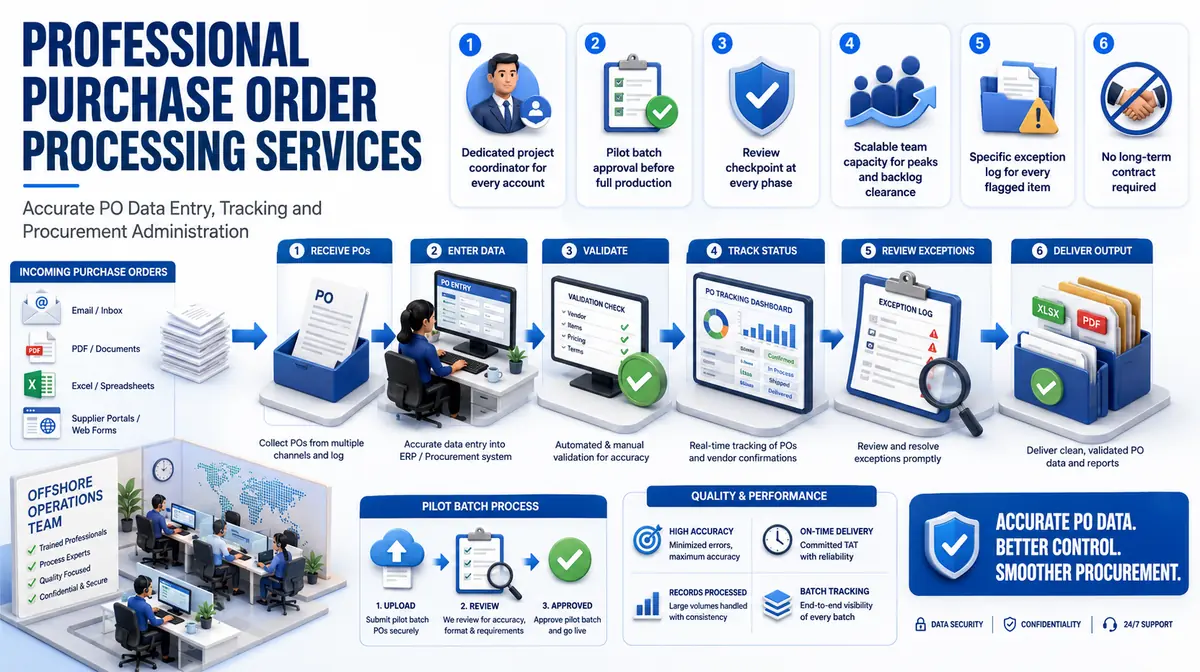

Structured support at the points where purchase information changes

Each stage preserves the original authority and exposes differences that require procurement judgement.

01

Purchase requisition data entry

Approved request details are captured with requester, cost centre, required date, item or service description and approval reference.

02

ERP purchase order entry

Confirmed order fields are prepared or entered in an approved ERP workflow without releasing, approving or transmitting the order unless authorised.

03

Supplier order entry

Supplier, address, contact and order references are connected to the correct master record, with possible duplicates held for review.

04

PO validation

Mandatory fields, item codes, units, quantities, currencies, totals and reference relationships are checked against confirmed rules.

05

Order acknowledgement entry

Supplier acknowledgements are recorded and differences in quantity, date, price or fulfilment status are routed to procurement.

06

PO fulfilment tracking

Approved status facts, promised dates, shipment references and receipt information are updated from authorised sources.

Business System Compatibility

Purchase Order Processing Services: Direct Integration and Software Compatibility

Outputs are prepared around the field structure, controlled values and import requirements of your destination environment. Files can be delivered for review, staging or authorised import without forcing your team to rebuild the completed work.

Supported destinations

Structured output for the platforms your team already uses

Files are mapped to the client’s approved template, naming rules, identifiers and system structure before full production begins.

  • Microsoft ExcelControlled worksheets and import tables
  • Google SheetsShared review and operational files
  • SharePointLists, libraries and metadata columns
  • SalesforceCRM objects and approved fields
  • ERP / CRM SystemsClient-defined import templates
  • Custom SQLStaging and relational tables
Source continuity

References stay connected

Source IDs, filenames, record keys and approved relationships remain available for review and downstream traceability.

Import control

Fields are mapped before production

Mandatory fields, formats, controlled values, character limits and relationship keys are checked against the destination specification.

Pilot validation

Test the handoff with a representative batch

Rejected rows, unsupported values and mapping conflicts are returned with exact references so approved corrections can be incorporated before full-volume delivery.

Delivery formatsStructured for review, staging or import
  • CSV
  • XLSX
  • XML

Column order, encoding, date rules, multi-value handling and destination-specific requirements can follow the receiving system’s approved specification.

Compatibility means SDES prepares outputs to specifications supplied or approved by the client. Product names identify commonly used destination systems and do not imply endorsement, certification or partnership.

Process, Quality and Security

A purchase order workflow built around controlled changes, not blind document copying

1. Map Procurement Authority

Approval references, buyer responsibilities and prohibited actions are recorded before any entry begins.

2. Connect Master References

Supplier, item, location, project and cost-centre identifiers are linked to approved lists.

3. Define Variance Rules

Permitted formatting changes and differences requiring buyer review are separated by field.

4. Test the Order Chain

A pilot follows requisition, PO, amendment and acknowledgement records through the proposed workflow.

5. Process by Priority

Orders are entered according to approved cut-offs, urgency markers and queue ownership.

6. Return Variances and Status

Completed items, blocked orders and supplier differences are handed to the relevant procurement owner.

Purchase inputs should converge without losing their separate authority

The operator needs to know which source controls each field and which difference requires a buyer decision.

📂 Source formats we accept
  • Approved requisitions
  • Supplier master records
  • Contracts or price lists
  • Purchase order forms
  • Supplier acknowledgements
  • Receipt and tracking updates
📤 Delivery formats
  • PO import or entry queue
  • Validation report
  • Acknowledgement variance list
  • Amendment register
  • Order status tracker
  • Held-item log

Samples should include amendments, split deliveries, alternate units, tax differences and supplier substitutions because they determine the real exception rate.

Checks focus on references that affect downstream work: supplier, item, unit, quantity, currency, delivery location, approval and amendment status. Totals are compared using agreed calculation rules, not assumed commercial logic.

System access can be limited to draft creation or specified fields. Release, approval, vendor banking and payment functions should remain unavailable unless a separately authorised workflow requires them.

Service levels and review percentages are defined from order complexity and consequence. This page does not replace project evidence with a universal accuracy or savings promise.

🔒 NDA Protected Before files are shared
🌐 GDPR Aware EU data handling
Defined Quality Target Confirmed by pilot
🛡️ Secure Transfer Encrypted file access
📋 Exception Log Every delivery
👥 Project Team Only Controlled access
Free accuracy test

Need better visibility before purchase orders reach suppliers or finance?

Share redacted requisitions, PO formats, supplier references and common exception examples. We will identify the fields, checks and authority boundary.

✓ No credit card required✓ No contract required✓ 24–48 hour return
Map Purchase Order Processing
Source sampleyour_sample_data.csv
Received
Verified deliveryverified_output.xlsx
Reviewed
▣ Encrypted transfer◉ Quality controlled
Why Outsource to SDES?

Why procurement teams outsource structured PO administration while retaining buying authority

Purchase Order Processing Services workflow and quality review
  • Professional line-level instructions
  • Expert variance escalation
  • Offshore coverage for recurring order queues
  • Supplier and item references preserved
  • Amendments kept distinct from originals
  • No release or payment authority by default

A purchase order processing solution is effective when buyers review exceptions instead of reconstructing routine records. SDES prepares consistent order information and keeps unsupported changes out of the clean queue.

The client remains accountable for budget, supplier choice, commercial terms, tolerance and release. This separation enables teams to outsource repetitive purchase order processing without delegating procurement decisions.

Start Your Project →
Industries We Support

Purchase records reflect the operating model of each sector

Manufacturing

Parts, materials, maintenance and service orders linked to plant references.

Retail and Wholesale

Merchandise and replenishment orders across supplier catalogues.

Healthcare Administration

Approved supply and service orders under procurement controls.

Property and Facilities

Contractor, repair and site-supply orders by asset or location.

Logistics

Transport, warehousing, packaging and operational supply orders.

Professional Services

Project, subscription and contracted-service purchase records.

Case Studies

Relevant Project Experience

Maintenance PO Intake

Project Name
Maintenance PO Intake
Volume
30,195 records per month
Problem
Free-text requests used inconsistent asset, supplier and cost-centre references. Within Maintenance PO Intake in United Kingdom, the inconsistencies affected search, merchandising and upload readiness across the client’s sales channels.
Solution
Approved reference tables supported draft PO preparation, while unmapped assets and suppliers entered a buyer queue. For Maintenance PO Intake in United Kingdom, sKU and channel relationships were checked before delivery, while unsupported attributes and probable matches entered a separate review queue.
Outcome
The model let facilities staff submit requests consistently without giving the offshore team purchasing authority. As a result of the Maintenance PO Intake in United Kingdom workflow, the resulting workflow made recurring delivery more predictable while preserving client authority over unsupported decisions.
Title
Facilities Procurement Manager
Industry
Facilities Management
Country
United Kingdom

Supplier Acknowledgement Review

Project Name
Supplier Acknowledgement Review
Volume
27,813 records per month
Problem
Promised dates and quantities differed from issued orders but were buried in supplier PDFs. Within Supplier Acknowledgement Review in Australia, the inconsistencies affected search, merchandising and upload readiness across the client’s sales channels.
Solution
Acknowledgement values were captured beside PO lines and differences classified for buyer review. Within the Supplier Acknowledgement Review in Australia workflow, the team preserved supplier provenance and applied approved mappings only where the source supported the destination value.
Outcome
The professional procurement team could concentrate on material variances rather than reading every unchanged line. After completing Supplier Acknowledgement Review in Australia, product, variant and asset relationships remained consistent across releases, reducing repeated correction work for merchandising teams.
Title
Supply Planning Lead
Industry
Wholesale Distribution
Country
Australia

Historical PO Amendment Register

Project Name
Historical PO Amendment Register
Volume
49,166 records — completed in 8 weeks
Problem
Teams could not reliably identify the current version or explain changes during review. Within Historical PO Amendment Register in United States, the inconsistency slowed routine processing and allowed unresolved questions to move into downstream teams.
Solution
Original orders, amendments and effective references were indexed without overwriting historical values. During production for Historical PO Amendment Register in United States, representative searches were tested against the completed index to confirm that users could retrieve the intended source files.
Outcome
The expert audit owner received a traceable order history and a list of unresolved version conflicts. After completing Historical PO Amendment Register in United States, internal reviewers could focus on genuine exceptions instead of rechecking every completed record.
Title
Procurement Controls Director
Industry
Manufacturing
Country
United States
FAQs

Questions about purchase order processing

Can SDES approve or release purchase orders?

Not by default. Draft preparation and approved data entry are separate from budget, commercial and release authority. Any release action would require explicit access and governance.

Can acknowledgements be compared with PO lines?

Yes. Quantities, dates, prices and references can be captured and differences flagged using client-supplied rules. The buyer decides whether a difference is acceptable.

How are amendments handled?

Amendments should retain the original order reference, version or effective date and changed fields. The workflow avoids silently overwriting history where traceability is required.

Can Purchase Order Processing Services follow our existing template or platform fields?

Yes, when the destination fields, accepted values, identifiers and permitted actions are confirmed. Delivery can be prepared as PO import or entry queue, Validation report, with unresolved records excluded from upload-ready output.

📩 Review a PO Workflow
💬