India-Based Data Entry Outsourcing Support Serving USA, Canada, UK, Australia, Europe, New Zealand, Singapore, UAE
Product Data Scraping Services

Product Data Scraping Designed Around Authorised Sources and Verifiable Records

Public product pages can contain useful specifications, prices and availability, but their layout, scope and reuse conditions differ. A successful collection project needs more than extracted text: it needs source authority, field definitions, timestamps and a responsible operating boundary. Our professional product data scraping services begin there.

An specialist reviews the permitted sources, terms, robots directives, access method, target fields, collection frequency, data use and escalation conditions. The delivery team then gathers supported public information without bypassing access controls, authentication, CAPTCHAs or technical restrictions.

Retail, research and product teams outsource authorised catalog collection when page volume and change frequency exceed internal capacity. The solution delivers structured records with source URLs and collection times, plus an exception queue for changed layouts, conflicting facts, unavailable pages and fields that cannot be collected responsibly.

Shri Data Entry Services team working on Product Data Scraping Services projects
5000+ Completed Projects
90% Returning Clients
16+ Years Experience
45+ Countries Served
50+ Professionals Team
Services We Offer

Retain where each product fact came from, when it was observed and what it actually described

  • Source permission reviewed
  • Field scope fixed
  • Product identity retained
  • Timestamp captured
  • Rate policy defined
  • Restricted content excluded

A displayed price may exclude delivery, apply only to a selected variant or change by region. Availability may refer to one location, and a specification table may describe a broader model family rather than the exact item. Context determines whether a collected value is usable.

We define each output field and its page-level evidence before production. Product identity, selected options, currency, units, seller, location and timestamp are retained when relevant, preventing isolated values from appearing more universal than their source supports.

Structured production review supports large, diverse source sets. The documented workflow combines controlled collection with manual evidence checks and stops or escalates when a site changes its access rules, structure or permitted use.
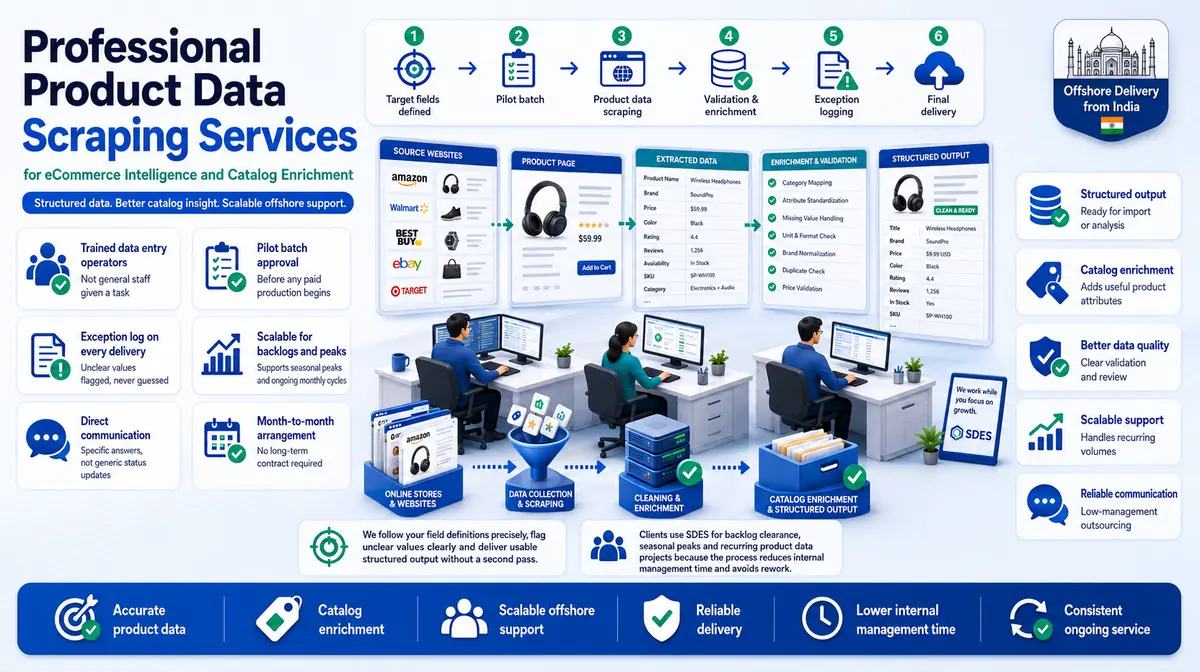

Structured product information collected with source, scope and change controls

Collection proceeds only from approved sources and within the agreed technical and usage boundaries.

01

Source inventory and collection feasibility

Domains, page types, public accessibility, terms, robots directives, rate expectations, required fields and intended use are reviewed before production. Restricted or unclear sources remain outside scope pending owner approval.

02

Product identity and specification extraction

Approved names, brands, models, identifiers, descriptions and technical attributes are collected from relevant page elements. Variant, regional and model-family context is retained rather than flattened into one generic record.

03

Price, promotion and availability capture

Displayed price, currency, seller, promotion text, availability state and observation time are captured under defined rules. Shipping, membership, coupon or selected-option conditions remain separate where the page provides them.

04

Image, document and source-link indexing

Permitted image and document URLs, page links and supporting asset references are indexed by exact product. Collection does not imply ownership or unrestricted reuse; rights and downstream publication remain with the client.

05

Scheduled change and assortment monitoring

Approved sources are revisited at an agreed interval to identify new products, removals and changes to selected fields. Observed changes are versioned rather than overwriting the previous state without history.

06

Parsing validation and layout-change review

Field coverage, selector behaviour, values, units and source URLs are sampled by template and category. Sudden missingness, duplicated blocks or structure changes pause affected records for investigation.

Commerce Platform Compatibility

Product Data Scraping Services: Direct Integration and Software Compatibility

Outputs are prepared around the field structure, controlled values and import requirements of your destination environment. Files can be delivered for review, staging or authorised import without forcing your team to rebuild the completed work.

Supported destinations

Catalog and product files prepared for multichannel commerce

Files are mapped to the client’s approved template, naming rules, identifiers and system structure before full production begins.

  • ShopifyProducts, variants and collections
  • WooCommerceCatalog and attribute imports
  • AmazonSeller and marketplace templates
  • eBayListings and item specifics
  • Magento / Adobe CommerceCatalog and store-view fields
  • PIM / ERP SystemsClient-defined product schemas
Source continuity

References stay connected

Source IDs, filenames, record keys and approved relationships remain available for review and downstream traceability.

Import control

Fields are mapped before production

Mandatory fields, formats, controlled values, character limits and relationship keys are checked against the destination specification.

Pilot validation

Test the handoff with a representative batch

Rejected rows, unsupported values and mapping conflicts are returned with exact references so approved corrections can be incorporated before full-volume delivery.

Delivery formatsStructured for review, staging or import
  • CSV
  • XLSX
  • XML

Column order, encoding, date rules, multi-value handling and destination-specific requirements can follow the receiving system’s approved specification.

Compatibility means SDES prepares outputs to specifications supplied or approved by the client. Product names identify commonly used destination systems and do not imply endorsement, certification or partnership.

Process, Quality and Security

A responsible product scraping workflow from source approval to evidence-backed delivery

1. Approve Sources and Purpose

Domains, permitted access, intended use, fields, frequency, geography and restrictions are documented.

2. Define Page Evidence

The setup review maps each output field to relevant page elements, context and validation rules.

3. Pilot Page Variations

Categories, variants, sellers, promotions, unavailable items and different layouts test the collection design.

4. Collect at Controlled Scale

The delivery team gathers approved public data within rate and access boundaries while retaining provenance.

5. Validate Values and Coverage

Identity, field completeness, units, currency, timestamps, duplicates and template changes are reviewed.

6. Deliver Data and Exceptions

Validated records, versioned changes and pages requiring source, legal or technical decisions are separated.

📂 Source formats we accept
  • Approved domain and page lists
  • Collection purpose and usage policy
  • Field dictionary and output schema
  • Product identifiers and seed URLs
  • Frequency, geography and timestamp rules
  • Exclusion, stop and escalation conditions
📤 Delivery formats
  • Structured product dataset
  • Product and source URL index
  • Price and availability observation file
  • Specification and attribute table
  • Change-history dataset
  • Blocked, changed and unresolved-page log

Quality checks cover source URL, access status, product identity, selected variant, field presence, parsing accuracy, currency, unit, seller or location context, collection timestamp, duplicate observations and agreement with sampled pages.

A technically accessible page is not automatically approved for every use. Terms, robots directives, client authority and collection purpose are reviewed, and blocked, authenticated or restricted content is not bypassed.

The production team collects within approved boundaries. An expert client owner approves sources, legal basis, frequency, retention, intellectual-property use, competitive policy and downstream publication.

🔒 NDA Protected Before files are shared
🌐 GDPR Aware EU data handling
Defined Quality Target Confirmed by pilot
🛡️ Secure Transfer Encrypted file access
📋 Exception Log Every delivery
👥 Project Team Only Controlled access
Free accuracy test

Need product data collected from specific marketplace or competitor sources?

Share your target sources, required fields and update frequency. We run a pilot scraping batch and deliver a free sample dataset for your review before full production.

✓ No credit card required✓ No contract required✓ 24–48 hour return
Discuss Your Scraping Project
Source sampleyour_sample_data.csv
Received
Verified deliveryverified_output.xlsx
Reviewed
▣ Encrypted transfer◉ Quality controlled
Why Outsource to SDES?

Why useful product scraping needs provenance and operational restraint

Product Data Scraping Services workflow and quality review
  • Source approval
  • No access-control bypass
  • Field-level context
  • Timestamped evidence
  • Layout-change detection
  • Scalable review capacity

Data and research teams outsource professional product data scraping when authorised source volume and repeated validation exceed internal capacity.

The documented workflow gives the delivery team clear collection boundaries while legal basis, data rights, competitive-use policy, source approval and publication remain with authorised client owners.

Start Your Project →
Industries We Support

Product collection adapted to different evidence and monitoring needs

Retail and eCommerce

Approved assortment, price, promotion, availability and specification observations collected with variant context.

Manufacturing and Distribution

Public manufacturer catalogs, part details, documents and technical attributes indexed by exact model or identifier.

Electronics and Technology

Capacity, interface, region, generation and seller-specific offer details retained as distinct evidence.

Home and Building Products

Dimensions, materials, finishes, installation documents and displayed availability captured from approved pages.

Medical and Laboratory Supply

Public product details collected without inferring clinical claims, regulatory status or suitability.

Market Research and Analytics

Timestamped product observations prepared for authorised assortment and trend analysis with source lineage.

Case Studies

Relevant Project Experience

Public Assortment Change Monitor

Project Name
Public Assortment Change Monitor
Volume
1.8 million approved product pages across 46 retail sites — completed in 12 weeks
Problem
Category teams could not distinguish genuinely new products from URL changes, temporary unavailability and duplicate regional pages. For the Public Assortment Change Monitor in United Kingdom workload, channel teams had to compare supplier sources manually, slowing publication and increasing the risk of inconsistent product records.
Solution
A professional observation model retained product keys, canonical source, region, variant and timestamp, then versioned approved field changes. Within the Public Assortment Change Monitor in United Kingdom workflow, the team preserved supplier provenance and applied approved mappings only where the source supported the destination value.
Outcome
Analysts received a defensible assortment history and a focused queue for identity conflicts and changed page structures. Following delivery for Public Assortment Change Monitor in United Kingdom, channel teams could publish confirmed products from a clean file and resolve supplier exceptions without rechecking the complete catalog.
Title
Retail Intelligence Director
Industry
Consumer Market Research
Country
United Kingdom

Industrial Specification Collection

Project Name
Industrial Specification Collection
Volume
370,000 manufacturer product and document pages — completed in 12 weeks
Problem
Specifications were distributed across tables, PDFs and model-family pages, making it easy to attach shared values to the wrong part. Within Industrial Specification Collection in United States, the inconsistencies affected search, merchandising and upload readiness across the client’s sales channels.
Solution
The delivery team indexed approved sources by manufacturer number and captured page-level or family-level scope. The solution routed uncertain inheritance to expert product engineers.
Outcome
The distributor gained source-linked attributes without converting broad family statements into unsupported part facts. Following delivery for Industrial Specification Collection in United States, channel teams could publish confirmed products from a clean file and resolve supplier exceptions without rechecking the complete catalog.
Title
Product Content Programme Lead
Industry
Industrial Distribution
Country
United States

Price Observation Quality Recovery

Project Name
Price Observation Quality Recovery
Volume
9.4 million scheduled observations — completed in 9 weeks
Problem
Selected options, member offers and delivery conditions were being mixed with standard displayed prices in earlier research files. For the Price Observation Quality Recovery in Singapore workload, reviewers spent additional time opening individual files because filenames and folder locations did not answer common retrieval questions.
Solution
Professional collection separated base price, promotion condition, seller, variant, currency and observation time under explicit rules. During production for Price Observation Quality Recovery in Singapore, priority identifiers and cross-field relationships were checked before the clean delivery file was released.
Outcome
The analytics team received more comparable records and a transparent set of observations excluded from direct comparison. As a result of the Price Observation Quality Recovery in Singapore workflow, the resulting workflow made recurring delivery more predictable while preserving client authority over unsupported decisions.
Title
Commercial Analytics Manager
Industry
Consumer Electronics
Country
Singapore
FAQs

Source permission, collection scope and evidence requirements

Do you bypass logins, CAPTCHAs or website access controls?

No. Collection is limited to approved access methods and sources. Restricted access, technical blocks or changed permissions trigger an exception or project pause.

Can collected prices be used directly for comparison?

Only after variant, seller, currency, promotion, delivery and timestamp context is considered. We retain those fields where the source provides them.

What should we provide when we outsource product data scraping?

Provide approved sources, collection purpose, field definitions, seed URLs or identifiers, geography, frequency, usage rules, exclusions and named legal or business owners.

Which items are held for client review during Product Data Scraping Services?

Product Data Scraping Services work separates unreadable values, conflicting identifiers, unsupported classifications and out-of-guide decisions from clean catalog and product records. The source reference for each held item stays attached for review.

📩 Discuss Your Scraping Project
💬